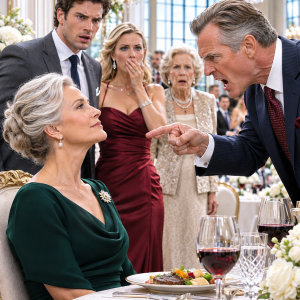
Confusion crossed her face first, followed by disbelief.
Then fear.
She looked toward the nurse.
“I’m sorry, we need the chief of cardiothoracic surgery. This is my husband.”
The nurse hesitated.
“Mrs. Whitmore, Dr. Carter is our chief of cardiothoracic surgery.”
Patricia stared at me.
Daniel closed his eyes.
I checked the clock.
7:31.
There would be time for embarrassment later, assuming we were lucky enough to have later.
I handed Daniel the consent forms.
“Listen carefully. This operation is complicated, but not operating is not a reasonable option. I need you to understand that before you sign.”
He nodded and began reading.
Patricia came closer.
“You’re operating on Robert?”
“Yes.”
Her voice dropped. “After everything I said to you yesterday?”
I met her eyes.
“Once he’s in my operating room, he’s not the man whose wife insulted me at brunch.”
I took the consent form back from Daniel.
“He’s my patient.”
At 7:46, we began.
PART 2 — THE BOOK ON THE TABLE

The first images had been bad, but once Robert’s chest was open, we discovered the dissection was more extensive than the CT had suggested. Blood was already collecting around his heart, and his pressure began dropping before we had fully established bypass.
The operating room became intensely quiet in the way good operating rooms often do when something is going wrong. Nobody shouted. The anesthesiologist called out the pressure while the perfusionist prepared the heart-lung machine, and my team moved with the speed that comes from years of knowing one another’s habits.
Outside those doors sat a woman who had spent six weeks assuming I wasn’t important enough to sit beside doctors.
Inside them, that fact had no relevance at all.
Robert’s tissue was fragile, and repairing the damaged section took hours. We replaced the worst portion of the ascending aorta, stabilized the surrounding structures, and began to believe we had moved beyond the most dangerous part.
Then his pressure fell again.
The rhythm on the monitor changed.
My anesthesiologist looked at me. “We’re losing output.”
I checked the repair and found what the original imaging had failed to show clearly: the dissection extended farther than we had expected.
“We need to extend the graft.”
One of my fellows glanced at the clock. “He’s already been on bypass almost five hours.”
“I know.”
There are moments in surgery when every option is dangerous and the job is no longer choosing between safe and unsafe. It is choosing which danger gives the patient the best chance of seeing another morning.
We continued.
I learned later what happened in the waiting room during those hours.
For nearly an hour, Patricia barely spoke. Eventually, she turned to Daniel.
“How long has she been a surgeon?”
Daniel gave her a tired look.
“Longer than I’ve known her.”
“But she told me she worked in surgery.”
“Yes.”
Patricia stared at the operating-room doors. “Why didn’t she correct me?”
Daniel leaned back in his chair.
“Because she wanted to know whether you could respect her before you knew her title.”
Patricia apparently had no answer.
At 1:22 that afternoon, Robert’s heart began producing a stable rhythm again. We gradually reduced bypass support and watched his pressure carefully.
For several minutes, everything held.
Then an alarm sounded.
His pressure disappeared.
“No pulse.”
The room shifted instantly.
We resumed support, corrected the cause of the collapse, and tried again. By that point Robert had been on bypass long enough that every additional minute increased the risk of neurological injury and other complications.
The perfusionist looked at me.
“Mariana, we’re getting into dangerous territory.”
“I know.”
Nobody needed the risks explained.
We also knew what stopping meant.
Forty minutes later, Robert’s heart produced one weak contraction.
Then another.
A third followed.
The monitor developed a rhythm.
“We have a pulse.”
Nobody celebrated. In surgery, celebrating before the patient is stable is one of the fastest ways to tempt fate.
We waited.
His pressure held.
Only then did I let my shoulders relax.
“Let’s close.”
I walked into the waiting area shortly after three in the afternoon, almost thirty hours after I had last slept properly.
Daniel stood before I reached him.
Patricia did too.
“He’s alive,” I said.
Daniel covered his face with both hands for several seconds before coming toward me. He hugged me briefly, carefully, as though only then remembering that I was still in surgical clothes.
Patricia remained by the wall.
“The operation was more complicated than we expected,” I explained. “There was a major complication near the end, but we got him stabilized. He’s going to the cardiac ICU now, and the next several hours matter.”
Her mouth trembled.
“Can I see him?”
“Not yet. They’ll let you know as soon as it’s safe.”
She nodded, then tried again.
“Mariana, I…”
I raised one hand.
“Not today.”
She swallowed.
“Please. I need to say—”
“Today your husband needs you to be his wife, and Daniel needs you to be his mother. We can deal with everything else another time.”
I removed my surgical cap.
For once, Patricia didn’t argue.
Robert remained sedated for two days. On the third morning, he opened his eyes, and once the breathing tube was removed, his first question was about Daniel.
His second was about me.
I visited him that afternoon.
He looked smaller in the hospital bed than he had at brunch. There were lines running from both arms, monitors above his head, and a long recovery ahead of him, but he smiled when he saw me.
“I suppose I have to call you Dr. Carter now.”
“Mariana still works.”
He laughed and immediately winced.
“Don’t make me do that.”
“I wasn’t trying to.”
I checked the monitor and examined the incision before asking about his pain.
When I finished, Robert remained quiet.
Then he said, “I should have stopped her.”
I looked up.
“Stopped who?”
“Patricia.”
He stared toward the window.
“I heard the comments. I saw where she seated you at that charity dinner. Yesterday with the cookbook…” He paused to catch his breath. “I told myself it was easier not to get involved.”
He rubbed one thumb slowly against the blanket.
“Not getting involved was still a choice.”
That apology mattered more to me than if he had spent ten minutes praising my medical career.
He wasn’t asking me to forget what happened.
He was naming his part in it.
“Get better first,” I told him.
He glanced at me. “That’s not a yes.”
“No.”
A faint smile appeared.
“Fair enough.”