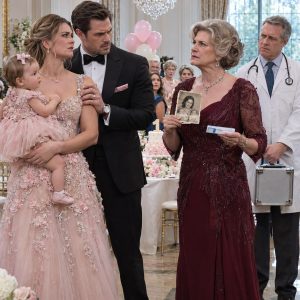
I stood. “Is the little girl all right?”
“She’s safe. One of the event staff is with her.”
Julian started toward the door, but I moved into his path.
“Go to her first,” I said. “She didn’t choose any of this.”
He looked at me as if he had not expected concern for Brooke’s daughter from the woman she had spent years belittling. Then he nodded and went out.
I remained with Owen and Lily, listening to the muted movement beyond the library door. The party had not merely brought an old marriage into the open. It had opened a door to something else, something that had been growing quietly beneath the polished surface of Julian’s family life.
A few minutes later, he returned with the little girl. She stayed close to him, her face uncertain, while a hotel staff member waited in the hall. Julian told us that Brooke had been carrying documents related to several family companies and had arranged for a driver to take her and her daughter out of the city before midnight. She had claimed she was protecting her child’s future, but the papers suggested a different story.
For years, money had been moved through unfamiliar accounts. Several documents appeared to carry signatures that Julian did not recognize as his own. The hotel had contacted the appropriate authorities, who were now speaking with Brooke.
Julian placed the folder on the table and stared at it.
“She’s been lying to me for years,” he said.
I felt no triumph. “Do you understand now what it costs to trust someone without asking questions? When you let me be humiliated because you wanted to protect your reputation, you made it easier for the wrong people to stand beside you.”
He didn’t answer. The little girl sat near Owen and Lily, keeping her hands folded in her lap. My children exchanged a few quiet words with her, both of them careful in the way children can be when they sense another child is frightened.
Julian arranged for a trusted caregiver to take his daughter to a quiet suite away from the ballroom. He made sure she would not be drawn into any conversation about her mother’s choices.
Then he turned back to me.
“I know I don’t deserve a second chance,” he said. “But I’d like to learn how to be their father.”
I looked at Owen and Lily. They were still beside me, but their expressions had softened. They were curious, though not ready to trust him.
“You’ll have the chance to show them,” I said. “Don’t confuse that with my forgiveness.”
He nodded.
I left the hotel with my children that night, declining the car Julian offered. I wanted to go home in our own time, without stepping into the life I had worked so hard to build outside his influence.
The next morning, he sent a short message asking whether he could meet the children at a park. I said he could, as long as we agreed on the time and place. He arrived ten minutes early, without a security detail, a driver, or a stack of presents. He had brought three cups of hot chocolate and looked vaguely worried that he had chosen the wrong kind.
Owen asked him about his work. Lily showed him a drawing she had made of a house with a purple roof. Julian listened as though every answer mattered, and when the children paused, he let the silence be.
It was not a reunion anyone would have written into a storybook. Neither child ran into his arms, and neither called him Dad. They drank their hot chocolate, asked questions, and left with me when they were ready.
Julian came the following week, and the week after that. He learned what subjects Owen liked at school and which bedtime stories Lily requested most often. He discovered that they cared little about his company, his house, or the black car that waited outside his office. They cared about whether he remembered what he had promised.
I continued with my own life. I did not move back into his home, and I did not take his surname. I let the children build their relationship with him gradually, with boundaries that we all understood.
Learning to Show Up

Several months later, Julian asked if I would meet him for dinner. I declined the dinner and agreed to speak over coffee in a neighborhood café. He arrived before me and stood when I entered, but he did not reach for my hand or act as though the years between us had disappeared.
“I’m sorry,” he said after we had ordered. “I spent a long time believing I could control what people thought of me. When you asked me to acknowledge you as my wife, I let fear make the decision. I told myself I was protecting the business, the family, and the future. I was protecting my pride.”
I wrapped both hands around my cup. “You didn’t lose me in one evening. You lost me a little at a time, every time you asked me to wait, every time you let someone speak down to me, every time you put your position ahead of my dignity.”
He nodded. “I know that now.”
I didn’t promise that I would return to him. I didn’t promise forgiveness. I told him he could keep being present for Owen and Lily as long as he never made them feel they had to earn a place in his life.
When I walked out of the café, I realized I no longer needed his acknowledgment to know who I was. Ten years earlier, I had entered a ballroom hoping my husband would say a few words that would give me a place beside him. This time, I left knowing I had a place of my own.
In the weeks that followed, the name Julian Vale stopped feeling like a wound I needed to keep covered. He was the father of my children, a man trying to repair an absence he could not undo. The past remained part of our story, but it did not have to dictate every page that came after.
One morning, while I was making breakfast, Owen walked into the kitchen with a serious expression.
“Mom, is Dad coming today?”
I set the knife down and crouched beside him. “He plans to. What’s on your mind?”
Owen hesitated. “Some kids at school say dads who don’t live with their kids don’t love them. Did Dad not love us before?”
The question pressed against a tender place in me. I put my hands gently on his shoulders.
“Listen to me, sweetheart. Adults sometimes make choices that hurt people, and those choices can keep families apart. Your father made choices that meant he wasn’t here when you were little. But none of that happened because of you. You never had to earn love, and you never had anything to fix.”
He leaned into me, and I held him for a long moment.
When Julian arrived that afternoon, I told him what Owen had asked. He listened without interrupting, then knelt in front of our son.
“I wasn’t there when you were little,” he said. “I can’t change that. But I won’t ask you to carry the weight of my decisions. You can be angry with me, ask me anything, or decide you don’t feel like seeing me one day. I’ll still keep showing up, if you and your mom let me.”
Owen watched him closely. “Will you come next Sunday?”
“Yes,” Julian said. “And I’ll be early.”
He kept that promise. Sunday by Sunday, he became a steady presence in their lives. He came to their school performances and soccer games. He learned how Lily liked her pancakes and accepted the elaborate rules she invented for board games. He listened when Owen talked about a book he was reading, even when the story took longer to explain than Julian’s business meetings usually lasted.
The children did not care about the titles people used for him. They wanted him to remember, to listen, and to come back.
Meanwhile, the inquiry into Brooke’s actions continued. Investigators found that money had been moved through several companies, and some documents appeared to have been altered to give her a claim to family assets. Julian made sure his daughter stayed away from the legal conversations. He refused to let a child become responsible for choices made by adults.
That decision mattered to me more than he knew. It showed that he was beginning to understand that protecting a child meant more than providing a grand home or a comfortable life. It meant keeping the burden where it belonged.
What Was Promised
One afternoon, Julian called about papers from our divorce. I reminded him that any legal matter between us needed to go through my attorney. He agreed, and a week later we met in my lawyer’s office.
He placed an envelope on the table. Inside were copies of the papers from our divorce, including the financial agreement he had promised to honor when I left Boston. I recognized the language and my own signature.
“You never received the settlement,” he said. “Brooke blocked the transfers and moved the money elsewhere. I found records that show what happened.”
I read the documents carefully before looking up.
“You should have checked at the time.”
“Yes.”