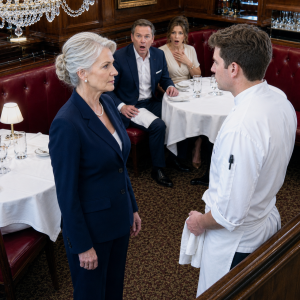
“The contract I was expecting didn’t close.”
“You told me it closed in April.”
“It fell apart before the final signatures.”
Vanessa stepped away from him.
“Then how have we been paying the school tuition, the club membership, and the car leases?”
He looked at me before quickly turning away.
That brief glance gave her the answer.
“You’ve been using Rachel’s account?”
“Only temporarily.”
“For how long?”
He did not respond.
“How long, Douglas?”
“A couple of years.”
The relatives around the table became very interested in their phones, purses, and watches. One uncle suddenly remembered an early appointment. A cousin announced that her babysitter needed her at home. Another aunt said she had a long drive ahead of her.
Within minutes, nearly everyone who had praised Douglas’s generosity had left the room.
My parents remained at the table, along with Douglas and Vanessa.
My father looked at the watch as though it had changed into something unfamiliar.
“You used your mother’s care fund to buy this?”
Douglas sat down heavily.
“I wanted the evening to be special.”
“You wanted people to admire you,” Vanessa said.
The door opened again, and a server carried in Jamie’s dinner. He placed a perfectly cooked filet in front of him, along with mashed potatoes, green beans, and an enormous slice of chocolate cake.
Jamie looked from the plate to me.
“Can I really have all of this?”
I smiled and brushed his hair away from his forehead.
“Of course. You belonged at this dinner from the moment you walked through the door.”
He picked up his fork, sitting straighter than he had all evening.
Across the table, Douglas watched him take the first bite.
For once, my brother had nothing to say.
The Cost of Pretending

My parents arranged a payment plan with the restaurant because neither Douglas nor Vanessa could cover the bill. The luxury watch was returned the following morning, and the money was placed back into the family reserve.
Over the next several days, the rest of Douglas’s finances came into view. He had borrowed against nearly everything he owned and had used my account to maintain the appearance of success. The vacations, impressive gifts, and extravagant family events had not been signs that his business was thriving. They had been decorations placed over a structure that was quietly collapsing.
Vanessa moved into her sister’s home before the end of the week and began formal separation proceedings soon afterward.
Douglas blamed me.
He sent a long message accusing me of ruining our father’s retirement celebration and dividing the family over a child’s dinner.
I replied with one sentence.
“You gave my son a paper plate while using my money to purchase luxury for everyone else, and you expected me to call that family.”
Then I left the family message group.
Two weeks later, my father appeared at my front door.
Without his tailored suit and polished shoes, he looked smaller than I remembered. He wore an old gray sweater and held an envelope in both hands.
I remained in the doorway.
“What brings you here?”
“I came to return the rest of the money Douglas used.”
He offered me the envelope.
“There’s also a card.”
“For me?”
He shook his head.
“For Jamie.”
I took it.
“Does it say that you’re sorry for what happened, or does it explain why everyone else was wrong?”
My father looked down.
“It says I should have spoken up.”
That was the first honest thing I had heard from him in a long time.
“I’ll let Jamie decide whether he wants to read it.”
That evening, I carried the card to Jamie’s room. He was on the carpet building a spaceship from plastic bricks, completely absorbed in balancing a narrow wing across the top.
“Grandpa sent you something,” I told him. “He wants to apologize for the dinner.”
Jamie opened the card and read it quietly. When he finished, he folded it, placed it in the bottom drawer of his desk, and returned to his spaceship.
There was no dramatic response, no angry speech, and no immediate forgiveness.
Children sometimes understand boundaries more clearly than adults do. Jamie did not feel obligated to make his grandfather comfortable simply because an apology had arrived.
I followed his example.
A Table for Two
I closed the family reserve account and placed the remaining money into a protected education fund for Jamie. I stopped paying for gatherings I had not arranged and declined invitations where I knew respect would be treated as optional.
Some relatives called me unforgiving. Others said I should make peace because family relationships were too important to lose.
I agreed with the second part.
Family relationships were important, which was precisely why they should never be built on humiliation, silence, or access to someone else’s bank account.
Jamie and I began a new Friday tradition at a small Italian restaurant near the river. The tables were crowded together, the kitchen was always noisy, and the owner greeted every customer as though they were returning from a long trip.
We ordered garlic bread, shared a large bowl of spaghetti, and finished with one slice of tiramisu and two spoons.
No one measured Jamie’s worth by the price of his meal. No one expected me to finance an evening while pretending someone else had provided it. There were no velvet boxes, no carefully managed appearances, and no relatives waiting to see who would pay.
One Friday, after Jamie had eaten the last spoonful of dessert, our server approached with a cheerful smile.
“Will this be one check or two?”
I looked across the table at my son. He had chocolate on the corner of his mouth and was telling me a long story about a science project involving a cardboard volcano.
I handed the server my card.
“One check,” I said. “Only for the people who came together.”