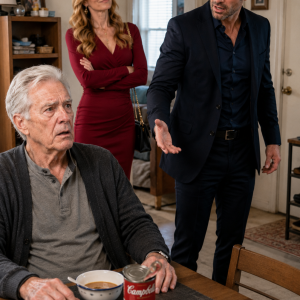
At that moment, Andrew’s phone rang. Eleanor was calling, and he put her on speaker.
“The woman from the school is outside my building,” Eleanor said. “She’s asking which unit we’re in. Lucy is with me, and every door is locked.”
Everett’s face lost its color.
When an officer asked who the woman was, Valerie remained silent, but Everett wiped his forehead and answered.
“Her name is Paige.”
Trevor turned sharply.
“Keep your mouth shut.”
“No,” Everett said. “I agreed to buy properties cheaply and resell them. I did not agree to take a little girl.”
The room became still.
Under further questioning, Everett explained that Paige was supposed to collect Lucy, keep her for several hours in a short-term rental, and then call Claire. Claire would be told that Lucy would return safely as soon as the documents were signed.
Trevor lunged toward him, but the officers intervened before he crossed the room.
Minutes later, Eleanor called again. Paige had been stopped near the building. Inside her purse were another copy of the school note, the rental address, and messages from Valerie detailing when and where she should approach.
Lucy had seen none of it. Eleanor had kept her in a bedroom watching cartoons.
Claire sank into a chair when her legs began to weaken. Andrew knelt beside her.
“Lucy is safe.”
Claire closed her eyes.
“I know. She’s the reason all of us are.”
The Promise to Listen

The investigation uncovered photographs of other homes, copied identification cards, contract templates, and several names Trevor had used. Megan provided a statement, and other women eventually came forward with remarkably similar stories.
For Claire, the hardest truth was that Trevor had not selected her because she was foolish. He had found her when she was tired—tired from work, parenting, and a divorce that had turned every conversation with Andrew into a contest neither of them could win.
Naomi reminded her of that whenever guilt returned.
“He did not choose a careless woman,” she said. “He chose a worn-out one. Trusting someone never gave him the right to use that trust against you.”
Andrew never turned Claire’s regret into another weapon. Instead, he admitted that their constant conflict had created an opening Trevor exploited. Claire acknowledged that she had allowed Trevor to convince her Andrew wanted to take Lucy away.
For the first time in years, they stopped arguing over who had caused the oldest wounds and began discussing how to protect their daughter together.
Lucy needed time. She asked Claire to check the closet every night and wanted to know whether Trevor might still possess another key. Whenever an unfamiliar adult approached at school, she watched closely.
Claire and Andrew gave her one promise and repeated it until she believed them.
“No one picks you up unless we know about it. If something frightens you, tell us, even if an adult becomes angry.”
One evening, Lucy asked the question Claire would remember longest.
“What if nobody believes me?”
Claire sat on the edge of her bed.
“Then say it again, louder, and keep looking until you find someone who listens.”
“Will you listen?”
“Always.”
Months later, the recordings, forged note, messages, contracts, and statements established a clear pattern. Trevor could no longer disguise what had happened as a misunderstanding between partners. Valerie and Paige faced consequences for their roles, while Everett cooperated without escaping responsibility for his own choices.
As Claire left the courthouse after the final hearing, Trevor called after her.
“You know I never would have hurt Lucy.”
Andrew began to step forward, but Claire raised one hand. This answer belonged to her.
“You did not need to touch her. You turned her fear into a tool for forcing me to sign. That tells me everything.”
“I loved you.”
“No. You needed me to trust you. Those are not the same thing.”
She walked away without looking back.
In time, ordinary life returned. Andrew remained close, first for security and then because Lucy loved eating breakfast with both parents. Claire and Andrew entered counseling, spoke honestly about the marriage they had damaged, and slowly discovered that forgiveness did not require pretending the past had never happened.
A year later, they married again in Eleanor’s backyard before a handful of friends. Lucy had imposed only two conditions: chocolate cake and parents who arrived on time.
That night, back at the apartment, she ran to her bedroom, opened the closet, inspected it carefully, and returned to the hallway.
“Everything’s okay,” she announced.
Claire smiled and held out her arms.
Later, as she tucked Lucy beneath the blankets, the child looked up at her.
“Do you remember the day on the bus?”
“Every day.”
“I thought you were going to be mad at me.”
Claire brushed a strand of hair from her forehead.
“For a moment, I almost was.”
“But you didn’t make me get off.”
“No, sweetheart. I didn’t.”
Lucy smiled, closed her eyes, and soon drifted into peaceful sleep.
For years, Claire had believed a good mother was someone who always knew the right answer, noticed every danger, and never trusted the wrong person. Now she understood something quieter and more important.
Sometimes a good mother is simply the woman who, amid impatient strangers, embarrassment, and the pressure to keep moving, pauses long enough to believe her child.
On that crowded afternoon bus, Lucy had said she did not want to go home, and Claire had allowed the doors to close.
That one decision protected their home and their future, but it also gave Lucy something no one could ever take from her again: the certainty that fear had a voice, and that genuine love would never demand her silence.