The Invitation I Wanted to Believe
The call came on a Tuesday afternoon while I was repotting a basil plant beside the kitchen window of my small condo in Charlotte, North Carolina.
My son, Adrian, almost never called anymore.
At thirty-nine, he had become the kind of man whose days were divided into meetings, business lunches, conference calls, and carefully scheduled family obligations. Most of our conversations had been reduced to short text messages.
Hope you’re doing okay, Mom.
Crazy week. I’ll call soon.
Maybe we can get together next month.
“Soon” had gradually become weeks.
Sometimes months.
So when his name appeared on my phone, I wiped the soil from my fingers and answered immediately.
“Hi, sweetheart.”
“Mom,” Adrian said, “Lydia and I were wondering if you’d have dinner with us Saturday night.”
For a moment, I simply stood there.
“Dinner?”
“Yes. Her parents are coming too. We thought it might be good for everyone to sit down together.”
His voice was unusually gentle.
That small kindness was enough to awaken hope I should probably have stopped carrying years earlier.
“I’d like that,” I said.
“Eight o’clock. Hawthorne & Vine.”
I nearly smiled.
Of all the restaurants in Charlotte, they had chosen Hawthorne & Vine.
Adrian had no idea how well I knew that place.
“I’ll be there.”
After we hung up, I remained beside the window, staring at the basil plant.
Perhaps things were changing.
Perhaps Adrian had finally noticed how distant we had become.
Perhaps Lydia had decided that shutting me out of their lives had gone too far.
I wanted to believe Saturday would be a beginning.
I did not yet understand that they had invited me there to explain why they wanted even less of me.
Everything I Had Once Given Him
My name is Marjorie Whitmore.
I was sixty-eight years old that summer, and for most of my adult life, motherhood had been the center of everything I did.
Adrian’s father left when our son was eight.
There was no dramatic farewell. No shouting in the driveway. He simply decided that family life was not the future he wanted.
Afterward, I learned how expensive survival could be.
I worked mornings in the kitchen of a private school. Three evenings a week, I helped manage inventory for a neighborhood grocery store. On weekends, I prepared desserts for a small catering company.
Adrian never knew how often I skipped things I wanted so he could have things he needed.
When his soccer shoes became too small, I waited another year to replace my winter coat.
When he needed a laptop for high school, I worked two extra weekends.
When his university acceptance letter arrived, I celebrated with him first and worried about tuition later.
I eventually found a way.
I always did.
At his graduation, Adrian hugged me so tightly that my glasses nearly fell off.
“Mom, one day I’m going to give you everything back.”
I laughed.
“You don’t owe me anything. Just become a good man.”
At the time, that seemed like the simplest request in the world.
Then he met Lydia Prescott.
Lydia came from a very different background.
Her father, Warren Prescott, had spent decades developing upscale commercial properties. Her mother, Celeste, belonged to several civic organizations and could turn almost any conversation into a discussion about connections, schools, neighborhoods, and status.
Lydia was charming when Adrian first introduced us.
She complimented my cooking.
She brought me flowers.
She even asked if I would teach her how to make Adrian’s favorite apple pie.
But after their wedding, something shifted.
My small condo became “cozy” in a tone that meant unimpressive.
My clothes became “practical.”
My neighborhood became “interesting.”
Whenever Adrian and Lydia hosted business associates, my invitations became less frequent.
Eventually, they almost stopped entirely.
I noticed.
I simply chose not to fight for a seat where I was no longer warmly welcomed.
The Seat They Had Chosen for Me
Saturday evening, I arrived at Hawthorne & Vine wearing a soft sapphire-blue dress, low heels, and a pair of small pearl earrings.
The restaurant occupied a beautifully restored 1920s building near Myers Park, with high windows, walnut paneling, a landscaped courtyard, and a private dining wing.
It had taken nearly a decade to turn it into what it was.
But Adrian knew none of that.
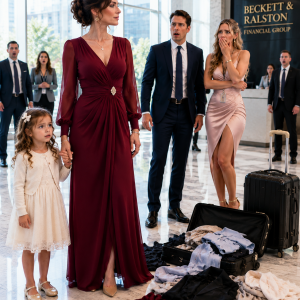
When I reached their table, Lydia checked her watch.
“Marjorie. We were beginning to wonder.”
I was six minutes late.
“Traffic was backed up near Queens Road.”
“Well, you’re here now.”
There were five chairs around the table.
Mine was at the far end.
Warren and Celeste were already drinking wine. Adrian gave me a quick smile but did not stand.
I sat down.
A server approached.
His name was Caleb Monroe.
I had known him for three years.
The instant he saw me, recognition crossed his face.
“Good evening, Ms.—”
I gave him a tiny shake of my head.
Caleb understood immediately.
Lydia opened the wine list.
“We’ve already decided on dinner,” she announced. “Four filet entrées, the roasted vegetables, and another bottle of the Pinot Noir.”
Caleb looked at the table.
Then at me.
“Four entrées?”
“Yes.”
I waited.
Lydia finally turned toward me.
“Marjorie will just have water.”
I thought I had misheard her.
“Excuse me?”
She gave me the patient smile people sometimes use when explaining something they believe should be obvious.
“Adrian mentioned you’ve been watching your expenses. This place is rather costly, and we don’t want you worrying about splitting the check.”
“I’m capable of paying for my dinner.”
Adrian finally spoke.
“Mom, please. We’re trying to make things easier.”
“By not ordering food for me?”
He lowered his voice.
“Can we not turn this into something bigger than it needs to be?”
Lydia folded her napkin neatly across her lap.
“Sometimes accepting limitations gracefully is the most dignified thing a person can do.”
I looked at my son.
He stared at the table.
That hurt more than Lydia’s words.
After several seconds, I looked at Caleb.
“Water is fine for now. Thank you.”
He hesitated before walking away.
The Conversation Behind the Dinner
Their meals arrived twenty minutes later.
Four beautiful plates were placed around the table.
Nothing was placed in front of me.
Celeste complimented the wine while Warren began discussing Adrian’s career.
Apparently, one of Warren’s longtime associates was considering Adrian for a senior position at an investment firm.
“The compensation could put you in a completely different circle,” Warren said.
Adrian smiled.
“That’s what we’re hoping.”
Lydia touched his arm.
“And once that happens, we can finally move.”
“Move where?” I asked.
She named an expensive neighborhood south of the city.
“We found a six-bedroom property. The school district is excellent, and it’s much better for entertaining.”
“I’m sure Maisie will love the yard.”
At the mention of my eight-year-old granddaughter, Lydia’s expression changed slightly.
“Actually, Maisie is part of what we wanted to discuss tonight.”
There it was.
The real reason I had been invited.
I placed both hands around my water glass.
“Go ahead.”
Lydia exchanged a look with Adrian.
Then she said, “As Adrian’s career develops, our social life is changing. There will be more formal gatherings, more professional events, more people whose impressions matter.”
“And?”
Celeste joined in.
“People can be judgmental, Marjorie. It isn’t fair, but presentation matters.”
I almost smiled.
“My presentation?”
Lydia sighed.
“Please don’t make this personal.”
“You’re talking about me. That makes it personal.”
Adrian shifted uncomfortably.
Finally, he spoke.
“Mom, Lydia and I think it might be better if you don’t come to some of the larger events anymore.”