He hesitated.
“I knew you hadn’t signed the original transfer when I first requested it.”
“And afterward?”
He lowered his eyes.
“I didn’t ask enough questions.”
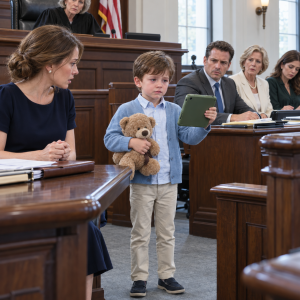
Evelyn explained that she had accessed the archived system because she wanted to confirm which version of the agreement remained in the company’s records. Using credentials that should have been disabled years earlier, she had requested the historical file and sent a message to her former employer’s old email address.
Unknown to her, that address forwarded to Nathaniel.
She showed us his reply, sent only minutes after her message.
It instructed her not to release the documents until he had reviewed them.
I looked at him for a long moment.
“You knew something was wrong, and your first instinct was to keep it quiet.”
Nathaniel pressed his lips together.
“I was afraid the company would lose its largest contracts.”
“So you let me believe I had contributed nothing?”
He did not answer immediately.
Then, almost too quietly to hear, he said, “Yes.”
Strangely, I felt no satisfaction.
I had once imagined that hearing Nathaniel admit his dishonesty would somehow repair the years of self-doubt, but standing there with the original agreement in my hands, I understood that no confession could return the time I had spent questioning myself.
What mattered now was what I chose to do with the truth.
What Justice Looked Like in the Months That Followed

Gerald recommended that the records be secured immediately and reviewed by independent legal counsel, with a complete accounting of the company’s licensing income.
Benjamin offered to help me find an attorney with experience in intellectual property disputes, but he made it clear that every decision would remain mine.
The months that followed were exhausting, involving meetings, financial reviews, correspondence, and difficult conversations about events I had hoped never to revisit.
The investigation established that Open Pages had continued generating substantial revenue through licensing agreements with schools, nonprofit organizations, and educational publishers.
The original records supported my ownership, while the disputed transfer could not be substantiated as a valid agreement.
With independent legal representation, I eventually reached a settlement recognizing my rights, compensating me for the company’s past use of my materials, and restoring control over future licensing.
Nathaniel stepped away from the company during the review, and its remaining leadership reorganized the business around a more transparent approach to ownership and contracts.
I never asked to take over the company.
By then, I had built a life I valued far more than the business Nathaniel and I had once shared.
Instead, I used part of the settlement to establish a children’s reading foundation near our home.
Our first learning center opened the following spring in a modest brick building with wide windows, comfortable reading corners, and shelves low enough for little hands to reach.
Benjamin helped assemble the furniture, while Sophie insisted on placing colorful labels beneath every shelf, even though several of her letters faced the wrong direction.
Brooke attended the opening and brought a collection of handmade bookmarks created by students in an arts program where she had begun volunteering.
Evelyn also came.
She had cooperated fully with the document review, acknowledging her part in preserving records that should have been questioned years earlier.
One afternoon, as we arranged books together, she apologized again.
“I wish I’d spoken up when I first realized something wasn’t right.”
I considered her words before answering.
“You can’t change what happened then, Evelyn. But you can decide what kind of person you want to be now.”
She nodded, and we returned to our work.
Nathaniel sent one letter after the settlement was finalized.
It contained explanations, regrets, and an apology that was more direct than anything he had said during our marriage.
I read it once and placed it in a drawer.
I did not need to answer.
Forgiveness, I had learned, did not require me to reopen a relationship that had already taken too much from me.
The Place Where My Daughter Found Me
Almost a year after Abigail’s wedding, our family returned to the same estate for a small anniversary gathering.
The gardens looked much as I remembered them, with white roses climbing the terrace walls and sunlight filtering through the old trees.
Sophie, now five, stood beside me beneath the oak where Nathaniel had approached us.
She looked around thoughtfully.
“Mommy, is this where I found you at the wedding?”
I smiled.
“It certainly is.”
“And Daddy was looking for you?”
“That’s right.”
She slipped her hand into mine.
“Were you lost?”
The question caught me by surprise.
For a moment, I thought about the woman I had been five years earlier, sitting alone in a small apartment, convinced that losing her marriage meant losing everything she had worked toward.
Then I thought about the woman who had stood beneath this same tree a year before, listening to Nathaniel announce how fortunate he was to have left her.
Perhaps I had been lost once, although not in the way Sophie meant.
“A little, sweetheart,” I answered. “But I found my way.”
Benjamin approached carrying a picnic basket and a small paper bag filled with strawberries, which Sophie immediately recognized as her favorite treat.
She took his hand and began telling him about a picture book she wanted us to read when we returned home.
As we walked toward the garden, Benjamin leaned close.
“You seem happy today.”
I looked at him, then at our daughter skipping ahead.
“I am.”
“Any particular reason?”
I thought about the learning center, the children who now had books to take home, and the work that had finally returned to the purpose for which I created it.
Then I thought about the quiet, ordinary happiness of our mornings together, the laughter around our dinner table, and the comfort of knowing that I no longer had to earn anyone’s respect by making myself smaller.
“I think I’ve finally stopped wondering what my life would have looked like if things had happened differently,” I told him.
Benjamin squeezed my hand.
“And what does it look like now?”
I watched Sophie turn around, waving impatiently for us to catch up.
“It looks like ours.”
Later that afternoon, we visited the reading center on our way home. Sophie ran straight to the children’s corner, where a new collection of picture books had arrived, and Benjamin followed her, pretending he needed her expert advice about which story to choose.
I stood near the doorway for a moment, listening to their laughter.
There was no grand portrait of me on the wall, no expensive plaque announcing what I had recovered, and no public reminder of the years it had taken to bring my work home.
There were only shelves of books, bright windows, and children discovering stories that might help them imagine a different future.
And that was enough.
Because the greatest thing I recovered was never the money, the recognition, or even the work Nathaniel had tried to claim as his own.
It was the quiet certainty that my value had never depended on his willingness to acknowledge it.
I had spent years believing that someone else’s decision to leave meant I was somehow less deserving of love, respect, and happiness.
But watching my husband settle onto the reading rug beside our daughter, I finally understood something I wished I could have told my younger self.
Sometimes the person who walks away from you is not taking your future with them.
Sometimes they are simply making room for the life you were always meant to build.