“And never opened it?”
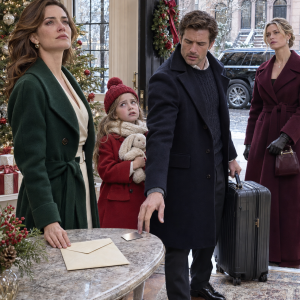
He stared at the envelope.
“If it was nothing, I’d have to admit I ended our marriage over nothing. If it was something, I’d have to admit I’d lost everything. So I put it away and built a company and told myself I was fine.”
I opened it and slid the image across the table. Three small shapes showed against a gray background. The sonographer had marked them Baby A, Baby B, and Baby C.
Adrian pressed his knuckles against his mouth.
“Three,” he whispered. “I thought it was one. I didn’t even know it was three.”
“You never asked.”
He looked up. “Why didn’t you contact me after they were born?”
I held his gaze.
“I sent a letter to your office with a photograph. I told you the door was open, but I wouldn’t ask twice.”
His face shifted, just briefly.
“I never got a letter.”
I wanted to believe him. Then he told me that six months after I left, his executive assistant, Celeste Ward, had shown him a blurry photograph of a woman who looked like me, wearing a wedding ring beside another man in Zurich. Adrian had taken it as proof that I had moved on.
“I have never been to Zurich,” I said.
He didn’t argue. That was the first thing that surprised me.
Celeste was still his chief of staff, and they had been seeing each other on and off for two years. She managed his schedule, his calls, and, by his own admission, much of his daily life. When I told him someone had obtained my itinerary, he went still.
“Celeste changed my flight Friday,” he said. “She told me the earlier one was overbooked.”
I walked to the window and watched Chicago begin its day.
“We’re going to do a DNA test. It’s for the girls, so no one can ever claim they’re a story I invented to get money. Until then, you don’t contact them unless I say so. No gifts, no promises, and no press. Children remember promises.”
“Whatever you need.”
“If you hurt them, even by accident, you will not see them again.”
“I understand.”
Before I could answer, Nora hurried into the room carrying a thick envelope.
“I’m sorry to interrupt. This just arrived from Adrian’s company.”
The first page named his firm as plaintiff in a patent lawsuit against my lab. They claimed the energy-storage membrane my team had spent four years developing belonged to them because I had supposedly signed away my rights while I was married to Adrian.
The filing was dated two weeks earlier and authorized by Peter Shaw, Adrian’s chief operating officer, his co-founder, and the best man at our wedding.
I turned the papers toward Adrian.
“You promised no press and no lawyers. This was filed two weeks ago.”
He read the page, then called Peter and put the phone on speaker.
“Did you file a patent suit against the Mercer Institute?”
Peter answered smoothly. “It’s standard protection. The legal team flagged it months ago. I didn’t want to bother you with a routine matter.”
“It’s Maren’s lab.”
There was a pause.
Then Peter lowered his voice. “Adrian, I know you saw her. I know about the children. Be careful. I’ve been handling this for years to protect you.”
Adrian looked at me.
“How do you know about the children?”
Peter claimed that my lawyer had contacted the company four years earlier, demanding fifteen million dollars in exchange for keeping a paternity story out of the press. He sent Adrian a scanned letter with my name at the bottom.
I watched Adrian study it. Five years earlier, a document like that would have been enough to make him turn away from me.
He put the phone face down.
“I don’t believe it.”
I hadn’t realized how much I needed to hear those words until my eyes began to sting.
“Why not?”
“Because you walked away from a fortune in our divorce. You wouldn’t invent a demand for fifteen million. And because I’ve believed the wrong people once already.”
Three Girls and One Drawing
Adrian met the girls that Saturday at Samuel’s estate in Lake Forest. Samuel insisted on being there, and so did Helen, his longtime housekeeper, who had appointed herself the girls’ unofficial grandmother.
I told them only that Adrian was someone I had known a long time ago and that he wanted to meet them. Lila stood in front of her sisters with her arms folded.
“Why didn’t you meet us before?”
Adrian crouched so they were at eye level. I could tell he had rehearsed what to say, but he set the words aside.
“Because I made a very big mistake, and I’m sorry.”
Lila considered this.
“Like when Willa cut June’s hair?”
“Worse than that.”
“That was really bad,” she warned him.
“I believe you.”
June quietly handed him a drawing: three girls, their mother, a tree, and a dog they did not own. In one corner she had drawn a man just outside the picture.
Adrian looked at it as if it might break.
Willa marched up and pointed at the dimple in his cheek.
“You have my dent.”
“I think you have mine,” he said, his voice unsteady.
She squinted at him.
“Are you the man in the picture Mommy keeps in her sock drawer?”
I looked at the sky.
They played for two hours. Adrian was poor at tag and worse at hide-and-seek, but he let Willa ride on his shoulders and didn’t complain when she held his ears like reins. When she grew tired, he noticed before I said anything. I told him quietly about her heart operation when she was four months old. He walked to the edge of the lawn and stood there by himself for a while.
The DNA results arrived that afternoon. There was no ambiguity: Adrian was their father.
He bent forward over his knees, shoulders shaking, as the girls shrieked with laughter near the sprinklers. I sat beside him on the porch step. I didn’t touch him, but I didn’t leave.
Then tires crunched along the driveway. A white SUV stopped in front of the house, and Celeste stepped out in a cream coat and expensive sunglasses.
“Adrian, the board has called an emergency meeting. They’re voting to remove you as CEO on Monday.”
She said a gossip site had published a story about the triplets, and the company’s stock had fallen. Peter was telling the board that Adrian was too distracted to lead.
Celeste’s smile turned toward me.
“Hello, Maren. You look exactly the same.”
Later, she found me alone in the side garden.
“Women like you always come back when there’s money on the table.”
“I didn’t come back. He sat beside me.”
She glanced toward the girls, who were playing on the lawn.
“Then take them and disappear again. Especially the little one. With her heart, she shouldn’t be under this kind of stress.”
My hands went cold. Only her doctors, Samuel, and I knew about Willa’s medical history. Adrian had only learned that day.
The next morning, the story was everywhere: the ex-wife had hidden triplets and was demanding hundreds of millions. Photographs showed the girls outside their school, their faces blurred but the school sign clearly visible. News vans appeared on my street.
Lila stood at the living-room window.
“Mom, why are those people taking pictures of our tree?”
I closed the curtains, turned on the bathroom faucet, and let myself cry into a towel for a few seconds. Then I washed my face and made pancakes.
At noon, I walked onto the porch alone. The cameras turned toward me.
“My name is Maren Hale. I’m a materials researcher, and I have three daughters. I have never asked Adrian Hale for money, and I never will. My children are not a scandal. They’re five years old, they like pancakes and silly cartoons, and they deserve privacy. Please leave them alone.”
That afternoon, Adrian released a statement in his own words. He said Lila, June, and Willa were his daughters, that he had believed a lie instead of his wife, and that the failure was his. He also said I had asked for nothing and had earned everything I had.
I read it several times and didn’t know what to feel.
Then my former obstetrician called from New York. Dr. Matthew Ellis said there was something he should have told me years earlier. A woman had come to his clinic asking for my medical records, claiming Adrian had authorized the request. The clinic refused, but nine days later its patient portal was breached. My messages, including the notes about the pregnancy, had been accessed.
Dr. Ellis flew to Chicago with Barbara, his former office manager, who had kept the old visitor log. Samuel brought in Ruth Bennett, a retired federal financial investigator.
Barbara opened the log and pointed to the date.
“I remember her. She was very polished and very rude when I wouldn’t hand over the file.”
The signature read: Celeste Ward, Office of Adrian Hale.
The clinic’s investigation had gone nowhere at the time. But the records explained how Celeste had learned about the triplets, Willa’s health, and eventually my new address and travel plans.
Dr. Ellis also asked how his number had been saved in my phone.
“As Dr. Ellis, OB,” I said. “That’s how it’s always been saved.”
Adrian looked up.
“It showed a man’s name with a heart beside it,” he said quietly. “That was what I saw.”
I remembered the night everything ended. I had left my phone charging at the lab after a late meeting. When I got home, I realized I didn’t have it. Celeste had brought it to our house and handed it to Adrian in the foyer, saying he should look at the messages.
She had changed the contact name.
Adrian stared out the library window.
“I married the most honest person I knew, and I let a name in a phone convince me she was lying.”
Ruth cleared her throat.
“You can feel sorry about it later, Mr. Hale. Right now, we need evidence.”
The Things We Chose to Believe

For two days, Ruth worked through financial records, company filings, and old correspondence. The pieces formed a picture none of us wanted, though it made the past easier to understand.
Peter had paid a private investigator through a shell company to photograph me entering a building in New York. The pictures showed me walking into the lobby, but the investigator had cropped out the directory listing the medical offices upstairs. Peter had used the images to make it appear that I had been meeting another man.
The shell company belonged to a trust he controlled. Celeste, Ruth discovered, was Peter’s half-sister. She had changed her surname before he recommended her for a job in Adrian’s office.
Over four years, tens of millions of dollars had moved from Adrian’s company through consulting contracts to firms connected to Peter. A pending company audit threatened to expose the transfers. The patent lawsuit against my lab would have helped Peter take control of our new technology and fold it into the company before its planned public offering.
The forged patent assignment carried a date when I had been in a Chicago hospital on bed rest. I had been there for a week, worried about the girls and unable to travel.