The Afternoon Millie Noticed

The Day the House Fell Quiet
The afternoon Millie noticed something was wrong began with an ordinary problem: our babysitter was sick, Beth was working at the clinic, and I could not afford to miss another shift. I packed Millie lunch and a picture book and brought her to the Bellamy estate outside Milwaukee.
I had worked there for nineteen months as household coordinator, keeping schedules and daily routines in order. The estate had iron gates, a long drive, and broad windows reflecting the Wisconsin sky; it still felt built for people whose lives ran by different rules.
Four-year-old Millie thought of the mansion as a grand place to play quietly. In the sitting room beside the library, she colored and examined her stuffed rabbit with the pink toy stethoscope she carried everywhere.
Graham Bellamy owned shipping firms, hotels, and commercial property across the Midwest. Stories about shadowy connections followed him, though I never knew what was true; I knew only that he was reserved, exacting, and approved my paycheck.
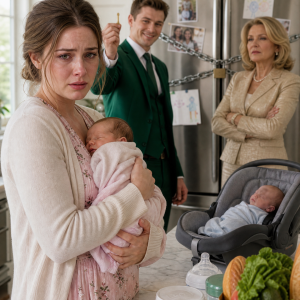
That day, he was meeting executives in his library when a crash sounded behind the doors. I hurried in and found him on the carpet, pale and struggling to breathe. Cole Bennett, head of security, knelt beside him while another guard called emergency services.
I kept Millie close, but she had seen enough to understand that something was wrong. Her small fingers tightened around my hand, then she looked past me toward Graham.
“Mommy, Mr. Graham is sick.”
“Stay right here with me, sweetheart.”
She watched his face and throat, where raised patches were appearing beneath his collar. His lips looked swollen, and each breath took more effort.
Millie slipped her hand from mine and took two small steps closer, holding her toy stethoscope in both hands.
“I’m a doctor,” she whispered, as if Graham might need the reassurance.
The guards waited for direction. Millie touched the plastic end of her toy to Graham’s shirt, then looked up at me, worried.
“Mommy, his neck looks like Aunt Beth’s did.”
I remembered Beth’s serious reaction to a dessert containing nuts at a family picnic. Millie had seen the swelling and raised marks that appeared first.
I turned to Cole. “Does Mr. Bellamy have any allergies?”
He looked at me as if he had not heard. “What?”
“A serious allergy. Does he have one?”
Cole glanced at Graham, and recognition came over his face. “Tree nuts. It can be severe.”
I asked whether Graham had eaten anything. Cole said that a dessert had been brought in during the meeting, though it was supposed to have been prepared without nuts. He relayed the allergy information to the emergency dispatcher, who gave instructions while one of the staff members retrieved Graham’s prescribed medication. The staff member administered it as directed, and we stayed beside Graham until the paramedics arrived and took over his care.
I held Millie close, my hands trembling. She reached out and rested her fingers against Graham’s hand.
“You’re going to be okay, Mr. Graham,” she said.
As the paramedics prepared to move him, Graham opened his eyes for a brief moment. His gaze passed over Cole and settled on Millie. The hard lines in his face eased, and he seemed about to say something, but the crew was already guiding the stretcher toward the hall.
I thought the urgent part was over when the ambulance pulled away. Then I saw Cole examining the dessert plate left on the desk. He studied it, called one of the guards over, and looked toward the doorway with an expression I had never seen on him before.
“This plate didn’t come from the kitchen the way it was prepared,” he said quietly.
Nineteen Months Behind the Gates
My name is Tessa Ward. Millie and I were white Americans raised in Wisconsin, as were Graham, the household staff, and the local detectives who later came to see me. At twenty-nine, I was trying to give my daughter a steady childhood, though her father had left before she was born and never kept his promise to call.
Before the estate, I worked at a hotel and restaurant, with occasional errands and housecleaning for neighbors. Beth watched Millie when her clinic schedule allowed. I applied for the estate job because its steadier pay and health insurance could give us room to breathe.
Beth was less enthusiastic.
“You know what people say about Graham Bellamy,” she said when I told her.
“I know what people say about rent, too,” I answered. “I have to try.”
Florence Hale, the estate manager, interviewed me about my experience and discretion, then handed me an employment agreement. I read each page before signing.
“Most people are eager to get through the paperwork,” she said.
“I have a little girl depending on me. I need to know what I’m agreeing to.”
Florence gave a small, approving smile. “That’s a sensible answer.”
During my first weeks, Graham was a distant figure in dark suits, speaking quietly with staff before disappearing into his office. He rarely raised his voice, but noticed everything.
Once, I accidentally knocked a crystal bowl from a shelf. It broke across the marble floor, and I stood still, already rehearsing an apology. Graham appeared in the doorway.
“Are you hurt?” he asked.
“No, sir. I’m sorry about the bowl.”
He looked at the scattered pieces and then at me. “Ask maintenance to clear it safely. It’s only a bowl.”
I began to say that it had probably been expensive, but he had already turned away. At the doorway, he paused.
“Objects can be replaced, Ms. Ward. People are more important.”
He said it as plainly as if he were reminding me to lock a window, yet I remembered it for a long time.
Months later, Millie became ill, and I used my leave to care for her. I returned before she was fully well because I feared falling behind on rent. Graham found me wiping my eyes after a call from our landlord.
“Is Millie still unwell?” he asked.
“She’s improving. I’m sorry. I should be working.”
“Then why are you here?”
I told him I could not afford more unpaid time away. He listened without interrupting, then asked Florence to arrange paid leave for the days I had missed. I tried to explain that I might not qualify, but he had already made his decision.
When I returned, a package of children’s books was waiting in the staff room. Florence said Graham had heard Millie liked stories. I was touched, though he was still my employer, and I kept a careful distance.
Then Millie walked into his library with her toy doctor’s kit, and the distance between our lives changed in a way neither of us could have predicted.
The Dessert That Had Been Changed

Graham remained in the hospital overnight. The next morning, Cole called to say Graham was stable and expected to recover. I sank into a kitchen chair, realizing I had been holding my breath.
“I’m grateful,” I said. “Millie keeps asking whether he’s coming home.”
Cole paused. “Tell her he’s getting the care he needs. I have to ask you something, Tessa. Did you see who brought the dessert into the library?”
I remembered a tall executive in a gray jacket taking a plate from the serving cart. I had noticed because Florence seemed displeased that he was handling the refreshments.
“Wesley Pike,” I said. “He’s the finance director, isn’t he?”
“Yes. Are you certain?”