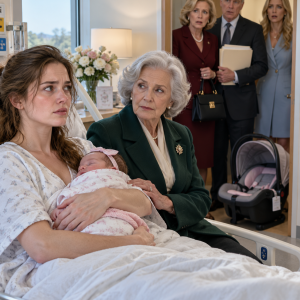
Owen and I arrived at the house within minutes of each other. Diane, Molly, the jar, and the foil package were gone.
I showed my husband the recordings, the receipt, and my medical results. He watched his mother add the powder to my tea, then sank into a chair.
“There has to be another explanation.”
“I told myself that for ten years. Right now, we have to find Molly.”
One of Owen’s cousins remembered Diane asking for directions to an old family chapel near the Blue Ridge Mountains. We contacted the sheriff’s department and drove west through heavy rain.
Halfway there, my phone rang.
“Mom,” Molly whispered. “I’m cold.”
Diane took the phone from her.
“Don’t bring officers. I only want Owen to understand what he did when he chose you.”
“Give me my daughter.”
“You took my son from me, Rebecca. I gave him everything, and then you arrived and became the person he needed.”
We found them beneath the chapel’s covered entrance. Diane held the porcelain jar in one hand while keeping the other on Molly’s shoulder. Owen stepped forward slowly.
“Mom, let her come to us.”
Diane began to weep.
“At first, I only wanted Rebecca to feel weak. If she worked less and went out less, you might need me again. Franklin told me what to use.”
Molly slipped free and ran into my arms as deputies approached. The jar fell onto the wet pavement, scattering its contents into the rain.
While officers escorted Diane away, she turned toward me.
“Franklin knew your mother. He said she ruined his family, and he has been waiting years to settle the score.”
Later that evening, investigators searched the room Franklin had rented. They found photographs of our home, Molly’s school, and my mother as a young woman, along with a notebook containing our schedules.
One line had been underlined in red:
“If Diane fails, use the girl.”
Then an unknown number sent me a photograph of Molly’s bracelet, which she had lost near the chapel.
The message beneath it read, “Your mother was no hero. Come alone if you want the truth.”
What My Mother Had Hidden

Detective Dana Holt took my phone before I could reply. The number had been registered under false information, but Franklin was not trying to disappear. He wanted to guide us somewhere.
At the sheriff’s office, Dana showed me a photograph taken in 1997. My mother stood outside Piedmont Therapeutics, a pharmaceutical manufacturer that had once operated near Burlington, North Carolina. Behind her stood a much younger Franklin, who had supervised the company’s materials warehouse.
The company had been investigated after employees raised concerns about contaminated ingredients and altered quality records. My mother, who worked in financial compliance, had copied invoices and internal reports. Franklin lost his position after she reported several irregular shipments, yet the investigation collapsed when critical documents vanished.
I remembered something my mother had said during her final months.
“If anyone ever asks about the company where I used to work, don’t trust the first story you hear.”
At the time, I believed medication and exhaustion had left her confused.
Diane eventually admitted that Franklin had approached her five years earlier. He recognized her resentment toward me and fed it carefully, telling her that I intended to separate Owen from his family. Using money I had given Diane for household expenses, she paid Franklin each month for crushed medication.
He had not forced his way into our lives. Diane had opened the door.
A second message arrived that evening, directing me to an abandoned pharmaceutical warehouse outside Burlington. Franklin claimed he had something my mother had hidden. Dana arranged a controlled meeting and fitted me with a small microphone while officers waited nearby.
Before leaving, I took Molly to Tessa’s apartment, where two deputies were stationed downstairs.
I knelt in front of my daughter.
“Do not open the door unless Tessa or an officer tells you it’s safe.”
“Are you coming back?”
“Always.”
Franklin was waiting inside the warehouse beside a metal table. On it lay Molly’s bracelet and a faded yellow folder.
“You have Patricia’s eyes,” he said.
“What do you want from me?”
He claimed his young son had received medication produced by Piedmont Therapeutics and never recovered from a severe reaction. According to him, my mother had known about the company’s misconduct for months but delayed reporting it because she feared retaliation against our family.
“She protected you while other families suffered,” he said. “I wanted you to understand what it feels like to watch someone you love grow weaker every day.”
“So you targeted a child who wasn’t even born when any of this happened?”
“Families inherit what their parents owe.”
For the first time since Molly had told me about the powder, my thoughts became completely clear.
“Children do not inherit blame. My mother may have been afraid, and she may have waited too long, but that does not make Molly responsible. You turned your grief into permission to harm people who had nothing to do with your loss.”
Franklin lifted a small container from his coat pocket.