“He tried to force me to leave.”
Caleb immediately interrupted.
“She’s on pain medication. She’s confused.”
The officer beside him stepped closer.
“Sir.”
Caleb finally fell silent.
He Forgot About the Cameras
About fifteen minutes later, another officer entered carrying a tablet.
He spoke quietly to the hospital police supervisor.
Then he turned the screen so everyone in the room could see.
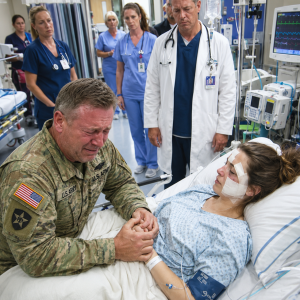
The hallway camera showed Caleb entering my room.
Another camera inside the room—installed for patient safety after repeated falls in the orthopedic wing—captured almost everything except the bathroom area.
Nobody had to guess.
The recording showed Caleb pulling my blanket away.
Dragging the wheelchair beside the bed.
Ignoring me when I raised my hands to stop him.
Then trying to lift me while I struggled.
The video had no dramatic music.
No perfect angle.
Just ordinary hospital footage.
Somehow that made it even worse.
The recording also caught one sentence clearly.
“You’re costing me a fortune.”
The room stayed silent after the clip ended.
The supervisor locked the tablet.
Then he faced Caleb.
“Do you have anything you’d like to add?”
Caleb swallowed.
“She wanted to go home.”
Nobody answered.
Because everyone had just watched the opposite.
The Arrest Happened in Front of Me
The officer removed a pair of handcuffs from his belt.
“Caleb Walker, you’re under arrest for assault causing bodily injury. You have the right to remain silent.”
Caleb’s eyes widened.
“You’re arresting me because I tried to help my own wife?”
The second officer stepped beside him.
“Turn around.”
Instead of cooperating, Caleb looked at me for the first time since security arrived.
His face wasn’t apologetic.
It was angry.
“Rebecca.”
I didn’t answer.
“Tell them this is a misunderstanding.”
I held the edge of the blanket with both hands.
The same blanket he had thrown onto the floor minutes earlier.
“Rebecca.”
His voice became softer.
Almost pleading.
“Don’t do this.”
I took one slow breath.
Then I said the shortest sentence I’d spoken in eleven years.
“I’m not doing this.”
I looked directly at the officers.
“He did.”
The handcuffs clicked shut.
For the first time in our marriage, someone else—not me—was telling Caleb what he could and couldn’t do.
As they escorted him toward the hallway, he kept turning back.
I never did.
My First Decision Wasn’t About Revenge
After he was gone, the room felt strangely quiet.
Angela picked up the blanket and covered my legs again.
The physician ordered additional X-rays and a CT scan to make sure Caleb hadn’t damaged the surgical repairs.
Fortunately, nothing had been broken again.
But the bruising across my abdomen confirmed recent blunt-force trauma.
Later that afternoon, a victim advocate from the hospital sat beside my bed.
She didn’t rush me.
She didn’t tell me what I should do.
She simply asked,
“Do you feel safe if he comes back?”
I answered before she finished the question.
“No.”
She nodded.
“Then let’s start there.”
That afternoon became the first time anyone explained protective orders, emergency housing, counseling services, and financial assistance without making me feel ashamed.
I learned something else.
Control wasn’t only physical.
Sometimes it looked like someone holding every bank password.
Every insurance document.
Every financial decision.
The advocate slid a legal pad across the table.
“Who do you trust?”
I wrote my older sister’s name.
Emily.
I hadn’t called her in almost eight months.
Mostly because Caleb always found a reason not to.
She answered on the second ring.
Before I could speak, she said,
“Rebecca?”
I started crying.
Not because I was afraid.
Because I finally didn’t have to pretend everything was fine.
Walking Again Meant More Than Physical Therapy
Two days later, Emily arrived carrying a small canvas tote bag.
Inside were clean clothes.
My reading glasses.
A framed picture of our parents.
And the old silver bracelet Mom had given me years before.
“I thought you’d want this,” she said.
I slipped it onto my wrist.
It suddenly felt heavier than I remembered.
Not because of the metal.
Because nobody had told me to take it off.
Over the next several days, physical therapy became part of my routine again.
Standing for thirty seconds.
Then a minute.
Then taking two careful steps between the parallel bars.
Every step hurt.
But each one belonged to me.
My attorney filed for divorce.
The court granted a temporary protective order before I was discharged.
For once, the paperwork wasn’t something Caleb controlled.
It was something that protected me.
I Walked Out Under My Own Strength
Five weeks after the attack, the automatic hospital doors opened in front of me.
Emily walked beside me, carrying my overnight bag.
I was using a walker instead of a wheelchair.
Slowly.
Carefully.
But on my own.
As we reached the parking lot, I stopped for a moment.
I looked back at the hospital building.
That room had been the place where I believed my marriage would finally break me.
Instead, it became the place where the truth was finally witnessed by people who believed what they saw.
Emily smiled.
“Ready?”
I tightened my grip on the walker.
Then I took another step toward the car.
Not because I was completely healed.
But because, for the first time in eleven years, every step belonged to me.