“They were preserved by a shareholder and former compliance director who had authorized access at the time. They were later submitted through protected legal channels.”
Judith pointed toward Mara.
“She is doing this because we did not approve of her pregnancy.”
Mara pressed a key on the table.
Judith’s recorded voice filled the room.
“Adrian will eventually lose interest. Men with his kind of money always do. When that happens, do not bring that baby to our door expecting us to rescue you.”
When the recording ended, no one spoke.
The transfer agreement appeared next on the screen. Beside it was the independent valuation of Mara’s shares, followed by messages showing that Chase had already discussed selling the same ownership interest to an outside buyer for more than six times the amount offered to her.
Adrian’s attorney folded her hands.
“The evidence suggests an attempt to obtain a shareholder’s interest through concealed valuation information and pressure applied during medical recovery. The agreement and related communications have been submitted to the appropriate committees.”
Raymond turned to Adrian.
For the first time, his commanding posture seemed to fail him.
“This can be handled privately,” he said. “Public conflict harms employees, investors and families. You understand that.”
Adrian leaned forward.
“Cedar Ridge is withdrawing from the proposed merger. Our lending partners and institutional advisers were informed this morning.”
The champagne bottle slipped from Chase’s hand. It struck the carpeted floor, rolled beneath the table and came to rest against a chair leg.
A federal representative addressed him.
“Mr. Ellison, your company devices, corporate messages and transaction records are subject to preservation and review. You are instructed not to alter or remove any material.”
Chase stared at Mara.
“You planned all of this.”
She looked at him for a long moment.
“No. I asked you to correct it when there was still time. You mistook my quietness for weakness.”
Raymond immediately began offering concessions. He suggested appointing Mara chief executive, transferring Chase’s voting authority to her, giving her the family’s vacation property and introducing Oliver publicly as the next generation of Ellisons.
Judith’s voice trembled.
“I was trying to protect our reputation. I could not bear the thought of people whispering about us.”
Mara placed one hand over Oliver’s back.
“You turned away from a newborn so you could pressure his mother into surrendering what belonged to her,” she said. “You did not protect the family name. You showed everyone what had been hidden behind it.”
The board suspended Chase before the meeting ended. Raymond was removed from daily leadership later that week. Several credit facilities were placed under review, and the company’s proposed expansion was paused while auditors examined years of records.
The investigation uncovered more than Mara had expected: padded purchase contracts, hidden personal debts, fabricated service fees and property expenses paid through company accounts.
Chase eventually accepted responsibility for multiple financial violations and received a multi-year federal sentence along with substantial repayment obligations. Raymond avoided confinement, but he surrendered control of the company, much of his ownership and the lake property he had secretly pledged against company borrowing. Judith’s jewelry collection and several luxury assets were sold during the civil recovery process.
Mara did not celebrate any of it.
The employees had not created the deception, yet they were the ones arriving each morning unsure whether their paychecks, health coverage and retirement plans would survive. She worked with the independent board and Cedar Ridge’s advisers to stabilize the business, protect essential jobs and separate honest operations from the accounts under investigation.
Once the company was secure, Mara sold her shares through a transparent, independently reviewed transaction.
She used part of the proceeds to create the Clear Ledger Foundation, which provided legal guidance and temporary financial support to employees who reported misconduct inside family-controlled businesses. She understood how easily loyalty could be used to demand silence and how often a person was called disloyal simply for telling the truth.
The Family Oliver Was Given
Oliver’s first birthday was held in the backyard of a modest cedar house outside Stillwater, beneath strings of warm lights and tall maple trees.
There were white balloons, a vanilla cake, Adrian’s cousins, Mara’s closest friends and several former Ellison employees whose jobs had survived the company’s restructuring. No photographers waited at the gate. No one discussed share prices or family reputation.
There was no place set for Judith or Raymond.
Over the previous year, eleven letters had arrived.
Some contained apologies. Others spoke of grandparents’ rights, family tradition and the importance of allowing the past to remain in the past. In the final letter, Judith wrote that she wanted to hold Oliver once, even if Mara never spoke to her again.
Mara returned every envelope unopened.
She did not do it out of anger. She did it because forgiveness and access were not the same thing. A person could release bitterness without returning a child to the hands that had once rejected him.
Near sunset, Oliver pulled himself upright against a garden bench. Adrian crouched several feet away while Mara knelt beside the cake table.
“Come on, buddy,” Adrian said softly. “You’ve got this.”
Oliver released the bench.
He took one uncertain step, then another, his arms raised for balance. On the third step, his knees folded, but Adrian reached him before he reached the grass.
Oliver laughed so loudly that everyone around them began laughing too.
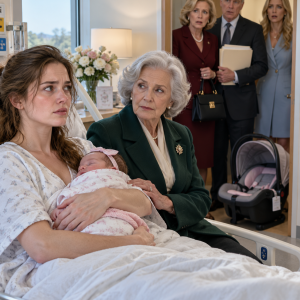
Mara lifted him into her arms and kissed the same small forehead she had kissed in the hospital, on the afternoon her parents declared that they would never hold him.
A year earlier, she had believed she was protecting her son from abandonment.
Only later did she understand that Oliver had never entered the world without a family. He had simply arrived before the wrong people had finished leaving.
The Ellisons had once measured family through ownership, obedience and public appearance. Mara had learned to measure it differently: by who remained beside you when there was nothing to gain, who guarded your dignity when you were too tired to defend it, and who welcomed a child without asking what that welcome might be worth.
Oliver rested his head against her shoulder while Adrian stood beside them, one hand against her back.
The people who refused to recognize the baby had lost the authority they believed would last forever.
But the child they called unwanted had never lacked a name, a home or love.
He had only revealed who truly deserved to be part of his life.