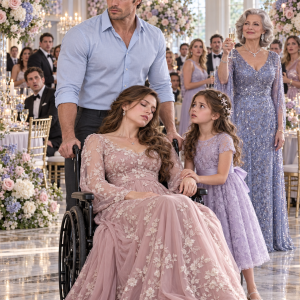
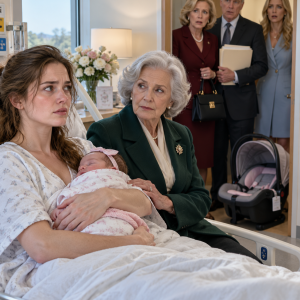
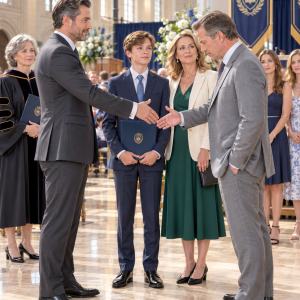
“I need five minutes,” Lucas said.
Nathan ordered him to leave, but Camille surprised everyone.
“No. Let him speak.”
Lucas handed the document to Graham. It was a copy of an emergency custody petition Nathan’s lawyers planned to file on Monday, claiming I was unable to care for Elodie and requesting temporary oversight.
“That document is privileged,” Nathan snapped.
“It was in the filing queue,” Lucas replied. “I resigned this morning. I won’t help you do this.”
Camille turned slowly toward Nathan.
“You told me Tessa didn’t want the baby.”
My name sounded strange in her voice.
“You told me she abandoned your marriage and that you were protecting your daughter.”
Nathan tried to take her arm, but she stepped away.
Then Lucas asked her to tell the truth.
Camille closed her eyes.
“I don’t know for certain that this baby is Nathan’s,” she admitted. “There was another possibility before Nathan and I began seeing each other.”
The guests became completely still.
Nathan had known there was uncertainty, yet he had allowed his mother to celebrate an heir and had discarded Elodie as though she carried no value. Camille removed her ring and placed it in his hand.
“This wedding cannot happen today.”
Judith protested, but Camille walked away from the arbor with Lucas following several steps behind, giving her space.
Nathan’s perfect celebration dissolved into murmurs. Then, cornered and desperate, he looked at my mother and smiled.
“Perhaps Tessa should ask why the birth of a daughter triggered a sealed alert in her father’s estate.”
My mother’s expression told me the question mattered.
“What is he talking about?” I asked.
She lowered her eyes.
“There is something in your father’s will we should have told you before Elodie was born.”
The Legacy My Father Hid

Back in my mother’s Concord home, I learned that my father had created a protective review for the first child born to me. If that child was a daughter, the review began immediately after her birth was registered; if the child was a son, it would not begin until he turned twenty-one.
At first, the distinction infuriated me.
Then my mother explained that my grandmother had grown up watching male relatives take control of property that should have supported her mother and sisters. Years later, she asked my father to ensure that future daughters in our family would never be left financially exposed.
The clause did not give Elodie more because she was worth more. It protected her earlier because history had taught my family who was most likely to be pushed aside.
Nathan had apparently discovered enough about the clause to realize that Elodie’s birth strengthened my protected position. His disappointment in the hospital had not been only about wanting a son. He had looked at our newborn daughter and seen a locked financial door.
With Lucas’s evidence, Sylvia blocked the planned custody petition. Nathan’s attorneys withdrew it before Monday.
A week later, my mother brought me an old wooden box containing a letter my father had written before he passed away. In it, he explained that wealth was not the heart of his plan; choice was. He wanted no spouse, relative, or business partner to turn a child into leverage.
His final instruction was simple: remain tender where tenderness belonged and become firm only where protection required it.
For the first time in months, I felt that Elodie and I were standing on solid ground.
Then Lucas asked to meet us at a crowded café.
He brought an email header showing that someone had sent Nathan an archived memorandum about the trust. The attachment carried my mother’s initials, although that did not prove she had sent it. A second document contained an older handwritten note.
Near the bottom, one sentence stood out:
The protected line may not descend from Tessa alone.
Graham’s face turned pale. My mother had not come to the meeting, and suddenly I understood that the secrets surrounding my father’s estate reached further back than my marriage.
I looked at Lucas.
“What does that sentence mean?”
He hesitated, glancing at Elodie asleep against my chest.
Then he placed one final page on the table.
“Tessa, there may have been another baby named in your father’s will.”