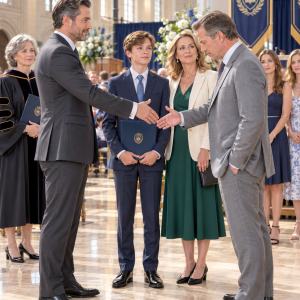
Caroline explained this without raising her voice.
“The fund will begin a formal review immediately. Until that review is complete, additional financing and pending partnership introductions are suspended.”
Brynn looked at Adrian.
“You’re going to ruin my company over one argument?”
Adrian shook his head.
“No. Your company will be judged by the agreements you signed and the choices you made. For once, those choices won’t be billed to Nora.”
The Word Family

Brynn began to cry.
I knew those tears.
I had seen them when we were children and she was caught breaking something she had blamed on me. I had seen them when a college professor refused to change her grade. I had seen them whenever consequences entered a room she had expected privilege to control.
She came toward me.
“Nora, please. Tell him to stop this. I’m your sister.”
There are words that carry an entire childhood inside them.
Sister was one of those words for me.
I remembered Brynn arranging family photographs so I stood at the edge. I remembered her posting an unflattering picture of me after a difficult treatment week and then insisting it had been an accident. I remembered Christmas dinners when she complained that everyone had to be “so careful” around me. I remembered my mother asking me to forgive quickly because Brynn was under pressure, Brynn was insecure, Brynn had not meant it that way.
I had spent years translating her cruelty into excuses.
I was finished translating.
“A sister doesn’t use the hardest season of your life to make herself feel taller.”
She covered her face.
My mother stepped into the aisle.
“Nora, think about the family.”
For thirty-three years, that sentence had worked.
This time, it did not.
“I have thought about the family my entire life,” I said. “Today I’m going to think about the one I’m building.”
I turned toward Adrian.
He was still holding my hand.
Not pulling me forward.
Not rescuing me.
Just standing beside me.
That difference meant everything.
Reverend Bell looked at us both.
Adrian smiled faintly.
“Nora, after all this, I should probably ask whether you still want to marry me.”
A nervous ripple of laughter moved through the chapel.
I looked at the man who had sat beside me in medical waiting rooms without pretending optimism was easy, who had learned which crackers I could tolerate on difficult mornings, who never once told me I was brave when I needed permission to admit I was tired.
“I do,” I said. “But I reserve the right to complain about the seating chart for the rest of our lives.”
This time, the laughter came warmly.
Adrian smiled.
“Fair.”
The ceremony continued.
Our vows were not the ones printed in the program.
I promised not to make myself smaller so other people could remain comfortable. I promised honesty, even when honesty was inconvenient. Adrian promised never to confuse love with ownership, protection with control, or support with speaking for me.
When Reverend Bell pronounced us husband and wife, the applause seemed to shake the old windows.
Brynn and my mother left quietly before the reception.
No dramatic scene followed.
No shouting.
Just two women walking through a side door while, for the first time in my life, I did not chase after them to repair what I had not broken.
What We Built Afterward
That evening, Adrian and I changed the reception.
We kept the dinner, the musicians, and enough champagne to prevent a small diplomatic incident, but we canceled several extravagances planned for later in the weekend. The private yacht brunch, the imported floral installation, the celebrity after-party, and a second-day beach celebration suddenly seemed unnecessary.
Over the following weeks, we redirected that money into something I had wanted for years but had never imagined I could build.
We created the Harbor Light Center in Providence, a support program for women undergoing demanding medical treatment.
It offered counseling, transportation grants, meal assistance, family mediation, appearance services for women who wanted them, free wigs for women who chose them, legal referrals, childcare support during appointments, and quiet rooms where nobody was required to be inspirational.
That last part was my idea.
I had grown tired of the pressure placed on unwell women to become symbols of courage for everyone around them.
Sometimes a woman needed to be brave.
Sometimes she needed soup, a blanket, and an afternoon when nobody asked her to smile.
Eight months after our wedding, the center opened.
The plaque near the entrance did not carry my maiden name or Adrian’s family name.
It read:
For every woman who deserves to be seen without apology.
By then, my hair had begun growing back in soft dark curls, no more than an inch long. For the opening ceremony, I wore a white pantsuit, small diamond earrings, and the same tiara from my wedding day.
Adrian laughed when he saw me.
“Subtle.”
“I’ve tried subtle,” I said. “It’s overrated.”
The first families entered shortly after ten.
Some women wore scarves. Some wore wigs. Some had closely cropped hair. Some came alone. Others arrived holding the hands of husbands, daughters, sisters, mothers, neighbors, or friends.
I stood near the glass doors and watched them walk inside.
For years, I had believed healing meant returning to the person I had been before everything changed.
I no longer believed that.
Sometimes you do not go back.
Sometimes you build forward.
I heard little from Brynn after the wedding. Her company lost several partnerships during the formal review and eventually closed one of its offices. My mother sent messages for months. Some were angry. Others were tearful. Later came apologies mixed with explanations, and explanations mixed with reminders that life was short and families should stay together.
I wished them well.
I simply stopped confusing forgiveness with unlimited access.
That lesson took me longer to learn than almost anything else.
Peace does not always arrive as reconciliation.
Sometimes it arrives as a boundary that finally holds.
Near the end of the Harbor Light opening, a little girl of about nine approached me. She had freckles across her nose and two missing front teeth. Her mother stood several feet away wearing a soft green scarf over her head.
The girl stared openly at my tiara.
“Are you a queen?”
I laughed and crouched so we were eye to eye.
“No.”
She considered this.
“Then why do you have a crown?”
I looked through the glass doors toward the center we had built, then back at her.
“Because once I was very afraid people would stare at me,” I said. “And then I learned I could keep walking anyway.”
The girl nodded with the grave seriousness children sometimes bring to answers adults would overcomplicate.
Then she returned to her mother.
I watched the woman listen as her daughter whispered something into her ear. A moment later, the woman touched the green scarf at her neck.
Slowly, she removed it.
She did not make a speech.
Nobody applauded.
She simply lifted her face toward the sunlight coming through the windows.
And standing there, with Adrian beside me and the diamond tiara resting on my short new curls, I understood something I had been too frightened to understand on my wedding morning.
Brynn had believed she could humiliate me by taking away the thing I planned to use as a covering.
Instead, she had accidentally taken away my last excuse to hide.
For years, I had thought my wedding happened in a chapel before five hundred people.
But I was wrong.
Something far more important began each time a woman walked into that center and discovered that dignity did not depend on appearing untouched by hardship, that love did not require perfect photographs, and that family was not defined by the people who demanded silence in exchange for belonging.
Sometimes the people closest to us teach us how to disappear.
And sometimes, after years of practice, we finally decide to be seen.