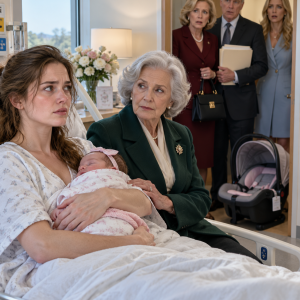
“You always say the grandchildren are your greatest joy.”
“They are a joy. They are also exhausting.”
The room went silent.
Evelyn had never admitted that before.
Rachel’s expression hardened.
“So now they’re a burden?”
“No. But I am not a machine that cooks, cleans, pays, and babysits without getting tired.”
Scott shook his head.
“You should have told us sooner.”
Evelyn felt years of swallowed words gather behind her ribs.
“You should have asked sooner.”
No one answered.
Rachel’s eyes filled with angry tears.
“You’re going to ruin Christmas.”
The sentence struck exactly where Rachel intended.
Evelyn pictured the grandchildren arriving at a dark house. She pictured their confusion. She pictured everyone blaming her.
Then she remembered something she had ignored for years.
Rachel and Scott were adults.
They had money, cars, homes, and spouses.
Their children’s happiness was not Evelyn’s sole responsibility.
“I am not ruining Christmas,” she said. “I’m refusing to create it alone.”
Rachel stared at her as if a stranger had taken her mother’s place.
“I don’t know who you are anymore.”
The words hurt.
But beneath the pain, Evelyn felt the faint beginning of freedom.
“Neither do I,” she replied. “That’s why I need to go.”
The next morning, Marjorie’s car pulled into the driveway beneath a pale winter sky.
Evelyn carried her suitcase outside.
Her phone began ringing before she reached the passenger door.
Rachel.
Then Scott.
Then Rachel again.
Evelyn silenced it.
For nearly four decades, every road she had taken led toward someone who needed something from her.
As Marjorie drove south, Evelyn watched her house disappear behind the falling snow.
She expected guilt to make her turn back.
Instead, she felt the unfamiliar relief of a woman whose time finally belonged to herself.
The Silence She Had Never Known
By the time Evelyn and Marjorie crossed into South Carolina, her phone showed thirty-two missed calls.
The messages were worse.
Rachel accused her of humiliating the family. Scott said the children were crying. Melissa wrote that they had lost their hotel deposit because of Evelyn’s “last-minute breakdown.”
Not one message asked whether she was safe.
Not one said they were sorry.
Evelyn read them twice before turning her phone facedown in her lap.
“You don’t have to answer,” Marjorie said.
“They’ll think I don’t care.”
“You do care.”
Marjorie kept her eyes on the highway.
“You’re simply not rescuing them.”
Evelyn looked out at the long road bordered by winter trees.
For years, caring and rescuing had felt like the same thing.
Her family had made sure of that.
The hotel in Charleston stood on a quiet street lined with old brick houses and iron balconies. Their room overlooked a courtyard where white lights glowed in magnolia trees.
No toys covered the floor.
No one called from another room.
No child complained that the blankets felt wrong.
Evelyn unpacked slowly, waiting for someone to need her.
No one did.
That evening, she and Marjorie ate at a small restaurant near the harbor. Evelyn ordered shrimp and grits because she wanted them, not because they were easy to share or acceptable to everyone else.
When the server asked whether she wanted dessert, Evelyn almost said no.
Then she changed her mind.
“Yes,” she said. “The chocolate cake.”
Marjorie smiled but did not comment.
That kindness moved Evelyn more than praise would have.
No one made her decision into a joke. No one reminded her of calories, cost, or someone else’s preference.
The cake arrived warm.
Evelyn ate every bite.
The Christmas They Blamed on Her
Christmas morning began with rain tapping gently against the windows.
Evelyn woke at eight-thirty.
For a few seconds, panic rushed through her. She had overslept. The turkey was not in the oven. The children would be hungry. The rolls still needed time to rise.
Then she remembered.
There was no turkey.
There were no children waiting outside her door.
There was only a quiet room, a soft robe, and an entire morning with no instructions attached to it.
She made coffee and carried it to the window.
It remained hot from the first sip to the last.
That had not happened in years.
Her phone vibrated on the nightstand.
Rachel had sent a photograph of the children sitting around a crowded kitchen table. Paper plates, cereal boxes, and takeout containers covered the counter.
The message beneath it read:
I hope you’re proud of yourself.
Evelyn studied the picture.
The children did not look devastated. Two were smiling. One held a pancake shaped like a snowman. Scott stood in the background wearing an apron.
The adults looked tired.
That, Evelyn realized, was the true emergency.
They had been forced to perform the work she usually made invisible.
Another message followed.
Mom, at least call the kids. They don’t understand why Grandma abandoned them.
The word struck hard.
Abandoned.
Evelyn had spent decades arriving early, staying late, and answering every call.
One refusal had erased all of it.
Her fingers hovered above the screen.
She wanted to explain. She wanted to soften everything. She wanted to apologize for the pain while ignoring the disrespect that caused it.
Instead, she called the grandchildren directly.
They shouted over one another, telling her about pancakes, a board game, and the blanket fort they had built in Scott’s living room.
No one sounded heartbroken.
Before hanging up, her oldest granddaughter asked, “Grandma, are you having fun?”
Evelyn looked at the rain sliding down the glass.
“Yes, sweetheart,” she said. “I really am.”
The answer felt almost forbidden.
After the call, she turned off her phone.
She and Marjorie walked along the waterfront beneath umbrellas. The city was nearly empty. Wet cobblestones reflected the pale sky, and church bells carried over the rooftops.
Evelyn stopped beside the harbor.
For the first time since becoming a wife at twenty-six, there was nowhere she was expected to be.
No meal depended on her.
No room waited to be cleaned.
No one’s comfort required her exhaustion.
She had believed freedom would feel exciting.
Instead, it felt quiet.
That was better.
The Guilt That Did Not Come
On the second morning, Evelyn sat alone in the hotel library with a novel resting open in her lap.
She had read forty pages without interruption.
The simple fact made her throat tighten.
For years, she had bought books and left them unfinished. Someone always called. A grandchild needed collecting. Rachel wanted help choosing curtains. Scott needed a document from an old filing cabinet.
Evelyn had treated her own interests like small fires she could safely extinguish.
Now, sunlight fell across the page, and no one interrupted.
She thought about the messages waiting on her phone.
She knew her children were angry.
She knew they believed she had failed them.
But for the first time, their disappointment did not automatically become evidence of her wrongdoing.
That realization came without drama.
It settled inside her gently, like dust after a door closed.
Other people could be unhappy with her.
She could still be right.