Before Scott grabbed the phone away, Megan photographed the message and saw images of Rebecca’s identification beside a prepared authorization form.
Scott frightened her into silence.
“The people I owe know where we live,” he warned. “If you talk, you could put our son in danger.”
The Call From Home

A week later, I traveled to Denver for a three-day compliance review at the insurance company where I worked. On the second afternoon, Rebecca sent me a message.
“I’m meeting someone connected to the loan documents. Paige knows where I’ll be. I’ll call you tonight.”
She never called.
At 9:40, my mother phoned me, crying so hard that I could barely understand her. She said Rebecca had been involved in a highway fire and had not survived. According to Evelyn, the authorities advised that the casket remain closed because identification had been made through personal belongings and records.
The room seemed to tilt beneath me.
Yet when I asked which agency had contacted her, which medical center had received Rebecca, or who had formally confirmed what happened, my mother had no clear answers.
I returned on the earliest flight. By the time I reached our house, relatives had filled the living room with flowers, framed photographs, and covered dishes. Evelyn sat among them in black, accepting condolences.
Lily waited until we were alone before pulling me into her bedroom.
“Uncle Scott came through the back door last night,” she whispered. “His clothes were muddy, and his hands were scratched.”
She opened her desk drawer and removed Rebecca’s silver bracelet.
“This fell out of his pocket. I heard him tell Grandma, ‘Once they bury her, Nathan will stop asking questions.’”
For the first time in years, I did not confront my mother, offer excuses, or try to calm everyone down. I told the family I needed coffee, drove two blocks away, and called Paige.
After hearing what Lily had seen, Paige instructed me to touch nothing and go directly to the county district attorney’s office.
There I met Detective Owen Mercer, who already had a preventive complaint Rebecca had filed regarding the property documents. He showed me fragments of an audio recording automatically synchronized from her smartwatch before the signal disappeared.
Scott’s voice came first.
“Please sign it, Rebecca. It’s only a guarantee.”
Then I heard my wife.
“Your debt will not be paid with my daughter’s home.”
Another man spoke.
“No one wants your building, ma’am. We just need security.”
“Then open the door and let me leave.”
After several seconds of movement and raised voices, Scott said the words that erased every excuse I had ever made for him.
“Sign it, and they’ll let you go.”
The investigators had already reconstructed much of what happened. Scott owed nearly one hundred thousand dollars to private lenders led by a man named Grant Collier. The money Rebecca had lent him covered little more than accumulated interest and the return of his truck. When he ran out of options, he offered information about her property.
A former title clerk created the false file, using the photographs Evelyn had supplied. However, the imitated signature would not withstand formal review. They needed Rebecca to sign the documents herself, so they arranged a meeting at an unused agricultural warehouse.
When Rebecca refused, the warehouse door was locked. Scott pleaded with her to rescue him one final time, but she reminded him that his business no longer existed and that he was asking her to risk Lily’s home to conceal debts he had never honestly explained.
She attempted to call for help, but one of the men took her phone.
“No one is holding you here,” Grant said. “We’re only having a conversation.”
“Then open the door.”
No one moved.
Rebecca looked directly at Scott.
“If I have ever been family to you, tell them to let me leave.”
Scott lowered his eyes.
“Just sign.”
They placed her in a vehicle, intending to move her somewhere less visible. During the drive, Rebecca noticed that one rear door did not latch properly. When the driver swerved around a delivery truck on a narrow country road, she pulled the handle and escaped onto the wet shoulder.
She injured her wrist but managed to reach tall reeds beside a drainage channel, where she remained hidden while two men searched the area. Later, a farmer heard her calling and brought help. She was taken to a nearby medical center, exhausted and bruised but safe.
Then Detective Mercer said the words I had scarcely allowed myself to hope for.
“Your wife is alive.”
My knees weakened, and I sat with my face in my hands.
“Can I see her?”
“Not yet. She asked us to complete the operation first.”
Her decision hurt, but I understood it. After twelve years of asking me to protect basic boundaries, Rebecca no longer trusted me to place her safety above my family’s comfort.
The Empty Casket

Scott and Grant believed Rebecca had disappeared into the channel, so they created a false account to gain time. Photographs of a burned vehicle were obtained from a salvage yard, Rebecca’s damaged phone and bracelet were placed nearby, and confusing calls were made to my mother by people pretending to be connected with the highway response.
Evelyn never contacted the authorities to verify anything. She thought about the documents she had taken, the false application, and the consequences Scott might face if Rebecca returned. Then she helped construct the funeral.
A manager at a struggling funeral home, already connected to Grant, accepted forged paperwork and prepared a weighted casket filled with bags of sand and old clothing.
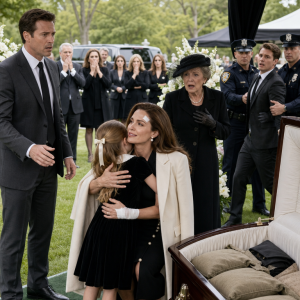
Detective Mercer wanted the ceremony to proceed because Scott still possessed missing evidence. Plainclothes officers quietly joined the mourners.
At the cemetery, Scott performed his grief for everyone to see.
“This is all my fault,” he told our relatives. “If I hadn’t gotten into trouble, Rebecca never would have met those people.”
Several cousins embraced him. I watched without speaking.
As workers prepared the burial site, Scott slipped away toward his truck and removed a black backpack. Officers intercepted him before he returned. Inside were Rebecca’s damaged phone, two SIM cards, copies of the false authorization, and handwritten details about her property.
My mother knew none of this. She remained beside the casket, pressing both hands against its polished surface.
“My sweet girl,” she cried. “I loved you like my own daughter.”