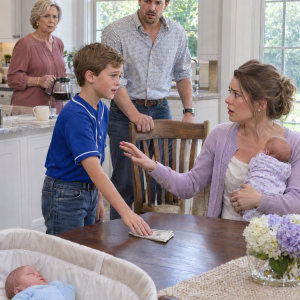
At first, Eleanor’s updates were reassuring. Later, they became less specific. She stopped talking about Owen’s schoolwork and began calling him difficult. She described questions as arguments and curiosity as defiance. When I asked to speak with him alone, she said I was making it harder for her to keep order from thousands of miles away.
There had been warning signs. Once, when Owen was eight, he became overwhelmed at a crowded family gathering and asked to go home. Eleanor made him stay until the evening ended, saying he needed to learn patience. When I spoke to her afterward, she reminded me that Matthew had grown up with firm rules.
During my deployment, a scanned drawing arrived from Owen. He had reinforced the bridge’s supports and written a note beneath it: The first one leaned when I pushed the corner. Maybe the weight needs more places to rest.
I saved the picture and told him how proud I was.
A week before the emergency call that sent me home, we spoke over a glitching video connection. Owen looked pale and kept glancing away from the screen.
“Mom, I sent you a picture of an invoice,” he said. “How can one machine be working at two places at the same time?”
Before I could ask what he meant, Eleanor’s hand reached into the frame and closed the laptop.
The call ended. Two days later, my commanding officer told me Owen had been taken to the hospital. The message gave me no more information than that he was in serious condition and that his caregivers had waited before calling for help.
Facts, Not Fear

After Owen’s warning in the ICU, the hospital’s child protection liaison, Miriam Pike, met me in a small consultation room. She listened while I repeated his words, then helped me focus on what could be done immediately.
“I want Eleanor and her brothers removed from his visitor list,” I said. “I don’t want them near his room.”
“We can secure his visitor list and notify hospital security,” Miriam replied. “Let us handle the access rules, so you can stay focused on being his mother.”
She also told me not to question Owen about the incident. A trained interviewer could speak with him when he was medically ready, but asking him to repeat painful details for my benefit could make his recovery harder.
I wanted answers. I also understood that my need to know could not come before his need to feel safe.
Back in the ICU, I opened a notebook Miriam had given me and wrote on the first page: What I know. What I need to verify. It was a small thing, but it gave my thoughts somewhere to go besides in circles.
Dr. Sutter confirmed that the family’s account of a storage rack could not explain every part of Owen’s injuries. She also pointed out that he had been left without close adult supervision near operating equipment.
“The reported explanation doesn’t match all the medical evidence,” she said. “And the delay in getting him help needs to be examined.”
I wrote down her words, then checked the timeline with the information I had. According to the initial report, Owen had been hurt at four-thirty. The emergency call had not been placed until five-forty-five.
Detective Mercer called that afternoon. I put him on speaker so Miriam could hear the conversation.
“Captain Carver, I’m trying to keep this from turning into a circus,” he said. “You’re taking a workplace accident and making it sound like a plot.”
“Your report says the incident happened at four-thirty,” I answered. “The dispatch record shows the call came in at five-forty-five. Why was there a seventy-five-minute delay?”
He paused, then told me I was making accusations I might regret.
“I’m documenting a timeline,” I said, and ended the call.
I wrote down his exact words, though my hands were unsteady by the time I finished.
Later, Owen woke long enough for the nurse to give him a few ice chips. His eyes moved toward the notebook on my lap.
“Are you keeping notes about me?” he asked.
“No, sweetheart. I’m writing down what the adults say and what the records show.”
He looked toward the ceiling. For a moment, I thought he had drifted off again, but then he spoke.
“Grandma said I make everything harder. She said I was a problem they had to handle.”
I placed both hands on the mattress where he could see them.
“You are a child, Owen. The grown-ups are responsible for what they choose to do. None of this is your fault.”
His eyes closed, and his breathing eased a little. I stayed beside him until the nurse asked me to rest, though I did not sleep much that night.
I kept thinking about the invoice. Owen had always been good with numbers, and he had been around the company’s paperwork because Eleanor liked to bring him to the yard. Maybe he had seen an inconsistency. Maybe it had nothing to do with the incident. I wrote those possibilities down rather than choosing one because I was afraid.
The next morning, a state investigator named Rachel Dunn arrived. She read my notes without interrupting, then asked me to separate what I had witnessed from what I suspected.
“We need to prove who was in charge during that delay,” she said. “And we need to follow the records wherever they lead.”
I bristled at the reminder, but she was right. I had to trust the evidence enough to let it speak for itself.
The Numbers Behind The Story
Rachel’s investigation began with the company’s work records. Voss Site Services held several municipal contracts, and its equipment moved between road repairs, utility projects, and private construction sites. The company’s invoices suggested that certain machines had been working on public projects at the same times they appeared in records from private jobs.
Rachel explained that if Owen had noticed a mismatch in those records, the question was not simply whether his uncles had been careless with paperwork. The records could point to years of improper billing.
While she worked, Arthur’s public relations adviser began speaking to local reporters. The story he offered was that I was an exhausted soldier who had returned home and turned a tragic accident into a dispute with her late husband’s family. I had no desire to answer through the press. My attention stayed on Owen.
Several days later, Eleanor tried to enter the ICU.
I was beside Owen while a physical therapist helped him move his uninjured arm when raised voices sounded outside the secure entrance. I stepped into the hallway and saw Eleanor arguing with a nurse and trying to pass the security desk.
“I helped raise that boy while his mother was away,” she said. “I have every right to see him.”