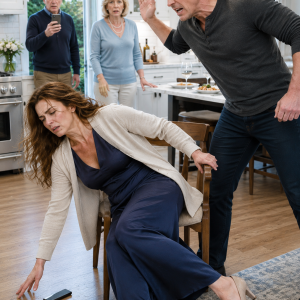
Then a letter arrived stating that payment for June’s residence had been canceled by the guarantor. The notice gave Clara ten days to make other arrangements.
Clara wept, not for the marriage, but because her mother had already lost so much of the world and now stood to lose the one room she still recognized.
Clara began sorting through old papers in search of assistance forms. At the bottom of a canvas hospital bag, she found the sealed pocket she had not opened since the night at the lodge. Inside were the folded menu and the small specimen tube.
She read her own emergency notes: time, pulse, medication, documented type.
Then she compared the entry with the paternity report.
The types did not match.
Clara checked again. The laboratory had accurately tested its sample, but that sample had not come from Adrian.
The next morning, she asked Miles to meet her at a roadside diner halfway between Richmond and Charlottesville. She placed the emergency notes, a photograph of the old specimen label, and the paternity report between them.
“That test did not use my husband’s sample.”
Miles had spent twelve years as an Army medic before joining the Blackwoods. He saw the discrepancy immediately.
“The physician who collected it resigned three days after the report was delivered,” he said. “His office was cleared out overnight.”
“Do you believe me now?”
Miles met her eyes. “Facts don’t become true when powerful people approve them. They were true before we walked into this diner.”
That evening, Miles drove to the mountain lodge and searched an old backup recorder that had been disconnected during a security upgrade. The files were incomplete, but one camera had captured the dining room.
Adrian watched the recovered footage alone. Clara climbed onto the table beside him, directed the frozen men around her, and worked for nearly an hour to keep him breathing. The video also showed someone place water beside her and Graham enter after two in the morning.
Adrian replayed the recording three times.
On the third viewing, he lowered himself into a chair and covered his face with his ungloved hands.
Then he asked Miles for Clara’s address.
The Evidence No One Could Replace

Rain was falling when Clara returned from work and found Adrian waiting beside the garage apartment. He looked out of place beneath the weak porch light, soaked through, without a driver or umbrella.
“If you brought another agreement, I won’t sign it,” she said.
“I saw the recording.”
Clara climbed the exterior stairs. Adrian followed, but he stopped at the open doorway. From there, he could see almost everything she owned: a single bed, a secondhand table, two mugs, a portable burner, and three clean uniforms hanging from hooks.
“You kept me alive for hours,” he said. “You lost part of that night, and then I let a piece of paper erase your word.”
Clara folded her wet coat over a chair. “I didn’t need an apartment or groceries. I needed you to believe me before a camera gave you permission.”
Adrian lowered his gaze. “You’re right.”
“I’m not here to ask you to forgive me,” he continued. “I’m asking whether you’ll allow an independent test, under conditions you control.”
Clara agreed on the condition that she select the laboratory, observe the collection, label the sample herself, and remain with it until it was registered.
Four days later, they opened the report together in a quiet hospital corridor. The probability of Adrian’s paternity was 99.99 percent.
He did not smile. He leaned against the wall and read the number again.
“What did they make me believe all these years?” he whispered.
The answer began with Dr. Howard Bell, who had signed Adrian’s first report thirteen years earlier. Miles found him living alone near Roanoke.
He produced the original evaluation, which showed that Adrian’s old injuries had not affected his ability to become a father.
“Who paid you to change it?” Adrian asked.
Dr. Bell’s hands shook. “Your uncle arranged the money, but your grandmother gave the approval. They told me it was for your protection. Your brother had been targeted because of the company. They said that if you believed you could never have a family, no future child could be used against you.”
Adrian turned toward the window, but Clara saw his shoulders tighten.
“You took thirteen years of my life and called it protection.”
“I used that word because it helped me live with myself,” the doctor admitted.
Evelyn asked to see Clara alone the following day. In the morning room at Hawthorne House, the older woman placed a cedar box on the table. Inside was another copy of Adrian’s original report.
“I knew,” Evelyn admitted. “After we lost his brother, fear became the only counsel I trusted. Graham said Adrian would be safer if he never had a wife he loved or a child he could lose. I told myself a lonely life was better than a shortened one.”
“You didn’t protect him,” she said. “You taught him that love was a weakness and that evidence mattered more than character.”
Evelyn accepted the words without defense. Then she removed a second folder from the box.
It contained freight routes, altered inspection numbers, shell companies, and hidden payments. Graham had used Blackwood vehicles to move undeclared goods through several states. Years earlier, Evelyn had asked an outside safety inspector to gather proof.
That inspector was Clara’s father.
Thomas had discovered falsified brake-service records. Shortly before meeting federal investigators, his truck suffered a catastrophic failure on a mountain descent. Graham then created false loans in Thomas’s name so Clara would be too burdened to examine the records.