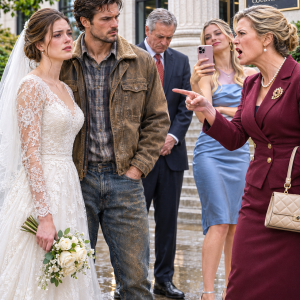
“Say that again.”
“What?”
“Speak about her that way again.”
My mother touched Colin’s arm. “Don’t.”
Brooke crossed her arms.
“You have no idea what it’s been like here. Nora has been difficult for years. She refuses to participate, won’t dress properly for events, and embarrasses Mom in front of guests.”
“Because I wouldn’t wear your clothes,” Nora said from the doorway.
She stepped into the hall, standing upright now.
“You told people I was unstable because I didn’t want to attend dinners where you introduced me as Andrew’s charity case. You told the gardener I came from nothing and didn’t know how to behave in a proper home.”
Brooke’s jaw tightened.
“People talk. Maybe you shouldn’t listen at doors.”
Nora gave a tired laugh.
“I was cleaning behind the doors.”
For once, no one had a quick answer. My mother tried to explain that they had acted to protect my reputation because my business was growing and Nora was lonely and overwhelmed. She said Nora had misplaced documents and frightened staff with her moods.
Nora looked at her steadily.
“I was lonely. I was overwhelmed. And when enough people tell you that you’re confused, you start checking everything twice. But I was not lying.”
I took her hand.
“She owes you nothing.”
For a flicker, my mother looked afraid—not hurt, not guilty, but afraid. Nora had been right. There was more.
I called my attorney, Martin Cole, a careful man who had worked with me since my second restaurant opened. I asked him to come the next morning with every power of attorney, property authorization, trust document, wire approval, and household payroll record connected to my family or home over the previous five years.
My mother’s expression changed as she listened.
Then I told my family I was taking Nora to a hotel.
“You own this mansion,” Brooke said.
“I thought I did.”
We packed one suitcase and left the rest. The dining room had been cleaned, but the chandeliers still shone over the empty table as if someone had arranged the room for a photograph. Outside, the air felt cool after the heat of the kitchen.
As the car pulled away, Nora sat beside me with her hands folded in her lap.
“I dreamed of this,” she whispered.
“Of me coming home?”
She nodded.
“In the dream, I always knew what to say.”
I reached across the seat. This time, she turned her palm upward.
“I don’t know what to say either.”
At the hotel, we took a quiet suite overlooking the city. Nora stood by the window, still wearing the plain dress and cardigan she had worn while washing dishes.
I offered to call a doctor about her hands. She looked at me.
“Andrew, I’m not fragile.”
“I know.”
“No,” she said gently. “You don’t. Not yet.”
We talked for hours. She told me that my mother had instructed the staff not to take orders from her without Lorraine’s approval. Brooke borrowed Nora’s jewelry and returned pieces damaged, then claimed Nora was forgetful. Colin held parties and told guests Nora preferred to stay out of sight. My calls often came when Nora was “resting” or “out,” and the letters she sent were returned or disappeared.
“How did you stay?” I asked.
“At first, I thought you’d come home and it would end. Then I didn’t want your mother to say I had abandoned the marriage. After that, I started looking for proof.”
She had been collecting records for two years while I signed business deals and gave interviews.
“I should have known.”
“Yes,” she said.
There was no cruelty in the answer, only exhaustion.
I apologized, but she didn’t rush to comfort me. I was grateful she didn’t. Our marriage couldn’t begin again with her making my guilt easier to bear.
Before dawn, she fell asleep on the sofa. I reviewed the records she had saved: transfers routed through consulting firms, household expenses inflated beyond reason, vehicles listed as security upgrades, and payroll entries for staff I had never met. Some emails seemed to come from my account, authorizing my mother to make decisions about Nora’s “condition” and telling staff not to trouble me with household issues. I knew I hadn’t written them, but they sounded close enough to my voice to fool someone who didn’t know me well.
The Records They Tried to Hide
Martin arrived at the hotel the next morning, carrying a folder. He looked at Nora with quiet concern.
“Mrs. Calloway, I’m glad you’re safe.”
The name was a detail I had forgotten to change in my head; the marriage certificate and the life we had built were still ours. Nora’s expression shifted at his words.
I asked Martin whether he had known what was happening. He removed his glasses and cleaned them with a cloth.
“I suspected.”
I stood slowly.
“You suspected my wife was being mistreated in my house and didn’t tell me?”
Martin explained that Nora had visited his office two years earlier with irregular household records and questions about certain authorizations. Some documents carried what appeared to be my digital approval. My mother had also supplied letters from a private doctor claiming Nora was confused and anxious.
Nora turned toward him.
“I never saw that doctor.”
Martin looked troubled. He said he had tried to contact me, but his emails bounced, calls were redirected through my family office, and an authenticated instruction limited his communication about domestic matters to my mother.
“My security protocol required two-step confirmation,” I said. “That couldn’t have been done without my approval.”
Martin paused.
“It was completed. Difficult doesn’t mean impossible.”
I thought of the temporary phones I used overseas, the shared devices, the times Colin borrowed my tablet, and the occasions my mother asked for tax forms or family photographs. Trust had made every door easier to open.
Then Martin showed us a property transfer request for our original restaurant. Hawthorne was listed as the buyer. The closing was scheduled in ten days.
The restaurant was the narrow brick building where Nora and I had worked eighteen-hour days, where she painted the bathroom because we couldn’t afford contractors, where we first imagined we might build a life together. The sale had not been about a celebration for my return. My family may have believed the restaurant was about to be transferred before I learned what was happening.
“Can they sell it?” I asked.
“Not without your signature—or what appears to be your signature.”
Nora covered her mouth. I looked at the documents and understood that the old restaurant was more than property to us, and perhaps more than property to Hawthorne.
Martin said he had received an early-morning request from my family office to move files from the house archive into off-site storage.
“The office near the library,” Nora said. “That’s where your father’s old desk is. My mother-in-law keeps a locked cabinet there. I saw her and Brooke going through papers last week. Brooke said something about making sure Andrew never saw the original.”
I turned to Martin.
“We’re going back.”
Nora placed a hand on my arm.
“Carefully. Together. Not as a man storming into his house. We go in as people they underestimate.”
I looked at her, and for the first time since I had returned, I saw not only what had been done to her but what she had done to survive it.
“You have a plan.”
A faint smile appeared.
“I have two years of practice.”
By noon, we returned to the mansion with Martin and two private auditors. My family hadn’t been warned. The house was quiet, the dining room spotless. My mother appeared near the staircase, dressed in a cream blouse and pearls.
“You should have called.”
“I’m done calling ahead.”
Martin greeted her. She didn’t seem pleased to see him. Brooke came out of the library, phone in hand. Colin followed, restless and unshaven.
I told them we were reviewing the household records.
“We have nothing to hide,” my mother said.
Nora walked toward the library.
“Good. Then you won’t mind opening the locked cabinet.”
My mother’s eyes flicked toward her. Just a moment, but everyone noticed.
Inside the library, the old wooden cabinet was built into the wall behind my father’s desk. Martin noticed the smell of shredded paper before anyone spoke. My mother said the cabinet held private family documents. Nora answered that she was family too.
I asked Lorraine to open it. After a long pause, she took a tiny key from her bracelet.
Inside were folders, binders, a small fireproof box, and several envelopes tied with string. Nora reached for the envelopes, but my mother caught her wrist.
“Don’t.”
Nora looked down at her hand.
“Let go.”
Her voice was quiet, and my mother released her.
The first envelope carried my father’s handwriting. He had called me “Andy” as a boy, and seeing that name on the paper made my fingers tighten. The letter was dated three months before he had passed away. It spoke of a loan he had taken years earlier to settle a debt connected to my mother’s brother, of a deed temporarily placed in someone else’s name, and of properties he meant to protect for me and the woman I chose to build a life with.
One line held me still:
Do not allow Hawthorne near the first restaurant. They have already tried to reach it through family, and they will try again.
Martin read over my shoulder, his expression becoming grave.
“This predates the current sale.”
My mother closed her eyes.
Nora picked up a second envelope. It was addressed to her, though my father had passed away before I met her.
“That’s impossible,” I whispered.
My mother stepped forward.
“Nora, give that to me.”
Nora didn’t move. Martin told her to open it. With trembling fingers, she broke the seal. A photograph slipped out first. It showed my father standing in front of the restaurant years before I bought it. Beside him was a dark-haired woman with Nora’s eyes, holding a small child against her hip.
Nora turned the photograph over. On the back were six words:
For Nora, when she finally comes home.
A Name in My Father’s Letter

For several seconds, no one spoke. Dust floated through a stripe of sunlight near the window, and the old clock in the hall ticked steadily.
“Who is she?” I asked.
Nora stared at the woman in the photograph as though the rest of the room had disappeared.
“I don’t know.”
My mother’s voice had lost its polished ease.
“I knew your name was on an envelope.”