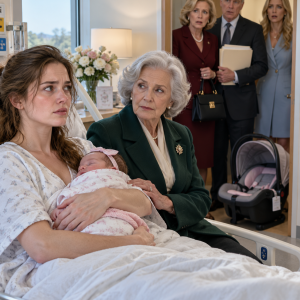
Not the way she cried during dinner when she wanted sympathy.
This was different.
Quiet.
Uncomfortable.
Real.
“I was so focused on protecting Grant,” she whispered. “I didn’t realize I was hurting you.”
I closed my eyes.
Because that was the sentence I had waited years to hear.
But hearing it did not erase everything that came before.
“Mom, understanding why someone hurts you doesn’t mean you have to let them keep hurting you.”
There was silence.
Then she answered.
“I know.”
For once, she actually did.

The Brother Who Lost Everything
Grant was the hardest person to face.
Because unlike my parents, he had always known exactly what he was doing.
He had been the favorite.
The protected one.
The person everyone rescued before he even admitted he needed saving.
Six months after Christmas, he lost his business.
Not because I refused to help.
Because the truth had finally reached the people who could no longer ignore it.
He moved into a small apartment across town and started working again.
No title.
No office.
No family money.
Just himself.
One afternoon, he asked to meet me.
I chose a coffee shop halfway between our homes.
Neutral ground.
A place where neither of us could pretend the past belonged to someone else.
He looked different.
Less confident.
More human.
“I used to think you were judging me,” he said.
I stirred my coffee.
“I wasn’t.”
He looked surprised.
“Then what were you doing?”
I thought about it.
“Waiting for you to become someone I could trust.”
He looked down.
That hurt him more than anger would have.
“I was jealous of you,” he admitted.
I said nothing.
“Everyone thought I had everything together. But you were the one who actually knew how to build something.”
For years, Grant had treated my patience like weakness.
He finally understood it had been strength.
“I’m sorry,” he said.
Two words.
Simple.
Heavy.
I accepted them.
But acceptance was not the same as forgetting.
“I hope you mean it,” I replied.
He nodded.
“I do.”
That was enough for that day.
Not forgiveness.
Not family.
Just the beginning of honesty.
The First Christmas After Everything
The following December, my parents asked if they could see us.
I did not say yes immediately.
I had learned that forgiveness without change was just permission for people to repeat themselves.
So I gave them conditions.
No pretending.
No rewriting history.
No expecting Nora to act like nothing happened.
My mother agreed.
My father agreed.
Grant did too.
We met at my house by the ocean.
Not their farmhouse.
Not a place where old roles could return.
Mine.
Nora helped decorate the tree.
She was nine now.
Still gentle.
Still creative.
But no longer the little girl who apologized for existing.
When my family arrived, my mother brought a small box.
Inside was the painting Nora had made years earlier.
The one Grant had criticized.
My mother had kept it.
I stared at her.
“I thought you threw it away.”
She shook her head.
“I almost did.”
Her honesty surprised me.
“Then I realized the problem was never the painting.”
She looked toward Nora.
“The problem was that I forgot the person who made it mattered more than how impressive it was.”
Nora walked over slowly.
She looked at the painting.
Then at my mother.
“Do you like it now?”
My mother knelt beside her.
“I loved it then. I just didn’t know how to show love the way you deserved.”
Nora thought about that.
Children have a way of seeing truth without needing complicated explanations.
Then she smiled.
“Okay.”
One word.
But it meant everything.
What Was Finally Built
A year later, my father sold the old farmhouse.
Not because he had to.
Because he wanted a smaller life.
A quieter one.
A life where he could no longer hide behind tradition and appearances.
My mother started volunteering at a local community center.
Grant continued working.
Slowly.
Honestly.
He never became the person everyone once imagined he was.
Something better happened.
He became someone real.
Our family did not return to what it was before.
That would have been impossible.
Instead, we built something new.
Something smaller.
Something more honest.
There were still awkward moments.
Still conversations that needed patience.
Still reminders that trust was not rebuilt in a single apology.
But there was effort.
And effort, I learned, was where real change began.
One evening, Nora and I sat outside watching the sunset over the water.
She rested her head against my shoulder.
“Mom?”
“Yes?”
“Do you think families can break and still become families again?”
I watched the waves move toward the shore.
I thought about Christmas night.
The empty space at that table.
The moment I realized I had spent years begging people to value me.
Then I thought about this house.
This life.
This child who had taught me what love was supposed to feel like.
“I think some families have to break before people finally decide what they want to rebuild.”
Nora smiled.
“I think ours is better now.”
I looked at her.
At the girl who had once wondered if she ruined Christmas.
At the daughter who showed me that leaving could sometimes be the beginning of finding yourself.
And I knew she was right.
Because family was never measured by the people who shared your last name.
It was measured by the people who made sure you never had to earn your place at the table.