“You do not want me back,” I said. “You want the respectable image you lost.”
Trevor looked toward the house.
When my father stepped outside, Trevor lowered himself to his knees.
“Mr. Whitaker, please forgive me. I should never have spoken to you that way.”
My father asked him to stand.
“Do not kneel before me. Kneeling is easy when you are frightened. Standing up and accepting responsibility is much harder.”
Trevor wiped his face.
My father continued.
“I mow lawns, plant trees, and clean up other people’s yards. None of those things make me less of a man. Real poverty begins when someone believes money gives him permission to look down on others.”
“Can you forgive me?” Trevor asked.
“I forgive you because I do not want bitterness living in my home. But forgiveness does not mean I will help you avoid the consequences of your choices.”
Trevor left a few minutes later.
It was the last private conversation I ever had with him.
A Love Built Without Pressure
Over the following months, the investigation continued. Some of the recovered funds were used to pay subcontractors and workers who had been underpaid.
My father received compensation for several projects.
He used part of it to repair his truck and placed the rest in savings.
Callum continued visiting us, but he never repeated his emotional statement from the wedding hall.
He helped my father repair equipment, joined him for coffee, and listened to his stories. With me, he was patient and thoughtful.
He did not ask me to make quick decisions.
He asked whether I was sleeping well. He wanted to know what frightened me and what kind of future I hoped to build.
I learned that he had grown up in a family of public school teachers near Missoula, Montana. He had joined the military because he believed service should mean protecting people who might never be able to repay you.
One afternoon, he gave my father a framed copy of the hospital receipt he had carried for fourteen years.
“I used to think this paper represented a debt,” Callum said. “Now I understand that it represents the kind of man I hope to become.”
My father embraced him without speaking.
My relationship with Callum grew slowly.
We walked beside the Spokane River, ate lunch in small family restaurants, and talked for hours.
I admitted that I worried his feelings had grown from gratitude rather than love.
He listened carefully before answering.
“Your father saved my life, Brynn. But I began loving you when I saw you choose his dignity over your own wedding. I am not trying to repay a debt. I am asking whether we might build something honest together.”
Six months later, he asked me to marry him again.
This time, there were no officers, guests, microphones, or public promises.
We were standing in my father’s backyard while Amos watered a row of newly planted roses.
Callum held out a simple ring.
“Brynn, I am not asking because of what happened at the wedding. I am asking because I have come to know your courage, your kindness, and your heart. Will you share your life with me?”
I looked at my father. He was pretending not to listen, but tears were already running down his face.
“Yes,” I answered.
The Wedding We Truly Deserved
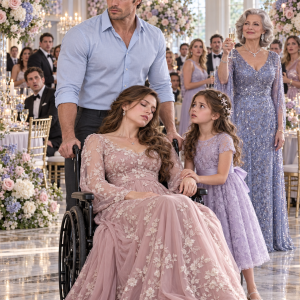
We married three months later in the same community hall where Trevor had tried to shame us.
I did not want to erase that place from my story. I wanted to give it a different ending.
The neighbors decorated it again. Mrs. Hensley baked another cake. Workers who had finally received their missing pay attended with their families.
Callum arrived without a military convoy. He came with his parents, his sister, and a few close friends.
My father wore the same charcoal suit.
This time, he walked upright.
Before leading me toward the ceremony, he squeezed my hand.
“For years, I thought my job was to earn enough money so no one would look down on you,” he said. “Now I understand that my real job was teaching you never to accept disrespect from anyone.”
“You taught me that every day of my life, Dad.”
When we reached Callum, he did not immediately take my hand.
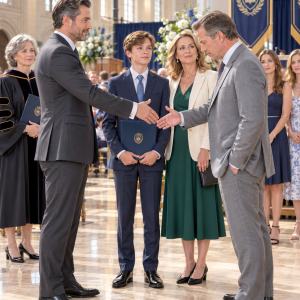
He first shook my father’s hand.
“Thank you for trusting me with someone so precious.”
My father smiled.
“I am not losing a daughter. I am gaining the son I never expected.”
During the reception, Callum told everyone about the landscaper who had stopped on a frozen road to help a stranger.
He did not focus on money or recognition. He spoke about choosing kindness when no one was watching.
The entire room rose to applaud my father.
Amos covered his face, overwhelmed by the attention.
That was when I fully understood his greatest gift to me.
It had never been the money in the metal box.
It was the example he had lived every day.
Trevor once believed my father was poor because he worked with soil beneath his fingernails. But true poverty had nothing to do with an old truck, a small home, or worn work boots.
True poverty was having every advantage and still possessing no gratitude, humility, or respect.
My father had spent his life planting gardens for other people.
Without realizing it, he had also planted loyalty, kindness, courage, and dignity in everyone who knew him.
And on the day one man tried to shame him for working with the earth, the entire room finally saw how much goodness he had quietly helped grow.
Never feel ashamed of the honest work that feeds a family, because dignity is not measured by the cleanliness of someone’s hands but by the honesty of the choices those hands have made.
A person who truly loves you will never ask you to hide your parents, your childhood, or the sacrifices that helped shape you into the person you are today.
Wealth may create comfort and influence, but it can never purchase the character that is built through humility, loyalty, responsibility, and compassion for others.
When someone humiliates you in public, remember that their cruelty reveals far more about the emptiness inside them than it ever reveals about your value.
Good deeds do not always return immediately, but kindness has a remarkable way of remaining alive in the memories of people whose lives were changed by it.
Forgiveness can free your heart from bitterness, yet forgiving someone does not require you to protect them from the fair consequences of their own decisions.
The strongest love is not the love that arrives with dramatic promises, but the love that stays patient, listens carefully, and proves itself through consistent respect.
Parents may not always leave behind great wealth, property, or important connections, but a life of integrity can become an inheritance more valuable than anything money could provide.
Never confuse social status with human worth, because some of the most honorable people live quietly while those who appear powerful may be hiding the weakest character.
The roots you were once taught to hide may eventually become the very reason you stand strong when appearances collapse and the truth finally comes into the light.