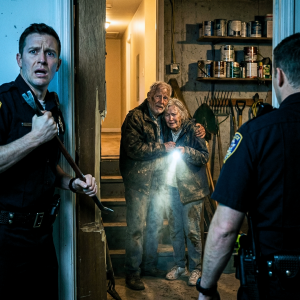
Then—a gasp.
A young woman sprinted toward us, “MINA!” The raw relief in her voice sent shivers down my spine. She collapsed in front of Silas, hands trembling as she reached for the kitten. “I’ve been posting flyers for days,” she choked out, pressing Mina against her cheek. The kitten purred, licking away her tears.
Her name was Anya, and she explained, voice breaking, that Mina was her last tie to her mother. “Mom found her in a parking lot the year before she died. Said Mina was her little guardian angel.” After an eviction, she had no choice but to leave Mina behind in hopes someone kind would find her. The hastily scribbled note had been an act of desperation.
Anya tried to press money into Silas’s hands. He stepped back. “I didn’t do it for money,” he said softly. For the first time, she really looked at him—not just his worn coat and broken shoes, but the quiet kindness in his eyes.
Over terrible gas station coffee (Anya insisted), their conversation took an unexpected turn. Silas mentioned he had been a volunteer firefighter in his twenties. Anya’s face lit up. “The shelter where I shower—they need someone to fix their plumbing. It pays $18 an hour.”

Here’s what the napkin didn’t say: Anya’s mother had founded Hope’s Corner, a local daytime shelter. When Silas showed up the next morning, tools borrowed from the janitor’s closet, the director greeted him warmly. “Lena’s daughter said you’d come.” She handed him a key.
That plumbing job turned into a part-time position. That job led to a tiny studio above the shelter. And Anya—grieving but determined—secured a grant for “Lena’s Fund,” a program that paired homeless animal fosters with shelter residents. Silas became the first official caretaker, a role that came with vet benefits and, more importantly, a sense of belonging.
Last I heard, Mina—now a well-fed, glossy-coated diva—divided her time between Anya’s apartment and Silas’s office, where she slept on a donated armchair known as “The Throne.” The napkin that started it all? Framed above it, a reminder of how one act of kindness can change everything.
We’re taught that help comes from charities, from systems, from institutions. But sometimes, salvation wears a threadbare coat and carries a kitten in its pocket. Sometimes, the one who needs saving the most is the one doing the rescuing.
So the next time you see someone the world calls “invisible,” remember Silas and Mina. Remember that the most powerful forces aren’t money or status, but the willingness to share your last sandwich, to leave a note with shaking hands, to say “I see you” without speaking a word.