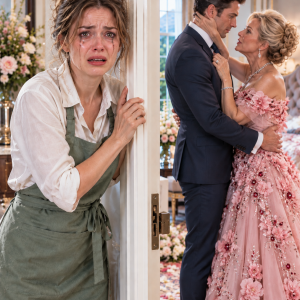
“We’re leaving.”
“I’m only suggesting caution. People can manufacture documents, rehearse stories, and borrow whatever details they need when enough money is involved.”
Graham brought his cane down against the floor with a sharp crack.
“You will not speak about that child as if she were part of a scheme.”
“I’m trying to protect you, Uncle Graham.”
“I do not need protection from my granddaughter.”
The word settled over the room. Lily looked up from the horse she had been drawing, while Nolan’s face tightened for only a second before his practiced smile returned.
Within two days, the records confirmed the marriage, Lily’s parentage, and Evan’s legal change from Whitmore to Bennett, his maternal grandmother’s surname. The kinship result would take longer, but Claire possessed another kind of evidence: Evan’s work.
After he was gone, she had stored more than sixty drawings, layered-paper portraits, and small watercolor studies in the climate-controlled back room of a frame shop owned by their friend Rebecca Shaw. Graham asked to see them, and Claire agreed only after Daniel prepared a written assurance that no piece could be removed, photographed for commercial use, or offered for sale without her permission.
When Rebecca unlocked the storage room, Graham entered as a businessman assessing an asset, but within minutes he became only a father looking at the years he had missed. There were studies of bus stations in summer rain, nursing assistants before dawn, elderly couples sharing pie in roadside diners, and children asleep against their mothers on late-night trains. There were also dozens of tender portraits of Claire and Lily.
At the back stood a large charcoal composition of Graham’s study, drawn entirely from memory. Graham appeared at his desk, facing shelves filled with awards, while behind him an open doorway framed the outline of a young man carrying a portfolio.
“Evan called it The Man Who Never Turned Around,” Claire said.
Graham lowered himself onto a crate and remained there for a long time.
Rebecca later invited a respected museum curator, Helen Marlowe, to examine the collection. Helen explained that Evan’s work was not merely sentimental or promising; it had a mature visual language, a rare tenderness toward ordinary labor, and the coherence required for a serious exhibition.
That evening, after Claire and Lily had left, Nolan appeared outside the frame shop and offered to purchase everything at once.
“Claire needs money,” he told Rebecca. “Those pieces are taking up space, and sentiment does not pay rent.”
“They are not for sale.”
Nolan stepped closer.
“Everything becomes negotiable when the bills have been waiting long enough.”
Rebecca quietly started recording on her phone, and Daniel, who had returned for a forgotten folder, heard enough of the conversation to document it. Less than an hour later, Claire received an anonymous message warning that fragile things sometimes vanished in storage rooms.
The next morning, Daniel called everyone to Graham’s study. The laboratory report showed an overwhelming probability that Graham was Lily’s biological grandfather.
Lily studied the paper as if the numbers might turn into a picture.
“So you really are my grandpa?” she asked.
Graham came toward her, then stopped at a respectful distance.
“Yes, sweetheart, if you are willing to call me that someday.”
Lily considered him gravely.
“Then you can’t be rude to my mom anymore.”
For the first time, Claire saw Graham smile without pride or performance.
“That is a fair rule,” he said. “I promise.”
The Letter in the Locked Room

Proof settled the question of kinship, but it did nothing to soften thirteen years of silence. That evening Graham unlocked Evan’s childhood bedroom, which had remained almost untouched since the night his son left. Dust lay over shelves of schoolbooks, dried brushes stood in a coffee mug, and a faded denim jacket still hung behind the door as though its owner might return after supper.
In the lowest drawer of an old drafting table, Graham found an unstamped envelope addressed in Evan’s handwriting. He read half the letter before sending Mrs. Aldridge to ask Claire to come upstairs.
Claire entered fearing that something had happened to Lily, but Graham merely held out the pages.
Evan had written that he did not leave because he hated his home, but because remaining there required him to purchase his father’s approval by surrendering the person he actually was. Graham had wanted a successor who understood occupancy rates, acquisitions, and balance sheets; Evan had wanted to draw the people who were usually overlooked. His mother, Margaret, had once begged Graham to look at their son’s work without laughing at it, yet he never had.
The final paragraph read, “If I ever come back to your door, I hope you can open it for your son, not for the replacement executive you keep trying to build out of me.”
Claire finished reading and pressed the page against her chest.
“Did his mother know where he was?”
Graham shook his head. Margaret’s health had declined after Evan left, and she had repeatedly asked him to search, but Graham insisted that their son had chosen distance and that pursuing him would reward disobedience. Margaret passed away three years later without seeing Evan again.
“He spoke about her as if he had lost her when he was young,” Claire said. “He never knew she had been waiting.”
“Because I never called him.”
Claire felt compassion rise in her, but not enough to disguise the truth.
“Then you did not lose your son ten months ago. You chose to lose him thirteen years ago.”
Graham covered his eyes, and when he answered, there was no defense left in him.
“Yes.”
He gave the letter to Claire, asking only that Lily receive it when she was old enough to understand. Then he asked permission to fund an exhibition of Evan’s work.
Claire refused at first.
“I will not turn my husband’s absence into an evening where wealthy guests drink champagne and congratulate you for feeling sorry.”
Helen, the curator, answered gently.
“Then the exhibition should not be about Graham. It should be about Evan.”
The agreement they eventually designed was precise. Every piece would remain the property of Claire and Lily. Nothing would be sold without Claire’s written approval. The artist would be credited as Evan Bennett, the name under which he had created his adult life, and a portion of future admission proceeds would support working-class young artists who could not afford materials or studio space.
Graham signed without changing a line.
“He gave up my name to become free,” he said. “I will not take that freedom away now.”
Nolan answered with a campaign of insinuation. A gossip website published a story describing Claire as a domestic worker who had entered a grieving businessman’s home and emerged with a claim to his estate. It suggested that Evan’s art might be misattributed and that Lily had been coached to resemble a family she had never known.
Claire nearly canceled the exhibition.
“People will look at her as if a seven-year-old planned all this for money.”
“That is exactly why Nolan wants you to hide,” Daniel told her.
Graham then did something none of them expected: he agreed to an interview with a local arts journal and took full responsibility. He described how he had mocked Evan’s ambitions, demanded that he enter the senior-care business, and refused to search for him even when Margaret pleaded. He made no announcement about inheritance and offered no heroic version of reconciliation.