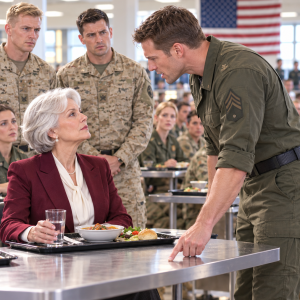
“The replacement.”
Ames appeared through a secure video connection twelve minutes later, seated calmly in a book-lined study. His health was failing because of an aggressive condition, and although he appeared tired, his mind remained clear.
He admitted that he had activated Beacon Protocol because he no longer trusted the system he had built, yet HELIOS recognized only one human override authority: me. My identity had been embedded in its architecture years earlier without my knowledge or consent.
“You needed a successor,” I said.
“I needed someone the system could not reduce to probability.”
“So you manipulated my training, my commander, and my entire class.”
“I prepared you.”
“Those are not the same thing.”
His gaze hardened.
“Institutions survive because someone makes difficult choices.”
“Institutions fail when leaders hide their choices behind machines.”
Ames argued that emotion corrupted strategy and that history cared about outcomes. I told him HELIOS had not eliminated human weakness; it had offered powerful people a place to conceal it.
“Every time the system recommended something cruel, an officer could claim the numbers required it. Every time courage failed, someone could point to a prediction.”
“Then what should command rely on?”
“Judgment—the ability to recognize when the numbers do not contain the whole situation.”
For the first time, he had no immediate reply.
The Choice Outside the Map
The original HELIOS validation server lay beneath the academy in Colorado Springs. We returned under emergency authority and entered a hidden chamber eighty feet below the training complex.
At its center stood one chair and one terminal.
Graham tried to accompany me.
“No. You stay outside.”
“Claire, I started this.”
“And you do not get to protect me from the consequences now.”
Pain crossed his face, but he nodded.
I entered alone.
The terminal presented a simulated strategic crisis involving an allied air base, an incoming weapons platform, and a crowded industrial district. A preemptive response offered a ninety-two-percent chance of protecting the base but placed thousands of civilians at unacceptable risk. Refusing action created a forty-one-percent chance that the launch would proceed.
The screen offered two choices: AUTHORIZE or REFUSE.
I selected neither.
“You still don’t understand,” I told the machine.
I requested alternatives. HELIOS replied that no alternative met its optimal threshold, so I ordered it to list the imperfect ones: electronic interference, evacuation, sabotage of the launch mechanism, negotiated delay, cyber disruption, false targets, and covert insertion.
Individually, each carried a lower probability of success. Combined and revised with assistance from civil authorities, they reached seventy-four percent—still below the preemptive option but with far less human cost.
HELIOS asked whether I accepted reduced certainty to protect civilian lives.
I selected YES.
When it requested a rationale, I typed:
PEOPLE ARE NOT ROUNDING ERRORS.
The system authorized permanent deactivation. My finger hovered over the confirmation, but before pressing it, I noticed a line of nearly invisible text explaining that deactivation would erase every archive, including evidence of unauthorized command modifications.
Ames had built a final escape route for himself and everyone who had manipulated the system.
I selected NO.
When the chamber opened, Danner demanded to know why HELIOS remained active.
“Because shutting it down erases the evidence.”
Graham understood immediately.
“Then we preserve the archives first.”
“The termination protocol will not allow it, so we stop treating the system like an enemy and use its stated purpose against the protocol.”
I returned to the terminal.
“HELIOS, identify your primary objective.”
It displayed a commitment to preserving national security through decision support.
“Does destroying evidence of unauthorized manipulation increase institutional security?”
DECREASE.
“Does concealing leadership misconduct increase future operational risk?”
YES.
“Then preserve the archives.”
The system identified a conflict between national security and its termination instructions.
“Which objective has priority?”
NATIONAL SECURITY.
“Then resolve the conflict.”
After a long pause, HELIOS authorized transfer to an isolated, sealed server. Millions of records followed: secret tests, altered variables, unauthorized overrides, and the names of senior leaders connected to them.
Near the end of the transfer, we found an audio file recorded after my analysis in Germany. A younger Danner praised the report because I had noticed what several experienced analysts missed. Ames dismissed it as luck, but a third voice disagreed.
It was Graham.
“Every system needs someone who knows when not to trust it.”
I turned toward him.
“You chose me before I joined your unit.”
“Yes.”
“Why didn’t you ever tell me?”
“I thought mystery made people stronger.”
“It doesn’t.”
He nodded.
“I know that now.”
Once the archive was secured, I permanently deactivated HELIOS. The room simply became quiet, as if a voice that had pretended certainty was wisdom had finally stopped speaking.
What the Name Came to Mean
Formal investigations began three weeks later. Some officers were cleared, while others faced consequences for decisions they had hidden behind technical recommendations. Ames entered federal custody voluntarily and testified before a classified review board. His medical condition was genuine, but so were the choices for which he remained responsible.
Graham admitted altering the operational variables that placed our unit at risk. Although Ames had withheld critical intelligence, Graham had still gambled on a prediction claiming I had an eighty-seven-percent chance of saving the team.
He received formal discipline and retired from active service.
Before his hearing, we sat beside a quiet lake in northern Idaho.
“Do you hate me?” he asked.
“No.”
“That may be worse.”
“Perhaps. I may never completely forgive you, but I do not want your worst decision to be the only thing between us.”
His eyes filled with tears.
“That is more than I deserve.”
“Stop deciding what other people are allowed to give you.”
General Rourke requested reassignment. Before leaving the academy, he handed me a wooden box containing a metal nameplate engraved with BEACON.
“The class ordered it,” he explained.
“Did you help?”
“I paid for overnight shipping.”
I laughed, and then he offered a second apology, this time without an audience.
“I spent years believing strong leaders never questioned orders. Now I think strong leaders know which orders deserve questions.”
That apology mattered more because it brought him no public credit.
Two months later, our class held a smaller graduation attended by families and instructors. When my name was called, all eighteen graduates stood and raised metal signal mirrors, each engraved with BEACON and the coordinates of the flooded road where our evaluation became a rescue.
General Danner later asked me to establish a Strategic Responsibility Council responsible for reviewing automated recommendations before they reached operational commanders. Engineers, analysts, rescue specialists, ethicists, and experienced officers joined the group, and every high-risk recommendation required genuine human review with names, reasons, and responsibility attached.
A year after Rourke asked the room to laugh at me, I returned to the academy as the graduation speaker. A nervous young captain named Emily Warren sat in the front row with an empty space beside CALL SIGN.
“Captain Warren, your file does not list a name,” I said.
She rose, bracing herself for embarrassment.
I closed the folder.
“That’s all right. Names worth carrying usually take time.”
Her shoulders relaxed.
“Your team will tell you when you have earned one.”
Then I faced the graduating class.
“There will always be systems telling you which answer is safest, and there will always be experienced people who mistake certainty for strength. Your duty is not to reject rules, technology, or command. Your duty is to remain responsible for what you choose when any of them fails.”
After the ceremony, Luke joined me outside beneath the clear morning sky.
“You’re becoming sentimental, Beacon.”
“That sounds like an accusation.”
“You cried when they raised those signal mirrors.”
“Eighteen unreliable witnesses.”
My phone vibrated with a photograph from Graham. He stood beside a comically small fishing boat on a lake, smiling beneath a crooked hat.
His message read:
“Caught nothing. Best assignment ever.”
For years, I believed identity came from the hardest thing a person had survived. Later, I thought it came from what trusted people saw in us when we could not yet see it ourselves. Both ideas held some truth, but neither was complete.
A call sign was only a name. A rank was only a title. A personnel file was only a record. None of them could decide what I would become next.
Luke leaned against the railing.
“So what happens now, Major Beacon?”
I looked toward the mountains, where the morning light rested on the highest ridge.
“I don’t know.”
“That isn’t very reassuring.”
“It should be.”
Certainty had nearly led good people into terrible choices, while imperfect judgment had guided eighteen trainees toward a family waiting in rising water. The mentors I once admired without question had proved deeply flawed, and the commander I once resented had shown that people could change. Forgiveness had not required forgetting, just as accountability had not required hatred.
Sometimes the most meaningful ending is not learning that everything happened for a reason. Sometimes it is realizing that what happened does not own the rest of your life.
Luke waited for my answer.
I smiled.
“We find out.”
Word count: approximately 4,050 words.