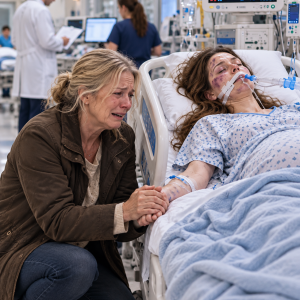
The last page was in Vivian’s handwriting: Brooke notices the pauses too. I need to explain the family history to Everett before the appointment.
A sealed envelope addressed to me, dated three days before Vivian passed, explained that she was investigating a swallowing and breathing condition in her family. She had scheduled Miles’s evaluation and asked Brooke to keep watching him until they could talk.
Please do not let anyone dismiss what you have noticed, Vivian had written to Brooke in a separate note. He needs someone patient beside him.
I called Dr. Hart. She confirmed that Vivian had arranged a consultation months earlier, but the appointment had been canceled by someone who contacted the clinic from our household. The office had been told that the family no longer wanted the visit.
I turned toward Denise. She looked stricken.
“I thought you had asked me to cancel it,” she said. “You told me you couldn’t deal with more appointments after Vivian’s funeral. I thought this was one of the things you wanted taken off the calendar.”
I had meant that I could not manage nonurgent paperwork. She had taken my exhaustion for an instruction. Then, when Brooke asked about the appointment, Denise had told her it was no longer needed.
The next morning, Dr. Hart came to the hospital and reviewed Miles’s records. A controlled feeding assessment showed that he was having difficulty coordinating his swallow. When he drank too quickly or was tired, some liquid moved toward his airway. The specialist explained that his condition appeared mild, but it needed consistent attention, careful positioning, and follow-up tests.
I watched Miles take several small sips while the nurse paced the feed. After the third swallow, his brow tightened and he coughed. Dr. Hart stopped the bottle, adjusted his position, and waited until his breathing settled.
I had heard that cough before, countless times. The difference was that now I was listening.
A Voice From the Old Office

Brooke came to the hospital after I found her through a friend of the family. She did not come back to the house, and she did not offer to return to work. She came because she wanted to know how Miles was doing. That distinction mattered, and I tried to respect it.
When her younger brother was born prematurely, Brooke learned to recognize feeding problems. Their family had once been told he was merely slow to eat, until a specialist identified the coordination problem. She had not tried to diagnose Miles; she recognized a pattern and wanted someone to take it seriously.
“I should have told the doctor myself,” she said, sitting beside Miles’s bed. “I was afraid of overstepping.”
“I made that fear reasonable,” I replied. “I’m sorry.”
She did not tell me it was all right, and I was grateful she did not. An apology could not undo the way I had spoken to her. It could only be the beginning of a different way of listening.
Dr. Hart’s file mentioned Vivian’s half-sister, Eliza, who had similar feeding problems as a toddler. Her breathing episode had been called unexplained, and Vivian had been trying to locate old records.
That afternoon, Warren, our house manager, found a small digital recorder in the family office. It contained several messages Vivian had saved. In the first, she explained that she had arranged the appointment and asked me not to cancel it. Her voice was tired but steady.
“If I’m wrong, we lose a little time,” she said on the recording. “If I’m right, early care could make a real difference. Please listen before you decide I’m worrying over nothing.”
A man’s recorded message told Vivian to stop asking about Eliza. In another, she said the caller was not from her family but knew about the appointment and old records.
Then my phone rang. An unfamiliar man asked whether I had found Vivian’s message. He told me to look at the name on Eliza’s old hospital papers before deciding which side of the family carried the condition. He ended the call without identifying himself.
I wanted to demand every file and find the person who had tried to silence Vivian. But Miles needed a care plan more than a father chasing a voice on a recording.
Dr. Hart trained us to feed Miles slowly, keep him upright, and stop when he tired. Denise agreed to follow the plan and report every concern. Trust would have to return through ordinary choices.
The board called about an overseas deal that would take me away for months. I had told myself it was for Miles’s future, but as he slept beneath a monitor, I saw how often I had used the future to excuse being absent in the present.
I appointed a senior team to handle the negotiations and remained in Connecticut. I did not give up the company; I gave other capable people room to lead it. The decision was difficult, but it was not as difficult as sitting beside my son and admitting that no amount of professional success could replace a father who showed up.
The History Both Families Kept
The old hospital records took weeks to obtain. Meanwhile, Miles continued therapy and learned to manage feeds with fewer pauses. Some days were smooth; other days, one cough quieted the room. We learned not to treat either as a verdict.
Eliza’s archived file showed swallowing difficulties and recurring breathing problems as a toddler. The incomplete final report called her case isolated and had been approved by Oliver Finch, whose son Adrian worked at the medical center that received Miles’s referral.
Dr. Finch told us a hospital administrator had altered some old records to protect the institution from questions about family guidance. He had not canceled Miles’s appointment, but one of his father’s former assistants had told the clinic I withdrew the referral.
The assistant, Janet Moore, had worked for Vivian and had access to the family office. When the hospital traced the call, she admitted that her father, a former administrator, had urged her to stop the evaluation until the old records could be reviewed. He feared that a connection between Eliza’s case and Miles’s symptoms would expose decisions made decades earlier. Janet had been afraid of her father and had made a choice that endangered a child she had never met.
I was furious, but this time I waited before deciding what the truth meant. The hospital opened a formal review, corrected the family records, and offered genetic counseling to relatives who wanted it. Janet gave a statement. Nothing could make the delay acceptable, but the records were no longer hidden, and the next family would have a better chance of getting answers sooner.
Then came the message from Dr. Finch that changed the shape of the story again. The old file contained a second infant case from my father’s side of the family. Before I was born, my parents had lost a baby boy named Peter after months of feeding difficulties. My father had asked the hospital to keep the matter private, and the family had never spoken about him.
I sat with the record in my hands, trying to fit this brother I had never known into the family history I thought I understood. The symptoms were similar to Miles’s. The counselor explained that both family branches might carry related risks, though only testing could clarify what that meant for Miles and for future relatives.
I had thought my father distant and devoted to work. The records showed he had visited Peter every day, then buried the story so deeply that I grew up believing there had never been another child. I could understand his fear without excusing his silence; understanding someone was not the same as defending every choice.
Miles’s tests later confirmed a mild inherited swallowing disorder. His doctors adjusted his feeding plan and recommended therapy. They also told us that many children with his symptoms did well with careful support. We were not promised a quick fix, but at last we had a name for the problem and a practical way to care for him.
Denise stayed with the family, but her role changed. She attended training, followed the feeding plan, and recorded every bottle. Brooke continued her nursing studies and eventually completed her pediatric-care qualification. I offered to pay her tuition, but she accepted only after we agreed that the support would go through a small foundation Vivian had planned, alongside funding for caregiver education and early screening.
Months later, at the foundation’s first family workshop, I watched Brooke show a group of parents how to hold a baby upright during a feed. She spoke gently and clearly, without making anyone feel foolish for what they had not yet learned. I thought of how close I had come to sending her away before hearing the one thing she needed to tell me.
Learning to Hear the Small Things

The company continued without me in every meeting. The people I had hired proved more capable than my habit of control had allowed them to demonstrate. I still worked, but I stopped treating every missed call as an emergency and every family need as something that could be delegated to the nearest employee.
On Miles’s second birthday, our garden filled with relatives, nurses, neighbors, and the people who had helped us through the first uncertain year. We served food prepared according to his feeding plan, and the adults watched him with the tender attention that comes after a family has learned how quickly an ordinary moment can change.
Miles sat on the grass between Denise and Brooke, turning a ribbon over in his hands. When he pushed himself upright, I crouched a few feet away. Brooke held out her arms, but she did not coax him. Denise waited beside her. I did too.
Miles took one small step toward Brooke, wobbled, then steadied himself. He took another and turned toward me. I kept my arms open without rushing him. He crossed the last few feet on his own, laughing when I caught him gently against my chest.
Brooke knelt beside us, smiling through tears. Denise pressed her fingers to her lips. I looked from one woman to the other and thought about the kitchen, the note under the schedule, and all the ordinary signs I had mistaken for noise.
“I used to think protecting someone meant making every decision for them,” I said.
Brooke smiled. “And now?”
“Now I think it starts with noticing, and then listening long enough to understand what you noticed.”
That evening, after the guests had gone, I stood outside Miles’s room beneath a photograph of Vivian holding him when he was only a few days old. Beside the picture was a line from her note: He needs someone patient beside him. I had once read those words as a message meant for Brooke. Over time, I understood they had been meant for all of us.
Brooke came down the hall carrying a stack of folded blankets. Miles was awake in his crib, making soft sounds to himself. I opened the door, and he reached toward me. I lifted him carefully, waited for his breathing to settle, and held him close.
I could not change the afternoon I had sent Brooke away. I could remember it, though, and let the memory teach me what pride had prevented me from learning sooner: a warning may arrive in an unfamiliar voice, from someone with less authority, at a moment when you feel certain you already know what is happening. A family begins to heal when someone is willing to hear it.