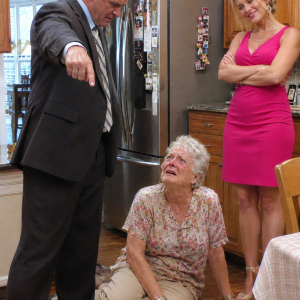
Elise came into the room while Tessa was explaining the final set of transfers. She had changed into a clean sweater and had wrapped both hands around a mug of tea. Her face looked worn, but her eyes were steady.
“She came to my apartment when the babies were three months old,” Elise said. “She stood beside their cribs and told me she could make the courts believe I was unstable. She said no one would listen to a woman with no money against the Mercer family.”
I felt anger rise, but I kept my hands flat on the table.
“You should never have had to carry that alone.”
Elise looked at me without softening.
“You were part of the family she used to frighten me.”
That was true, and I had no defense against it. My mother had made the threat, but I had spent years accepting the version of events that suited my life. It was not enough to tell Elise that I had not known. I had to show her what I would do with what I knew now.
I stood and walked around the table, then stopped a few feet from her chair.
“I’m sorry for every year I let your silence answer questions I never asked,” I said. “And I’m sorry that my name made it harder for you to ask for help.”
Elise’s eyes filled, though she did not look away.
“I need you to understand that this isn’t fixed because you found us.”
“I do,” I said. “So I’ll keep showing up.”
For a while, neither of us spoke. Then Tessa closed the folder and explained that the trust’s board was scheduled to meet the following morning at the annual Mercer Heritage Assembly. My mother planned to present a restructuring proposal that would give her permanent authority over the family’s holdings.
I looked at the documents again, then toward Elise.
“The children should be there,” I said. “If you want to come.”
She considered it before answering.
“I’ll come for them. I won’t be there to make you look like a good father.”
“That’s fair.”
The Assembly

The next morning, the assembly hall at the Lakefront Exchange was filled with company directors, investors, attorneys, and local civic leaders. High windows looked out over Cleveland, and the pale winter sun brightened the polished wood and crystal fixtures without warming the room.
My mother sat at the head of the long table in a dark coat and a string of pearls. Caroline sat beside her, and Philip Rusk had several documents spread in front of him. They looked prepared for the meeting they expected: a formal vote, a smooth presentation, and no serious questions.
The doors opened as Tessa and I entered with Elise and the children. Aaron walked a few steps behind us. June was well enough to attend for a short time, though her doctor had asked us to keep her comfortable and avoid making the day too demanding. She held her stuffed rabbit in one hand while Elise kept the other around her.
My mother’s silver pen slipped from her fingers and rolled across the table.
Caroline rose so quickly that her chair knocked against the wall.
“What is this?” Margaret demanded. “Calvin, you can’t bring children into a formal trust meeting without notice.”
Tessa stepped forward with a certified copy of the trust charter.
“They are beneficiaries named under the original agreement,” she said. “Their identities have been verified, and the board has received the required notice.”
Philip Rusk pushed back his chair.
“This is an improper interruption. The children have no standing until the trust’s administrative review is complete.”
I looked at him across the table.
“The review is complete.”
Tessa laid out the findings: the concealed account transfers, the payments related to Elise’s medical records, and the altered trust documents. She did not raise her voice. She did not need to. Each page had an official seal, and each signature matched the records our forensic accountants had examined.
The legal process had already begun. Federal investigators had obtained warrants based on the financial evidence, and the trust’s assets were frozen pending review. A judge had approved the recovery of funds that had been diverted from the children’s share.
My mother looked at the documents, then at Elise.
“You have no place here,” she said. “You were always after the family’s money.”
Elise’s face tightened, but she remained beside the children.
“I spent three years trying to keep them warm and get June medical care,” she said. “I never asked you for a dollar.”
I moved closer to Elise and the children.
“She is here because she is their mother. They are here because this is their family trust. No one at this table gets to pretend otherwise.”
Caroline turned to me, her expression caught between anger and disbelief.
“You’re ending our engagement over this?”
I thought of the ring box sitting alone on the bench beneath the bus shelter, then of the three children who had spent the night in a hospital room while I had been planning a new announcement.
“There was never an engagement,” I said. “And there won’t be one.”
My mother rose.
“I did what I thought was best for the company.”
“You made choices for me, for Elise, and for the children without giving any of us a say,” I replied. “You cannot call that protection.”
The marshals entered the room after Tessa gave them the signal. They served the court orders and escorted Margaret, Caroline, and Philip out for processing. They were charged in connection with the diverted trust funds and the falsified records. The case would take months to move through court, but their authority over the company ended that morning.
I did not feel triumphant. I felt tired, ashamed, and painfully aware that a courtroom could establish responsibility without repairing the years that had been taken from us.
When the doors closed, June tugged on Elise’s sleeve.
“Can we go see the fish?”
Elise crouched beside her.
“We can ask your doctor if you’re up for it.”
I looked at them, grateful for the child’s simple question, because it reminded me that the day belonged to them more than it belonged to the company.
What We Built Afterward
The legal case continued through the spring. My mother and her associates were convicted of financial crimes and tampering with official records. The court ordered the return of the diverted money to the family trust and barred them from holding positions in Mercer North American Logistics or managing any of its family funds.