“What if Grandma never learns?”
I paused.
His hair was sticking up from static, and there was flour on the tip of his nose.
“Then we can still love her without letting her treat us badly.”
He frowned.
“You can do both?”
I thought about that.
It had taken me forty years to learn what I was explaining to a seven-year-old.
“Yes. Loving somebody doesn’t mean giving them permission to do whatever they want.”
He nodded solemnly, then returned to cutting stars from the dough.
The Doorbell
Almost five months after Christmas, my doorbell rang on a Sunday afternoon.
My father stood on the porch alone.
He looked older.
Not dramatically older, but diminished in some subtle way. Without his office, his conference table and his position at the head of my parents’ dining room, he seemed less imposing.
He held a small paper bag.
“Can I come in?”
I hesitated.
“Ethan’s here.”
“I know.”
“Then before you come inside, I need to know why you’re here.”
He looked past me toward the hallway, then down at the porch.
“To apologize.”
I waited.
He cleared his throat.
“I should have stopped your mother that night.”
That was more than I expected.
“Yes.”
He nodded.
“And I shouldn’t have laughed.”
I had almost forgotten his small smile at the table.
Apparently he had not.
“No, you shouldn’t have.”
He shifted the paper bag between his hands.
“I spent my whole life thinking keeping the family together meant stopping arguments. Your mother could say something sharp, you could get upset, Paige could smooth it over, and I thought that if everyone remained seated, we were still a successful family.”
His mouth tightened.
“I think I confused quiet with peace.”
That sentence reached somewhere inside me that anger never had.
I stepped aside.
Ethan was building a model airplane on the living room rug when Richard entered.
My father stopped several feet away.
He did not demand a hug.
He did not say, Come give Grandpa some love.
He simply sat carefully on the edge of the sofa.
“Hey, Ethan.”
My son looked at him.
“Hi.”
Richard rubbed his hands together.
Then he spoke slowly.
“I owe you an apology. What happened at Christmas was wrong, and I should have defended you. Instead, I went along with something that made you feel bad. You didn’t deserve that.”
Ethan studied him.
Children are remarkably good judges of apologies. They are less impressed by eloquence than adults are.
“Why did you laugh?”
My father inhaled.
“Because I was being a coward.”
I looked at him.
It was probably the first time in my life I had heard Richard Wallace describe himself without protecting his pride.
Ethan thought for a moment.
“Okay.”
My father opened the paper bag.
Inside was a box from a small neighborhood bakery.
“I brought cookies.”
Ethan looked at me.
I smiled.
“You can have one if you want.”
He chose a chocolate chip cookie, broke it in half and, after considering my father for another moment, offered him one piece.
Richard accepted it.
That was all.
No dramatic embrace.
No perfect reunion.
Just half a cookie.
Sometimes that is how families begin repairing themselves—not with speeches, but with small evidence that tomorrow might be different.
The Things We No Longer Owe

My mother took longer.
Nearly a year passed before she offered Ethan an apology without adding an explanation afterward.
Even then, our relationship never returned to what it had been.
I am grateful for that.
The old relationship depended on me swallowing discomfort so everyone else could remain comfortable. It depended on my father refusing to interfere, my sister protecting the family hierarchy, and my mother believing generosity entitled her to obedience.
We did not need that relationship back.
We needed something new.
Something smaller, perhaps, but more honest.
Christmas the following year was held at my house.
Nothing matched.
I used ordinary white plates. Ethan made place cards with crooked little Christmas trees. My father brought rolls. Paige came late with a pie and, to my surprise, helped wash dishes without being asked.
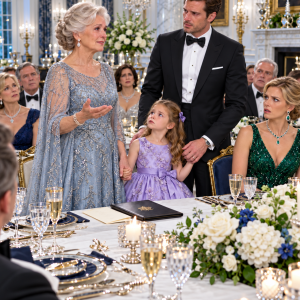
My mother arrived carrying the same green platter she had used the year before.
It was filled with butter cookies.
For one brief moment, I wondered whether bringing them had been wise.
Then she placed the platter on the kitchen island.
Ethan wandered in from the living room, spotted them and stopped.
My mother noticed.
So did I.
She did not touch his hand.
She did not tease him.
She did not make him ask.
Instead, she pushed the platter slightly toward him.
“Those are for everyone.”
Ethan glanced at me.
I nodded.
He took one.
Then he took another and carried it to his grandfather.
Dinner that evening was not perfect. Paige and my father disagreed about something political, my mother complained that my gravy needed more salt, and Ethan knocked over a glass of water ten minutes after we sat down.
Nobody laughed at him.
Nobody called him careless.
My father handed him a towel.
My mother moved the wet napkins.
And dinner continued.
Later that night, after everyone had gone home, Ethan and I stood together in the kitchen cleaning the last dishes.
He reached for one of the remaining cookies.
Then he paused.
“Mom?”
“Yeah?”
“Do you think Grandma likes me now?”
I dried my hands and crouched beside him.
“I think Grandma always loved you. She just didn’t always know how to behave lovingly.”
He considered that distinction carefully.
“That’s weird.”
I laughed.
“Adults are weird.”
He smiled and bit into his cookie.
For years I believed keeping a family together meant holding tightly to every obligation, every tradition and every expectation handed down to me. I believed being a good daughter meant paying bills nobody else could manage, forgiving words nobody apologized for, and teaching my own child to endure uncomfortable things because challenging them might upset the adults.
I had been wrong.
Families are not protected by silence.
They are protected when someone is finally willing to say, this stops here.
The most important thing I withdrew that Christmas was never the money.
It was my participation in an old agreement nobody had ever written down—the agreement that said peace mattered more than dignity, appearances mattered more than kindness, and the person most willing to tolerate disrespect should always be asked to tolerate a little more.
Once I stopped honoring that agreement, everything shifted.
Some things became harder.
Some things disappeared altogether.
But the parts worth keeping slowly became stronger.
And whenever I remember that Christmas now, I no longer picture my mother’s beautiful table or the candles or even Ethan pulling his hand away from the cookies.
I remember a quiet street illuminated by blue Christmas lights, my little boy asking whether he was good, and the answer I finally learned to give both of us.
Yes.
You are good.
And being good does not mean allowing people to make you small.