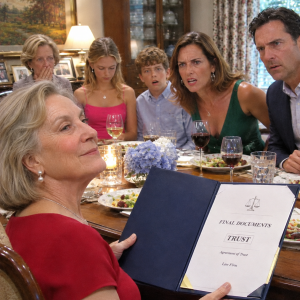
“I wish you had, Dad.”
Chapter 7: The Goodbye That Hurt More Than I Expected
The following weeks were difficult.
Mom told friends that I was forcing her out of the family home.
But her version of events began falling apart when relatives learned what had happened on Christmas Eve.
Mallory also confronted her about the false story she’d been told.
Dad temporarily stayed with his brother while he considered what to do.
Eventually, he and Mom found a modest apartment above a local dry cleaner.
They moved out three days before the deadline.
When I visited the empty house, I found the keys on the kitchen counter.
Beside them was a note in Dad’s handwriting.
“I replaced the furnace filter. I’m sorry I never got around to cleaning the back gutter.”
I sat on Grandma’s kitchen floor and cried.
I wasn’t crying because I’d changed my mind.
I was thinking about my father spending six years maintaining a house he believed someone else had given him.
He’d never known that his own daughter had quietly provided that security.
I regretted helping Mom hide the truth.
But I didn’t regret protecting Wesley and Lacey.
Those were two very different things.
Chapter 8: A Home That Finally Felt Like Ours
In April, the children and I moved into Grandma’s house.
Wesley chose the room that had once been her sewing room.
Lacey picked the bedroom overlooking the front porch.
We repainted the walls, rearranged the furniture, and filled the house with our own belongings.
For the first time, I didn’t feel like I was borrowing happiness from someone else.
The house belonged to us.
More importantly, it felt peaceful.
Wesley stopped worrying whenever I worked late.
Lacey began sleeping through the night again.
I made sure they understood that what happened at the gas station wasn’t their responsibility.
They were children.
They deserved to enjoy being children.
As December approached, I arranged my work schedule so I could spend Christmas at home.
I volunteered for extra hours on Thanksgiving in exchange for Christmas Eve and Christmas Day off.
This time, there would be no uncertain childcare arrangements.
No broken promises.
And no wondering whether someone would decide my children were inconvenient.
Chapter 9: The Christmas Morning That Changed Everything
On Christmas morning, Wesley and Lacey woke up beneath the same roof where their great-grandmother had once celebrated the holidays.
Their red stockings hung above the fireplace.
The living room smelled of cinnamon rolls and fresh coffee.
At nine o’clock, someone knocked on the front door.
It was Dad.
He stood on the porch holding a white bakery box.
“I brought something for breakfast. Would it be all right if I came in?”
I stepped aside.
“Of course, Dad.”
He spent the morning listening to Lacey describe her drawings and watching Wesley demonstrate his new headphones.
Nobody mentioned the previous Christmas.
For a few hours, we simply enjoyed being together.
Later, I noticed Dad carrying a stepladder from the garage.
He positioned it beside the back of the house and began clearing leaves from the gutter.
I stepped outside.
“Dad, you don’t have to do that today.”
He looked down at me.
“I know. But I should have finished it a long time ago.”
I stood quietly as he continued working.
He wasn’t making grand promises.
He wasn’t asking me to forget what had happened.
He was simply doing something he’d left unfinished.
And somehow, that small gesture meant more than a long apology.
Chapter 10: The Family I Chose to Protect
My relationship with Dad didn’t return to normal overnight.
Trust rarely works that way.
But he began showing up consistently, respecting my decisions, and making an effort to rebuild his relationship with the children.
My mother remained distant.
I didn’t know whether she would ever fully accept responsibility for what she’d done.
And I finally understood that I couldn’t force her to change.
For most of my life, I’d been the dependable daughter.
The one who solved problems.
The one who accepted disappointment.
The one expected to understand whenever Mallory needed something more.
I’d mistaken keeping the peace for keeping my family together.
But peace that requires children to feel unwanted isn’t peace at all.
That Christmas, I watched Wesley help his sister open a gift while Dad laughed beside the fireplace.
Grandma’s house was filled with warmth again.
Not because everything had been forgiven.
Not because every relationship had been repaired.
But because the people inside finally felt safe and welcome.
My mother had taught me, unintentionally, the most important lesson of my adult life.
Love doesn’t require endless sacrifice, and family loyalty should never mean ignoring the needs of your own children.
For years, I’d been afraid of disappointing my mother.
Now I was more concerned with becoming the mother my children deserved.
And when I looked at Wesley and Lacey smiling beneath the Christmas tree, I knew I’d made the right decision.
I chose my children. And I would choose them again.
A Message From the Heart
Sometimes the hardest part of growing older is realizing that the people who raised us can make choices that deeply disappoint us, and loving them does not mean we must accept every decision they make.
A child should never have to wonder whether they are welcome in their own family, because the smallest moments of rejection can remain in their memory long after the adults involved have forgotten them.
When someone repeatedly asks you to sacrifice your happiness to keep another person comfortable, it may be time to ask whether that relationship has ever been truly fair.
Setting healthy boundaries is not an act of cruelty, but a way of protecting the peace, dignity, and emotional security that every family deserves.
The people who genuinely love us may not always agree with our decisions, but they should still respect the limits we establish to protect ourselves and those who depend on us.
Sometimes a parent’s greatest responsibility is not preserving every family tradition, but recognizing when an old tradition has become unfair to the next generation.
An apology becomes meaningful when it is followed by patience, honesty, and consistent actions that show a genuine willingness to rebuild what has been damaged.
We cannot rewrite the painful moments of our childhood, but we can choose to create a different kind of home where our own children feel heard, respected, and unconditionally loved.
Family is not defined only by shared memories, familiar walls, or the names on a family tree, but also by the everyday choices people make to care for one another when it matters most.
And perhaps the greatest gift we can give our children is the quiet certainty that, no matter how complicated life becomes or how difficult our choices may be, they will never have to compete for a place in our hearts.