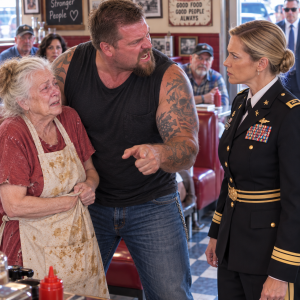
I looked past him at Audrey. We had shared a bedroom as children, traded sweaters in high school, and sat together through our mother’s final years. I had arranged Audrey’s wedding and stood beside her when she married Cole.
I still hoped some part of that history mattered.
“Audrey, your husband frightened Lily.”
She crossed her arms.
“He asked her to lower the music. Stop turning everything into a crisis.”
“He broke the radio.”
“Then buy another one.”
At that moment, I understood that my sister had already chosen. She had traded our shared history for Warren’s wealth and Cole’s approval, and she expected me to accept the cost.
I closed the door and locked it.
That night, I saved every recording, photographed every damaged item, and created a dated account of the incidents. I did not call anyone from my former unit. I did not make threats.
I simply prepared.
The Challenge Cole Regretted

Cole rushed at me before anyone had agreed upon rules.
His first swing passed beside my shoulder. I moved just far enough to avoid it, redirected his momentum, and let him stumble several feet across the lawn.
The crowd murmured.
Cole turned with surprise replacing the confidence in his face.
“You got lucky.”
He charged again, throwing wide, careless punches. He was strong, but every movement announced itself before it began. His eyes shifted toward his target, his shoulders tightened, and his balance rose whenever anger replaced patience.
Cole had trained to impress people.
I had trained to remain clearheaded when confusion could place an entire team at risk.
He attempted a dramatic turning kick. I moved out of its path, and his foot slid across the grass. He fell beside a picnic table, scattering several empty cups.
This time, someone laughed openly.
Cole stood, no longer interested in proving his skill. He wanted to recover his pride, and that made him even less controlled. He lowered his head and drove toward me.
I stepped aside, secured his arm without wrenching it, and used his own speed to guide him firmly onto the lawn. Within seconds, he was lying facedown while I held him in place without interfering with his breathing.
“Get off me!” he shouted.
“Stay down when you’re ready to stop.”
He struggled once more, then struck the grass three times with his palm.
I released him immediately and moved away.
The entire encounter had lasted less than two minutes.
Warren pushed through the crowd, but his steps slowed when I turned toward him.
“Come any closer,” I said, “and I will treat your approach as another threat.”
For the first time since moving to Hawthorne Lane, Warren stopped when someone told him to stop.
He called the police and loudly claimed that I had attacked his son without reason. Before I could answer, our neighbor Mr. Ellis stepped forward.
“That isn’t what happened,” he said. “Cole threatened her and moved first.”
A college student across the street had recorded the entire confrontation. The officers watched the video, spoke to several witnesses, and gave Cole a formal citation while explaining that further behavior could lead to more serious consequences.
As one officer finished taking my statement, Warren pointed at me.
“I’ll find out where you work, and when I do, you won’t have a career left.”
I said nothing.
He believed he had discovered the perfect weapon.
In reality, he had just aimed it directly at himself.
The Call That Changed Everything
The neighborhood video circulated for several days, and Cole’s athletic club suspended him after hearing the threats he had made before the confrontation. Warren, furious that money could not erase what dozens of people had witnessed, hired an investigator to search my background.
The investigator found exactly what public records were designed to reveal: Meredith Lawson, federal continuity-planning specialist, ordinary salary, limited authority, no accessible operational history.
Warren accepted that shallow description because it confirmed what he already wanted to believe.
At the time, Barrett Regional Transport was seeking a federal agreement worth nearly forty-two million dollars. The company hoped to move protected communications equipment between restricted government facilities, which meant its leadership, staff, records, and business practices required a detailed security review.
That review had recently been assigned to me.
My actual position involved assessing whether private transportation networks could be trusted around sensitive federal operations. I did not award contracts, nor could I reject a company because I disliked its owner. My responsibility was narrower and more important: I documented risk, verified compliance, and reported whether a contractor’s conduct matched its promises.
Until the cookout, I had reviewed Warren’s company with complete professional neutrality.
Then Warren called a senior official in my division and demanded that I be removed from federal service. To make his demand sound powerful, he threatened to withdraw his company’s bid unless I lost my position and benefits.
Ten minutes later, my secure phone rang.
“Lawson,” I answered.
Brigadier General Malcolm Reid spoke from the other end.
“I just received an extraordinary call from Warren Barrett.”
“I had a feeling you might.”
“He demanded that I dismiss you. He also tried to use his company’s pending bid as leverage.”
I leaned against the kitchen counter.
“What did you tell him?”
“Very little. The procurement line records all calls.”