The physician advised her to remain at the hospital, but Claire drew the route for investigators and marked a concealed entrance beneath the old carriage house. I went with Agent Keene while she stayed under a nurse’s care.
By the time we arrived, water shone across the lawn and smoke drifted above the damaged wing. Behind the carriage house, an investigator found a pressure latch hidden beneath a loose stone. It opened onto narrow brick steps descending into cool, stale air.
The corridor below did not resemble the theatrical chamber Spencer had described to Claire. It was worse because it was ordinary: plain doors, folding cots, storage cabinets, a desk, and shelves filled with carefully labeled boxes. This was not the work of one reckless evening. It was a system.
Inside the boxes were copied identification papers, loan agreements, private photographs, audio files, and handwritten notes about women the Bellamys considered easy to discredit. One ledger recorded payments to Warren Pike. Another listed public officials, attorneys, and reporters beside favors the foundation had arranged for them.
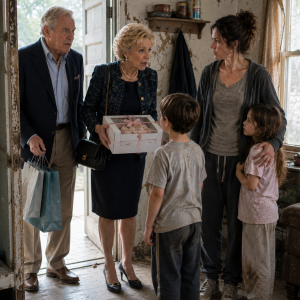
At the end of the corridor, an agent heard movement behind a locked utility room. When the door was opened, we found Marisol’s ten-year-old daughter, Isabel, wrapped in a wool coat and crouched beside a water heater. She was frightened and thirsty but alert. Marisol had hidden her there after realizing the Bellamys knew she had copied their files. She had promised to return, but she had not been able to reach the child before the authorities arrived.
Isabel clutched a small photograph of herself and her mother.
“Mama said the lady in the blue uniform would understand,” she told me.
I knelt so we were at eye level.
“Your mother was right. You’re safe now, and we’re going to find her.”
An hour later, officers located Marisol at a bus station north of Tulsa. She had been hiding after receiving warnings that Isabel would be taken from her if she spoke. When mother and daughter were reunited at the hospital, Claire watched from her doorway with tears on her cheeks. No one gave a speech. Marisol simply held Isabel, and Claire rested her head on my shoulder, while all the words we could have offered seemed smaller than the sight before us.
The People Behind the Polished Doors

Warren Pike was detained at his lake house the following morning. Bank records showed a series of payments from companies linked to the Bellamy Foundation, beginning weeks after he gave Lenora information about Claire. Confronted with the ledger and the recordings, he admitted that he had described Claire as independent, professionally respected, and often alone. He claimed he had never imagined how the information would be used.
That explanation did not comfort me. A person does not need to understand the full purpose of a betrayal to be responsible for opening the door.
The evidence beneath the carriage house also stripped away the Bellamys’ most dependable protection: their appearance of respectability. Several former employees came forward. Women whose names appeared in the files were finally able to compare their experiences. Officials who once returned Lenora’s calls began putting distance between themselves and her foundation.
Spencer requested permission to speak with Claire, apparently believing he could still persuade her to withdraw her statement. Claire agreed to a supervised meeting, not because she owed him an explanation, but because she wanted to reclaim the voice he had spent months teaching her to doubt.
He sat across a conference table in a plain interview room. Without the estate, the tailored suit, and his family surrounding him, he looked unexpectedly small.
“You’re misunderstanding what happened,” he began. “My mother was trying to protect the family.”
Claire studied him calmly.
“That is what you always say when you mean control.”
“We can fix this.”
“No, Spencer. Other people are fixing what your family concealed. I am rebuilding what you tried to take from me.”
He glanced toward me, perhaps hoping I would lose my temper and give him a new story in which he was the injured party. I remained silent.
Claire reached into a folder and placed her wedding ring on the table.
“You believed quiet meant weak,” she said. “You never understood that quiet can also mean finished.”
Then she stood and walked out beside me.
The legal proceedings lasted more than a year. The Bellamys faced charges related to unlawful confinement, financial fraud, intimidation, and interference with an investigation. Warren lost his retirement privileges and was prosecuted for misusing protected information. Several public figures were formally investigated, while the foundation’s remaining assets were placed under court supervision and later directed toward legal and housing assistance for those it had harmed.
Justice was neither swift nor cinematic. It arrived through interviews, documents, postponed hearings, and long afternoons in rooms with bad coffee. Yet it arrived, page by page.
The Sound of Her Own Key
Claire’s recovery did not follow a straight line. Some mornings she woke before dawn, certain she heard footsteps outside her room. Crowded restaurants made her uneasy. An unexpected telephone call could turn her hands cold. She worked with a counselor, took a leave from the museum, and slowly learned that accepting help was not the same as surrendering independence.
Six months later, she moved into a small brick bungalow near a park in Norman. On the first evening, I helped her assemble a kitchen table while Marisol and Isabel brought over a lemon cake. Isabel had drawn a picture of four women standing beneath an enormous blue sky. Claire framed it and hung it by the front door.
As I prepared to leave, Claire walked me to the porch. The sunset softened the houses along the street, and somewhere nearby a child was practicing scales on a piano.
“I used to think being brave meant never being afraid,” she said.
“So did I.”
“What do you think it means now?”
I looked at my daughter, at the faint marks still fading on her arms, and at the steadiness returning to her face.
“Telling the truth while fear is still in the room.”
She smiled, then closed the front door and turned the lock from the inside. It was a small, ordinary sound, but I understood what it meant. For the first time in a very long while, the key in Claire’s hand belonged only to her.
I had once believed my uniform would be the thing that saved her. It was not. Rank opened a few doors and made certain people listen, but it was Claire who carried the evidence out, Marisol who preserved the truth, Isabel who waited with faith beyond her years, and a circle of strangers who chose duty over influence.
The Bellamys had smiled in that hospital because they believed power was measured by the number of people one could silence. They never understood the older, steadier kind of power—the courage of one frightened person who finally speaks, and the willingness of another to believe her.
That was the silence they never saw coming: not the silence of surrender, but the silence left behind when their threats no longer had anyone willing to obey them.