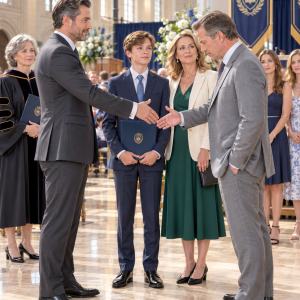
“You both knew?”
Bryce answered quietly.
“Yes.”
Graham turned toward me.
“You came here to take everything from me.”
“No,” I said. “I came because you invited me to watch you use another woman’s pregnancy as proof that I had failed. The truth took care of the rest.”
The room might have settled there, but Elsie looked at Vivian and called her “Grandma.” She used the word for nearly every silver-haired woman, yet Vivian treated it like a claim.
“Why would she call me that?” she demanded. “How old are these children?”
When I answered that they were three, Graham began reaching for a new story in which my children could belong to him.
“I want testing,” he said.
Nathaniel’s voice remained calm.
“They are not yours, and you have no right to question their family.”
Vivian stepped closer.
“If there is any connection to the Ashford line—”
I removed the final envelope from my folder.
“Before anyone speaks again about the Ashford line, Graham should see this.”
Inside was a private adoption certificate filed thirty-nine years earlier. Graham read it once, then again. Vivian’s expression changed before his did, which told him the document was genuine.
“You adopted me?” he asked.
Vivian whispered, “We gave you a better life.”
From the last row, an older man rose. He wore a plain navy suit, and his carpenter’s hands shook at his sides.
“My name is Samuel Keene,” he said. “I was told my infant son had not survived. I learned only last month that you were taken from the hospital and placed with the Ashfords.”
Graham looked from Samuel to Vivian, unable to fit either face into the life he remembered.
“Who am I?”
Vivian had ruled every room I had ever entered with her, yet now she could not answer.
Nolan tugged my sleeve.
“Can we go home?”
I gathered my children close, took Nathaniel’s hand, and walked out beneath the hotel’s bright chandeliers. Before we reached the car, an unknown number sent a message to my phone.
You found the adoption, but not the reason it was hidden.
The Files Behind the Wall

The message led our forensic investigator, Rebecca Marsh, to sealed hospital files connected to Edwin Sloane, a retired probate judge who had once controlled private adoptions across three states. Wealthy families paid his associates for clean records, while other parents were given false explanations.
Vivian had used that system, but she had not created it.
Samuel agreed to meet us in a quiet library in Providence. Graham came too, looking older than he had at the wedding. He no longer wore his family crest or the expensive confidence that had once entered a room before him.
Samuel explained that Graham’s birth mother, Eleanor, had passed away after delivering two infants, a boy and a girl. Samuel had been told neither child remained. Years later, a nurse named Helen Avery tried to contact him, but the meeting never happened.
At the sound of Helen’s name, Graham went still.
“She visited our house when I was young,” he said. “Vivian called her a distant cousin.”
Rebecca found Helen living under another surname in a care residence outside Hartford. She remembered holding both infants and watching Judge Sloane’s assistant carry the boy away. The girl, however, had been hidden by a courthouse records clerk who had discovered what the judge was doing.
That clerk was Marian Rowan, the woman I had always known as my mother.
My mother had passed away when I was seven. Her courage seemed impossible to imagine until Rebecca found a photograph of Marian outside the courthouse, holding a bundled infant beside Helen.
The infant was me.
Before she agreed to say more, Helen warned us that Judge Sloane’s records had never been destroyed. Marian had copied them and hidden them inside the house where I grew up in western Massachusetts.