Marjorie sat down in the nearest chair. She kept her gaze on the folder.
Grant turned to Celeste.
“You knew who he was?”
She began to cry.
“Not at first.”
Owen’s expression tightened.
“But you knew before you married Grant.”
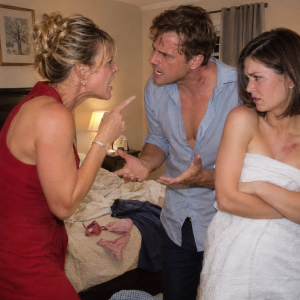
That sentence changed the room more than the paternity report had. Grant looked from Owen to Celeste.
“Married?”
I had assumed he knew. It was the first detail I had not expected to reveal.
“You and Celeste were married privately last month,” I said. “She wanted the legal arrangements settled before she announced the pregnancy.”
Grant shook his head.
“You told me she was planning the ceremony.”
Celeste wiped her cheek.
“I thought the baby was yours when we got married.”
Owen spoke quietly.
“You already knew the test might show otherwise. You asked me to keep the result private.”
“I was trying to figure everything out.”
“And you told me the child was mine.”
Celeste looked down at the floor. Her silence answered him more clearly than a denial would have.
Grant sat in a chair near the window. His face had lost its practiced composure, and for the first time that afternoon, he seemed unsure of what to say next. He looked at me with anger that seemed to need a place to land.
“You planned this. You came here to embarrass us.”
I kept my voice even.
“You and Celeste invited me into a room full of people, handed me an apron, and joked about my ability to have a family. I brought a gift that contained facts you already had a responsibility to face.”
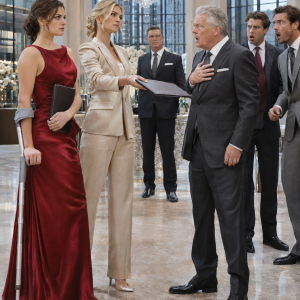
One of Owen’s attorneys stepped forward. He introduced himself, then explained that the company’s independent directors had called an emergency meeting. Until the financial review was complete, Grant’s executive authority had been suspended. The company was also seeking repayment of the disputed transfers.
Grant turned toward his mother.
“Marjorie, do something.”
But Marjorie was looking at the second folder Owen had brought. It contained documents concerning the family trust and the records that established Owen’s place among its beneficiaries. The trustees had begun reviewing distributions that appeared to have been made without proper disclosure.
“You can’t take everything from this family,” she said.
Owen did not raise his voice.
“I’m asking for what the documents say I’m entitled to. The court can decide the rest.”
I felt no satisfaction at Marjorie’s fear or Grant’s confusion. There was relief, perhaps, in seeing the truth acknowledged aloud, but that was different from enjoying the pain it caused. I had spent too many years watching people hurt one another while calling it a family matter.
Celeste reached for my wrist.
“Nora, please. I’m pregnant.”
I gently moved my hand away.
“Your child deserves honesty and a chance to grow up without being used to settle anyone’s arguments.”
She looked as if she wanted to answer, but no words came. The guests had begun to move toward the doors. Some left quietly, others whispering to one another. The cake remained untouched, its pink frosting bright beneath the ballroom lights.
Owen stood beside me, but he did not take over the conversation. He let me decide when it was time to go.
I picked up the empty silver box. The apron was still folded over the chair. I left it there.
A Home of Our Own

The months that followed were not as simple as the ballroom had made them look. A single afternoon can reveal a truth, but it cannot settle every question that truth creates.
The company’s directors completed their review and removed Grant from management. A court ordered him to repay a substantial portion of the funds that had been diverted, while the remaining matters continued through the legal process. Some of the accounts had been used for personal expenses; others had been moved through layers of company records that took months to trace. The process was slow, expensive, and far less dramatic than the baby shower guests might have imagined.
Grant and Celeste’s marriage did not last. The pressure of the financial investigation, the paternity results, and the fact that their relationship had been built on half-truths proved more than they could manage. Celeste moved into a modest apartment and began preparing for the baby without the life of luxury she had expected. Owen remained involved, first through the legal process and then in whatever way Celeste allowed him to be.
He never spoke of the child as a prize or proof that he had won something from Grant. He spoke instead about being present, keeping his commitments, and letting the child grow up with as much steadiness as the adults could provide.
Marjorie lost control of the family trust after the court approved a restructuring. She sent me one letter, written on heavy cream paper, in which she described the past as a series of misunderstandings. I read it once, then put it away. I did not need her to admit every wrong in order to stop carrying it.
Owen and I married at the vineyard on a bright September morning. The ceremony was small, with a few friends, my sister, and Rebecca sitting in the front row. There were no grand speeches about second chances. Owen simply told me that he would keep choosing honesty, even when it was uncomfortable. I told him I wanted a home where no one had to earn the right to speak plainly.
We adopted a little girl named Lily the following spring. She was placed in our care after months of meetings, home visits, and paperwork. The first night she slept in our house, I woke three times to check that she was warm, then lay awake listening to the quiet. Owen found me sitting beside the crib just before dawn.
“You know she’s all right,” he murmured.
“I know,” I whispered. “I just want to remember this.”
He sat beside me on the floor, and together we watched Lily sleep, her small hand curled beside her cheek.
A year later, when the days grew short and the fireplace became the center of the living room, I found the silver box on the shelf where we kept photographs. It was empty now, its ribbon neatly folded inside. Owen had placed it there after the wedding, not as a reminder of the baby shower, but because he said it had held the beginning of the truth.
I looked at our wedding photograph on the mantel, then at Lily’s picture beside it. The house was warm, the windows were dark with evening, and somewhere upstairs a small toy had been left in the middle of the hallway.
Owen came up behind me and rested his chin lightly against my shoulder.
“Any regrets?” he asked.
I thought of the years I had spent wondering whether motherhood was something other people could grant or withhold, whether I had failed some test I did not understand, whether the people who blamed me might be right.
Then I looked at our daughter’s picture.
“Only that I believed them for so long.”
The life I had wanted did not arrive in the way I once expected. It came by a different road, with paperwork and patience, through a man who listened and a little girl who made our home feel fuller with every passing day.
The greatest change was not watching Grant lose his position or seeing Marjorie’s influence diminish. It was understanding that the future I had feared losing had never belonged to them in the first place.