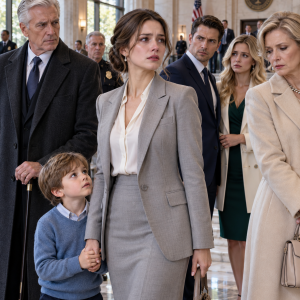
The Dinner That Ended My Silence
By the time Patricia Prescott tipped the silver ice bucket over my head, I had already been sitting at her dining table for nearly two hours, listening to people who had once called themselves my family explain, in one form or another, why my existence had become an inconvenience.
The water was so cold that my breath caught in my throat. Melted ice, wilted mint leaves, gray residue from the bottom of the bucket, and the remains of something that smelled faintly of lemon spilled through my hair and down the front of the navy maternity dress I had bought on clearance three weeks earlier. I was seven months pregnant, and when the freezing water struck my shoulders, the little girl inside me moved so suddenly that one of my hands went instinctively to my stomach.
Patricia remained standing beside me, one hand still wrapped around the empty handle.
She was sixty-one, beautifully maintained, expensively dressed, and utterly certain that the world had been arranged for her convenience. Her cream silk blouse probably cost more than my entire outfit, and the emerald earrings at her ears had been purchased through a corporate account she had no legal right to use.
She looked down at me and smiled.
“Well, there. At least nobody can say you didn’t get cleaned up before dinner.”
My former husband, Colin, laughed from the opposite side of the table.
Not an uncomfortable laugh. Not the nervous sound of a man embarrassed by his mother.
A real laugh.
Beside him sat Brooke Ellison, the woman he had begun seeing before our divorce papers were even complete, though both of them had spent months insisting there had been no overlap. Brooke pressed two manicured fingers to her lips as if trying to be polite, but the amusement in her face was unmistakable.
“Patricia,” she said, still smiling, “you’re awful.”
Patricia lifted her wineglass.
“I’m practical.”
Then Brooke glanced at the water dripping from my chair onto the antique rug beneath us.
“Someone should probably get her a towel. An old one.”
Another ripple of laughter moved around the table.
I remember looking at Colin then.
Ten years earlier, he had been a public-school history teacher in Greensboro, North Carolina, living in a small apartment with secondhand furniture and a refrigerator that made an alarming noise every time the motor started. He had been gentle in those days. He packed sandwiches for students who came to class hungry. He once drove forty miles through heavy rain because I had mentioned over the phone that I was sick and had no medicine in the house.
That was the man I had married.
The man across from me now wore a custom Italian suit, drove a company-owned sports car, and had spent the previous year telling friends that he had “carried” me financially through our marriage.
I sat in Patricia’s dining room with dirty water sliding from my hair and understood, with a clarity that surprised me, that I had spent too many years mourning a person who no longer existed.
They expected tears.
Patricia especially.
She wanted me to lower my eyes, gather my purse, and stumble out of the house while they watched.
Instead, I reached into my bag and took out my phone.
Colin leaned back in his chair.
“Oh, come on, Evelyn. Don’t start another scene.”
I wiped water from the screen with the inside of my wrist.
“I’m not starting one.”
I opened a secure contact and typed three words.
Initiate Harbor Nine.
Then I pressed send.
The Name They Had Never Bothered to Learn

For most of my marriage, the Prescott family believed I worked in corporate strategy for a large American industrial technology company called Rowan Arc Systems.
That was technically true.
What they did not know was that I had founded Rowan Arc when I was twenty-five.
By the time I met Colin four years later, I had already spent nearly a decade building the company from a rented workshop outside Raleigh into one of the largest privately controlled infrastructure-automation firms in the United States. We designed systems used in freight networks, regional utilities, manufacturing plants, and large-scale distribution centers. The company had offices in fourteen states, contracts across North America, and a private valuation that had crossed several billion dollars.
My ownership was held through a family trust and two private holding entities. I rarely appeared in business magazines, avoided lifestyle interviews, and had never enjoyed being photographed at charity galas. The public face of the company had long been our chief executive, while I served as executive chair and controlled fifty-seven percent of the voting interest.
Colin knew I was successful.
He simply never cared enough to understand how successful.
When we met, I found that refreshing.
Later, I realized I had mistaken indifference for humility.
After we married, I helped him leave teaching when he said he wanted a new challenge. He joined one of Rowan Arc’s regional training divisions, where, to his credit, he performed well at first. Over the years he moved into business development. His younger brother joined procurement. Patricia received a consulting role through one of our community partnerships. Eventually, even Colin’s cousin found a position in commercial leasing.
I never ordered anyone to hire them.
I only made introductions.
That distinction would matter later.
At Patricia’s dinner table, my phone rang less than a minute after I sent the message.
The caller was Adrian Pierce, Rowan Arc’s executive vice president for legal and governance.
I answered.
“Evelyn?”
His voice changed immediately.
“Are you safe?”
I looked at Colin.
He was swirling wine in his glass, smiling with the lazy confidence of a man who believed nothing in the room could touch him.
“I’m physically all right,” I said. “Activate Harbor Nine in full.”
Silence came from the other end.
Adrian had helped design the directive three years earlier after an internal risk review discovered that several executives and relatives connected to senior leadership had gained access to assets they did not own.
Harbor Nine was not a revenge mechanism.
It was a containment procedure.
It suspended discretionary account access, froze nonessential corporate privileges, preserved records, secured trust-owned property, and triggered an independent review of spending whenever there was credible evidence that company resources were being misused.
Adrian spoke carefully.
“Evelyn, once I authorize the full sequence, it affects every account connected to the Prescott review. Some of them may lose access immediately.”
“I understand.”
“Including Colin.”
“Especially Colin.”
Across the table, his smile faded.
“What are you talking about?”
I kept my eyes on him.
“Proceed, Adrian.”
“Understood.”
I ended the call.
Patricia gave an irritated sigh.
“Honestly, Evelyn, if you’re calling some lawyer because I spilled a little water—”
“You didn’t spill it.”
She paused.
It was the first time that evening I had interrupted her.
“Excuse me?”
I set my phone on the table.
“You poured it.”
Patricia stared at me, and for a moment the room became oddly quiet.
Then Colin pushed back his chair.
“Enough. You’re making everybody uncomfortable.”
I almost laughed at the absurdity of it.
My hair was soaked. My dress clung coldly to my skin. My daughter was moving restlessly beneath my ribs.
Yet somehow I was the one making people uncomfortable.
Before I could answer, headlights swept across the tall dining-room windows.
Several vehicles had entered the circular drive.
Colin frowned.
“Who is that?”
I folded my hands over my stomach.
“People who know who I am.”
When Every Phone Began to Ring

The front door opened less than five minutes later.
Wade Mercer, Rowan Arc’s director of corporate security, entered first. A former federal compliance investigator in his mid-fifties, Wade was a broad-shouldered white American man from Ohio who possessed the unusual ability to make a room quieter simply by walking into it.
Behind him came Adrian Pierce, two members of the governance team, our chief operating officer Helena Ward, and a representative from the private trust that controlled several properties used by my family.
No one raised a voice.
No one rushed.
That made what followed more powerful.
Wade stopped near the entrance to the dining room and looked directly at me.
“Ms. Evelyn Hart, are you all right?”
Colin’s expression changed.
Not dramatically at first.
Just a small tightening around his mouth.
“What did you call her?”
Adrian crossed the room carrying a dark wool coat. He placed it gently around my shoulders, careful not to press against my stomach.
“I’m sorry we weren’t closer when you called.”
Patricia looked from him to me.
“Who are these people?”
Helena opened a slim leather folder.
“Harbor Nine was initiated at 8:17 p.m. All protective actions are now in effect.”
Patricia gave a short, dismissive laugh.
“Protective actions? This is ridiculous.”
Then Colin’s phone rang.
A second later, his brother’s phone began vibrating on the sideboard.
Patricia’s lit up next.
Then Brooke’s.
For several seconds the room filled with overlapping ringtones.
Colin looked down at his screen and answered.
“Yes?”
His eyes shifted toward me.
“No, I didn’t request that.”
A pause.
“What do you mean suspended?”
Another pause.
He stood.