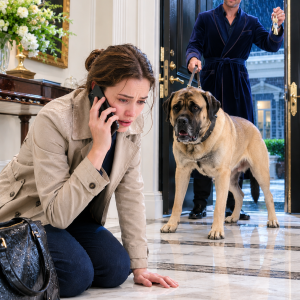
It wasn’t.
I walked to the hallway table and laid out every envelope I had photographed the day before.
Mail addressed to Ethan’s brother.
His aunt.
One cousin.
Even his parents.
Every piece carried my address.
Mr. Ellis looked at them quietly.
Then at Ethan.
“Can you explain these?”
Ethan hesitated.
“Dad thought… it would be easier if everyone used one address for a while.”
“Did your wife agree?”
No answer.
My father-in-law answered instead.
“It’s only paperwork.”
Mr. Ellis closed the folder.
“No, sir. It isn’t.”
He turned to me.
“Would you like me to call the county investigator now?”
I nodded.
For the first time all morning, my father-in-law stopped looking confident.
An investigator from the county recorder’s office arrived less than an hour later.
He asked only a handful of questions.
Then he examined copies of the envelopes.
He wrote several notes before asking Ethan one simple question.
“Who instructed these relatives to change their mailing address?”
Ethan looked toward his father.
That silence answered almost everything.
One Signature They Could Never Explain
While the investigator was still there, another black SUV pulled into the driveway.
A woman in a navy business suit stepped out carrying a briefcase.
She introduced herself as a representative from the commercial bank that financed my father-in-law’s construction company.
My stomach tightened.
She looked directly at me.
“Mrs. Carter, did you authorize your residence to be pledged as collateral for Carter Family Construction?”
I stared at her.
“What?”
She removed a copy of a loan package.
There, beside my printed name, was a signature that looked almost like mine.
Almost.
I knew immediately it wasn’t.
I had never seen the document.
I had never signed it.
Mr. Ellis didn’t even let me touch the papers.
“Please preserve the originals.”
The bank representative nodded.
“The loan has not been funded yet. During our final verification process, ownership records conflicted with the documents we received.”
She looked toward Ethan.
Then his father.
“That’s why we’re here.”
Nobody spoke.
Finally I asked one question.
“Who submitted this?”
The representative answered without hesitation.
“Your husband’s company.”
I slowly looked at Ethan.
He couldn’t meet my eyes.
His father tried anyway.
“It’s just a misunderstanding.”
The bank representative closed her folder.
“Submitting a false authorization for collateral isn’t a misunderstanding.”
Within twenty minutes, two police officers arrived to document the suspected forged signature.
No one was handcuffed.
No dramatic scene unfolded.
The officers photographed the paperwork, collected statements, and asked everyone to remain available for follow-up interviews.
That was enough.
The room felt colder than it had all morning.
The House Finally Became Quiet
Three days later, the bank officially canceled the loan application.
Without the financing, my father-in-law’s company lost the investor who had been waiting for the deal to close.
Several projects were suspended before they even began.
The business survived, but only barely.
Ethan moved into a furnished apartment before the end of the week.
He asked twice if we could talk.
I declined both times through my attorney.
Our divorce filing was surprisingly straightforward.
The postnuptial agreement removed almost every argument about the house.
There was nothing left for him to claim.
A month later, I stood in the nursery holding my daughter after bringing her home from the hospital.
The house sounded different now.
No debates over bedrooms.
No relatives discussing where their furniture would go.
No one asking for my keys.
Only the soft hum of the baby monitor and the rocking chair my father had assembled himself.
On the hallway table sat the same brass key I had refused to hand over that first afternoon.
I picked it up for a moment before placing it back on its hook.
Then I carried my daughter toward her room.
My parents hadn’t given me a house.
They had protected a home before anyone else even realized it needed protecting.