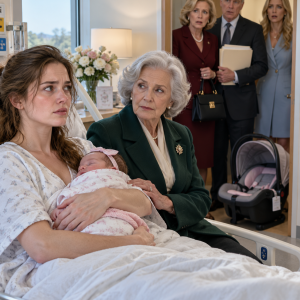
At the hospital, the doctors examined Maisie while a child-support specialist sat beside her. I was allowed to stay nearby, though I had to let trained professionals ask the questions. They spoke gently, never suggesting answers or asking her to repeat herself more than necessary.
The early test results showed that the cloudy liquid contained an unprescribed medication capable of making a small child weak, drowsy, and unsteady. The doctor would not speculate about Reed’s purpose, but she made one thing clear.
“Your daughter should never have been given this.”
I sat beside Maisie’s bed until dawn, holding Juniper beneath my arm. When she woke, she looked around the room and began to cry.
“Is Daddy mad?”
I leaned close enough for her to see my face.
“You are not responsible for Daddy’s feelings. You did nothing wrong.”
“Are there more bath games?”
“No, sweetheart. Those games are over.”
What the Records Revealed
Detective Rebecca Hale met me the next afternoon at the Dane County Family Advocacy Center. She was a calm woman in her fifties who spoke plainly without being unkind.
Reed’s computer, financial files, and phone had been taken for review. Investigators had already found overdue private loans, hidden credit accounts, and evidence that he had been moving money without my knowledge.
Then Rebecca placed a copy of an insurance document in front of me.
Four months earlier, Reed had opened a large policy connected to Maisie. My signature appeared on one of the forms, but I had never seen the document.
“This signature isn’t mine,” I said.
“We suspected that,” Rebecca replied. “A handwriting specialist will examine it.”
The policy included an unusually high payment if Maisie suffered a fatal household incident. The phrase on the page blurred as my eyes filled with tears. I pushed the document away.
Rebecca waited before continuing.
“We believe the bathroom routine was part of a longer plan. I won’t burden you with every detail, and some questions remain unanswered, but the evidence suggests he was trying to make a future incident appear accidental.”
I covered my mouth with both hands.
For weeks, I tortured myself with the same question: How had I not known?
Maisie’s therapist eventually helped me understand that this was the wrong question. Reed had spent years constructing an image of reliability. He knew when to smile, when to volunteer, and how to make concern sound like ingratitude. The responsibility belonged to the person who had created the deception, not to the family members who had once trusted him.
My attorney, Caroline Brooks, secured an emergency protection order. Reed was barred from contacting us, and his access to the house, school, and our financial accounts was removed. Later, after the evidence had been reviewed, he accepted a plea agreement carrying a lengthy prison sentence.
I did not attend the final hearing.
By then, I understood that justice did not require Maisie or me to sit in the same room with him. Our task was not to watch his future close around him. Our task was to rebuild our own.
Learning to Trust the Morning

Seven months later, Maisie and I moved into a smaller home near a lake outside Sun Prairie. The house had green shutters, creaky floors, and a backyard large enough for the rescue dog she named Waffles.
Recovery did not arrive all at once.
For a long time, Maisie refused to enter a bathroom unless the door remained wide open. We replaced baths with quick showers, and I waited outside while she sang songs to remind herself that she was not alone. Her therapist taught her that adults should never ask children to keep secrets about activities that make them uncomfortable.
One evening, she called me from the bathroom.
“Mom, can I shut the door halfway?”
I stood in the hall, surprised by the pride rising in my chest.
“You can leave it wherever you feel comfortable.”
She considered this and moved it another inch.
“Like that.”
“That looks perfect.”
In the spring, Caroline visited with the final documents establishing a protected trust for Maisie. The policy had been canceled, the forged forms had been entered into the case record, and the portion of our property legally belonging to Maisie and me was secure.
After Caroline left, I found my daughter racing Waffles across the backyard. Her curls flew behind her, and her laughter carried through the open kitchen window.
She stopped beneath the maple tree and waved.
“Mom! Watch me run all the way back without stopping!”
I stepped onto the porch.
“I’m watching.”
She ran toward me with her arms open, and when she reached the steps, I knelt and caught her.
I used to believe that keeping a family together was the highest form of love, but I know better now. A home is not made whole by the number of people living beneath its roof. It is made whole by honesty, safety, and the certainty that a child can speak without fear.
The night I looked through that bathroom door, I thought I was watching my family fall apart. In truth, I was seeing clearly for the first time.
Maisie had found the courage to give me one small piece of the truth. My responsibility was to believe her, follow it, and open the door the rest of the way.
Now, whenever she runs across the yard and calls for me to watch, I put down whatever I am holding and turn toward her.
And every single time, I answer the same way.
“I see you, sweetheart. I’m right here.”