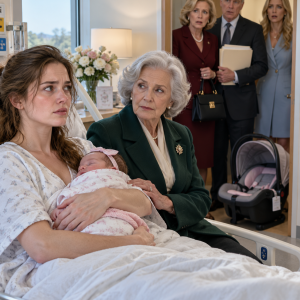
What I had once believed was only a cruel demand for obedience now looked like part of a much larger plan.
Reed and Diana had not simply wanted me silent.
They had been arranging a future in which my voice would no longer matter at all.
The Voice They Could Not Explain

Three weeks later, Reed appeared before an administrative military panel in his formal uniform.
His ribbons were perfectly aligned. His shoes reflected the fluorescent lights. He carried himself with the confidence of someone who had spent years learning that appearance often mattered more than character.
I sat across the room with my attorney. My father remained several seats behind me in his service uniform, his expression unreadable.
Reed told the panel that my father had manipulated me because of an old disagreement between our families.
“My wife is vulnerable,” he said. “Colonel Mercer has used his influence to turn a private medical matter into a campaign against me.”
The investigating officer opened a thick folder.
“Colonel Mercer did not make the initial complaint, Major Callahan. Your wife did.”
Reed looked at me.
Until that moment, I do not think he had understood that I had begun preparing to leave before my father arrived. He believed the quiet woman in the dark bedroom had simply waited to be rescued.
He had never considered that I might have been saving myself piece by piece.
The final recording was played through the room’s speakers.
Diana’s voice came first.
“If her pressure rises again, don’t call anyone immediately. Wait and see whether it settles on its own.”
Reed answered.
“What about the trust once the baby arrives?”
“It becomes harder to control. We need her signature before then.”
The recording continued with Diana instructing him to keep visible marks beneath clothing and Reed admitting that he had canceled my appointments because medical staff asked too many questions.
When the audio ended, Reed stood abruptly.
“That conversation has been altered.”
I rose slowly, one hand resting on my belly.
“Then explain what you meant.”
He stared at me.
“Evelyn—”
“Explain why my medicine was locked away. Explain why my doctor was told I canceled appointments I never knew about. Explain why money from my trust went to your mother.”
He looked toward his attorney, but no one answered for him.
The investigation expanded beyond the military panel. Financial records, digital messages, witness statements, and medical documentation were transferred to civilian authorities. A realtor produced an email in which Reed had asked how quickly the estate could be sold after the baby’s arrival. Government security logs also showed that he had used official systems to view portions of my father’s travel schedule, allowing him to know when Dad would be working out of state.
Diana eventually accepted responsibility for helping hide financial transfers and interfere with my care. She was ordered to return the money, sell property to cover restitution, and serve a lengthy custodial sentence.
Reed refused every agreement offered to him.
During the final hearing, he still insisted I was weak.
By then, the word had lost all power over me.
He was convicted of serious domestic offenses, financial fraud, intimidation, obstruction, and conspiracy to cause severe harm. His security clearance was revoked, his military career ended, and the court imposed a long prison term.
As he was escorted from the room, he looked back at me.
For years, I had mistaken his confidence for strength. Now I could see that it had always depended on my silence.
Outside the courthouse, reporters surrounded my father and asked whether his rank had influenced the case.
He paused beside me.
“My rank did not prove what happened,” he said. “Her evidence did.”
Then he turned away from the cameras and offered me his arm.
“Are you ready to go home?”
I looked toward the mountains beyond the courthouse, where the clouds had begun to separate and sunlight was moving across the foothills.
“Yes,” I said. “I think I finally am.”
Three months later, my daughter arrived healthy and strong.
I named her Iris because the flower had always reminded my mother of courage that grows quietly, without needing anyone’s permission.
When Iris and I returned to the estate, I changed the locks, removed the heavy curtains, and painted the bedroom a soft cream that reflected the morning light. Diana’s formal sitting room became a nursery with wide windows, pale wooden shelves, and a rocking chair beside the fireplace.
The missing trust funds were restored by court order. Reed’s name disappeared from my accounts, my property records, and every plan I made for the years ahead.
My father retired the following spring and bought a small house fifteen minutes away. He never tried to run my life. He did not check on me every hour or insist that he knew what was best.
He came by on Saturday mornings with groceries, badly brewed coffee, and jokes so predictable that I usually guessed the ending before he reached it.
One evening, as I rocked Iris beside the nursery window, I looked down at the faint lines still visible around my wrist. They were fading, as were many of the things I once thought would remain with me forever.
For months, Reed and Diana had hidden the truth beneath an immaculate uniform, a respectable family name, and explanations rehearsed until they sounded almost believable.
But the truth has its own patience.
Sometimes it remains quiet beneath a heavy quilt in a darkened room, waiting for the smallest opening—a father’s unexpected visit, a hidden recording, or one softly spoken word—before it finally steps into the light.