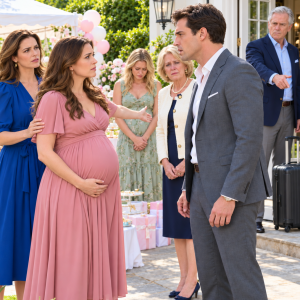
The Night My Husband Kissed Another Woman, a Private Plane Was Waiting for Me

Part One: The Evening I Finally Walked Away
The first thing I remember about that evening is the sound of laughter drifting across the ballroom, mingling with the gentle music of a string quartet and the soft clinking of champagne glasses, while I stood beside a towering arrangement of white roses and watched my husband make another woman feel more welcome at his side than I had felt in years.
I was six months pregnant, wearing a pale blue silk gown that my mother had helped me choose, and although the room was filled with people I had known throughout our marriage, I had never felt quite so alone.
My husband, Nathaniel Prescott, was standing near the entrance of the charity gala at an elegant hotel in Philadelphia, his hand resting comfortably against the lower back of a young woman named Vanessa Reed, whose sparkling burgundy dress and carefully arranged blonde curls made her impossible to overlook.
I had known about Vanessa for several months, although Nathaniel had repeatedly insisted that she was simply a colleague from his commercial real estate firm, someone whose enthusiasm for fundraising made her particularly useful at events like this one.
I had wanted to believe him, partly because I remembered the man who had once driven through a winter storm to bring me soup when I was sick, and partly because admitting the truth meant acknowledging that the marriage I had spent four years protecting was no longer the marriage I thought I had entered.
Then Vanessa leaned toward him, whispered something that made him smile, and kissed him in full view of the photographers gathered near the entrance.
He kissed her back.
What hurt most was not the kiss itself, but the ease with which he accepted it, as though he had forgotten that his wife was standing only a few yards away, carrying the child he had once promised would make our family complete.
When Nathaniel finally noticed me, his expression tightened with annoyance rather than embarrassment, and I understood that he was not particularly concerned about what he had done, only that I had witnessed it.
I turned toward the exit before the tears reached my cheeks.
For nearly two years, I had adjusted my life around Nathaniel’s preferences, giving up my position as an interior designer at a small architectural studio, accompanying him to professional dinners, and learning to remain quiet whenever conversations turned toward finances or business decisions that he considered too complicated for me.
My mother had once told me that a marriage should make two people feel stronger together, not leave one person constantly wondering whether her opinions were welcome.
I had dismissed her concerns because I loved my husband, and because Nathaniel could be extraordinarily attentive whenever he sensed that I was becoming unhappy enough to question our relationship.
But that afternoon, before leaving for the gala, I had signed the documents necessary to begin our divorce and placed them inside a cream-colored envelope on his study desk.
I had intended to tell him privately after the event, although some quiet part of me already knew that another conversation would simply become another opportunity for him to explain away my feelings.
Outside, a light spring rain was falling over Philadelphia, turning the pavement silver beneath the streetlights, and when the driver opened the door of the waiting sedan, I climbed inside with one hand resting protectively over my stomach.
“Where would you like to go, Mrs. Prescott?” he asked.
I thought about my parents’ house in the rolling countryside outside Frederick, Maryland, where my childhood bedroom still overlooked an apple orchard and my mother always kept extra blankets folded at the foot of the bed.
Before I could answer, my phone vibrated.
The message came from an unfamiliar number.
Your aircraft is prepared, Mrs. Prescott. The private aviation terminal is expecting you. Transportation and accommodations have been arranged.
A second message arrived almost immediately.
Please do not return to your residence tonight.
I stared at the screen, trying to understand why anyone would arrange a private aircraft for me when I had barely decided where I wanted to spend the night.
“Take me to the private terminal,” I finally told the driver, although I could not have explained why I trusted the message enough to follow it.
As we pulled away from the hotel, I looked back through the rain-streaked window and wondered whether I was leaving behind the worst evening of my marriage or stepping into something I understood even less.
Part Two: A Letter From Someone I Thought Was Gone
The private terminal was almost empty when we arrived, and the quietness of the building seemed especially strange after the crowded ballroom, where every conversation had felt like another reminder of how little control I had over my own life.
A silver-haired woman wearing a tailored navy coat approached me with the calm confidence of someone accustomed to handling difficult circumstances without drawing attention to them.
“Mrs. Prescott, I’m Evelyn Hartwell, and I’ve been asked to make certain you have somewhere comfortable to stay tonight.”
I studied her face, searching for any indication that she worked for Nathaniel.
“Who asked you?”
“Someone who cared about your future and wanted you to have choices if you ever needed them.”
She explained that her family operated a private aviation company and that the aircraft waiting outside could take me to Providence, Rhode Island, where a hotel room and an appointment with a prenatal specialist had already been arranged.
When I asked whether Nathaniel knew about the flight, she assured me that he did not.
Still, I refused to board until she explained who had paid for everything.
Instead of answering immediately, Evelyn handed me a sealed envelope marked with a small brass lighthouse.
I recognized the symbol.
Nathaniel’s grandmother, Beatrice Prescott, had used the same emblem on her personal stationery, and although she had passed away the previous winter, I could still remember the scent of lavender in her sitting room and the way she listened whenever I spoke.
Beatrice had been the only member of Nathaniel’s wealthy family who never treated my ordinary upbringing as something requiring explanation.
Inside the envelope was a handwritten letter.
My dear Caroline,
If you are reading this, I imagine you have reached a point where remaining in your marriage feels more difficult than leaving it, and I want you to understand that whatever you decide, you deserve the freedom to make that decision without fear.
There are matters concerning the Prescott family that you have never been allowed to understand, including financial arrangements that may affect you and your child.
Years ago, I established an independent trust intended to protect two women whom my family has repeatedly underestimated. You are one of them.
There is a house overlooking the water in coastal Maine. Inside my study, beneath the eastern window, you will find a locked cabinet containing documents that I could never safely explain during my lifetime.
The key has been with you longer than you realize.
I read the letter several times before looking up.
“Why would she leave something like this for me?”
Evelyn’s expression softened.
“Because she understood that money can sometimes be used to limit a person’s choices, and she wanted you to have the means to make your own.”
I thought about the antique pendant Beatrice had given me shortly after my wedding, a delicate silver piece shaped like a seashell that I had worn beneath my gown that evening.
She had told me it belonged to someone who believed every person deserved a place to return to.
Until that moment, I had considered it a sentimental gift.
Now I wondered whether it held something more.
Before boarding, I called my parents, who had already heard enough about the gala to understand that something had happened.
My mother answered immediately.
“Caroline, sweetheart, where are you?”
“I’m safe, Mom, but I don’t think I can go back to Nathaniel.”
For a moment, I heard only her breathing.
Then she said something I would remember for the rest of my life.
“You don’t have to make the rest of your life work tonight. Just tell us where you need us.”
My father joined the conversation, promising that they would meet me in Rhode Island the following morning, and for the first time since leaving the ballroom, I felt the tightness in my chest begin to ease.
The flight was peaceful, although sleep remained impossible.
I watched the city lights disappear beneath the clouds and thought about how Nathaniel had always described our unborn child as the next generation of the Prescott family, discussing schools, investments, and future responsibilities without once asking what kind of childhood I hoped to give our baby.
Somewhere above the dark Atlantic coastline, I began to understand that leaving him would not immediately erase my sadness, but it might finally allow me to make decisions without asking whether he approved.
Part Three: The Locked Cabinet by the Sea
My parents met me the following morning, and after a reassuring appointment with a local obstetrician, we drove north toward the small coastal town of Camden, Maine, where Beatrice had spent much of her later life.
The house stood beyond a winding road lined with pine trees, its weathered gray shingles and white porch overlooking a quiet stretch of water.
Inside, everything appeared almost exactly as I remembered it from my only previous visit, including the faded blue curtains, shelves crowded with old novels, and a collection of family photographs arranged beside the fireplace.
My father, who had spent thirty years working as a public school administrator, had always been practical about difficult situations, and while my mother helped me settle into a chair, he examined the letter with growing concern.
“Your grandmother-in-law contacted us before the wedding,” he admitted.
I looked at him in surprise.
“About what?”
“She wanted to know whether you had independent legal advice concerning the financial agreements Nathaniel asked you to sign. We told her you believed everything had already been handled.”
I remembered those documents, along with Nathaniel’s cheerful insistence that they were merely formalities required by his family’s business interests.
“Why didn’t you tell me?”
My mother sat beside me.
“We tried to encourage you to ask questions, honey, but you were happy, and we didn’t want you to feel that we were trying to turn you against him.”
I could hardly blame them, because I remembered how fiercely I had defended Nathaniel whenever anyone questioned his habit of making decisions on my behalf.
The study was at the rear of the house, facing a small garden that sloped toward the shoreline, and beneath its eastern window stood a tall walnut cabinet with a narrow brass lock.
I removed Beatrice’s pendant and examined its delicate silver frame until I noticed a nearly invisible seam along the back.
With my father’s help, I opened the compartment and discovered a tiny key.
It fit the cabinet perfectly.
Inside were several folders, an old photograph, and a small recording device accompanied by a handwritten note asking me to listen before examining the documents.
Related Posts

My Secretary Convinced Me My Wife Was Che@ting, So I Left Her For My Secretary. Five Years Later, My Ex Walked Into My Hotel With Twin Boys Who Looked Exactly Like Me. “She’s After Your Money!” My Girlfriend Shouted. Then My Ex Handed Me A Letter I’d Never Received—And My Girlfriend’s Face Went Pale…

“Where Did You Get Those Glasses?” My Husband Asked, Turning Pale When He Saw Them On Our Kitchen Table. “The Marlowe Hotel Called,” I Replied. He’d Claimed To Sleep At Work Three Weeks Earlier. But His Glasses Had Been Found In Room 926, Registered Under His Name And Another Woman’s. Then He Finally Confessed.
“Tonight, I’ll Teach You How To Respect Your Husband!” Daniel Snarled, Pulling Off His Leather Belt After I Refused To Clean His Mother’s Kitchen. He Thought My Five-Foot-One Frame Made Me Helpless. What He Didn’t Know Was That My Father Had Trained Me In Martial Arts For Twelve Years. Seconds Later, He Was On The Floor.

“Look What You Made Me Do!” My Husband Sn@pped After Sl@pping Me Across The Face In A Crowded Coffee Shop. His Mistress Immediately Wrapped Her Arms Around Him. After Eleven Years Of Marriage, He Expected Me To Come Home And Apologize. Instead, I Walked Away, Hired A Lawyer, And Discovered Where Our Money Had Really Gone.