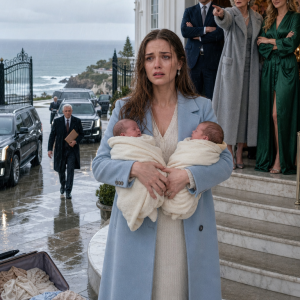
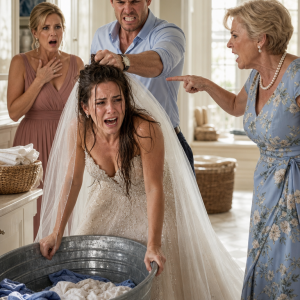
“Tell me his name.”
Caleb Whitaker placed six medical reports across the kitchen island.
I was eleven weeks pregnant.
“There is no one else.”
He tapped the papers.
“Six doctors, Natalie. Twelve years. They all said I can’t father a child.”
I knew.
It was one reason our marriage had seemed simple.
Three years. Separate bedrooms. Public appearances when necessary. No love expected, and no children possible.
I was an ICU nurse in Austin drowning in bills after my father died in a truck accident and my mother’s dementia worsened. Caleb belonged to one of Texas’s wealthiest families.
His family needed him to look settled.
I needed my mother’s memory-care bills paid.
So I signed.
But Caleb and I had met once before our marriage.
Months earlier, I’d been called to the Whitaker lake house near Lake Travis after he collapsed during a private fundraiser. I stabilized him and drew blood because nobody knew what he’d taken.
I documented everything, including his blood type.
O negative.
Then someone handed me water.
After that, my memory disappeared.
I woke hours later in a guest room beside Caleb, who was still unconscious. I left before sunrise.
Later, I discovered the silver brooch my mother had given me was missing.
Three months afterward, Caleb returned it.
“Found it at the lake house.”
Neither of us understood how it had gotten there.
Now I was pregnant.
Caleb pulled up another document.
“According to the house log, you left at 11:42 that night.”
I stared at the signature beside my name.
“That’s not mine.”
He looked exhausted rather than angry.
“Then we’ll do a paternity test.”
I agreed.
Three weeks later, the result came back.
PATERNITY EXCLUDED.
Caleb wasn’t the father.
I Left With One Suitcase
His family was present when he opened the results.
His uncle Grant sat across from me.
“Maybe Natalie should simply tell us what happened,” Grant said calmly.
“I already have.”
Caleb pushed back his chair.
“The marriage is over.”
I nodded.
He followed me to the front door.
“I’ll arrange an apartment. Your mother’s care will continue.”
“No.”
“Natalie—”
“I said no.”
I rented a small room in South Austin and returned to night shifts.
Then my mother’s memory-care facility called.
The Whitaker payments had stopped.
Caleb sounded surprised when I confronted him.
“I didn’t cancel anything.”
That was when I began wondering whether our paternity result wasn’t the only thing someone else had controlled.
A week later, while sorting medical supplies, I found a sealed specimen bag behind a freezer drawer.
Inside was the blood sample from Lake Travis.
Caleb Whitaker.
Date.
Time.
My handwriting.
I remembered something from the paternity report.
The blood submitted under Caleb’s name had been listed as A positive.
I grabbed my old notes.
O negative.
I called him.
“What’s your blood type?”
“O negative. Why?”
“Because the blood used for our paternity test was A positive.”
Silence.
Then:
“Where are you?”
Caleb arrived forty minutes later with his assistant, Marcus.
I placed the reports beside each other.
Marcus studied them.
“Someone switched the sample.”
Caleb looked at me.
For the first time since I’d told him I was pregnant, suspicion wasn’t directed at me.
It was directed at his own family.
Marcus recovered archived security footage from Lake Travis.
The house log claimed I’d left at 11:42 p.m.
The camera showed otherwise.
At 12:08, someone entered the office containing the visitor records.
Grant Whitaker.
I didn’t actually leave until 5:31 the next morning.
“I told you,” I said.
Caleb closed the laptop.
“We’re testing again.”
“My way.”
He nodded.
I personally watched his blood being drawn, labeled and sealed at an independent laboratory.
Three days later, we opened the result together.
99.99%.
Caleb was my baby’s father.
Six Doctors Had Lied
We tracked down the first doctor who’d diagnosed Caleb twelve years earlier.
He admitted the truth.
Caleb had never been infertile.
Someone in the Whitaker family had pressured him to falsify the diagnosis, supposedly because future Whitaker children could become targets.
Caleb drove straight to his grandmother Evelyn’s house.
She didn’t deny it.
“I knew.”
Caleb stared at her.
“For twelve years?”
“I thought I was protecting you.”
Then Evelyn looked at my stomach.
“But Grant isn’t trying to protect that baby.”
She opened a drawer and removed an envelope.
My father’s name was written across it.
Robert Torres.
Inside were old freight records.
My father had worked with a contractor serving Whitaker businesses. Before his death, he’d discovered Grant was using company trucks for illegal shipments.
He planned to report him.
Three days later, his truck went off the road.
The debts that appeared afterward—the same debts that eventually pushed me into marrying Caleb—had been fabricated.
Grant had created them.
He’d also controlled the Lake Travis staff.
The forged signature.
The switched blood sample.
My mother’s canceled payments.
It all led back to him.
But we still needed proof connecting him to my father.
We found it in the last place I expected.
My mother.
“Your Father Kept the Little Book”
Shortly before she died, Mom had one clear moment.
Her fingers touched the silver brooch on my sweater.
“Your dad kept the little book.”
“What book?”
“Blue. Garage wall. Behind the thermostat.”
The next morning, she was gone.
I went to my childhood home.
Behind the old garage thermostat was a narrow opening containing a blue notebook wrapped in plastic.
My father’s handwriting covered the pages.
Dates.
Truck numbers.
License plates.
Routes.
Grant’s initials.
I photographed every page before leaving.
That decision mattered.
A black SUV began following me.
I called Caleb and Marcus and drove toward a crowded gas station instead of going home.
Marcus arrived first.
Grant was inside the SUV.
The confrontation happened quickly.