Then she knelt in front of my son.
“You did nothing wrong. Speaking honestly never gives anyone permission to mistreat you.”
Owen finally took a bite of the dinner roll.
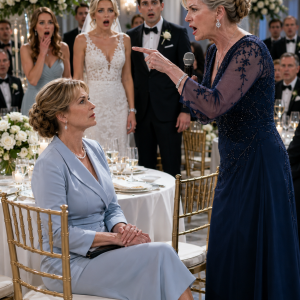
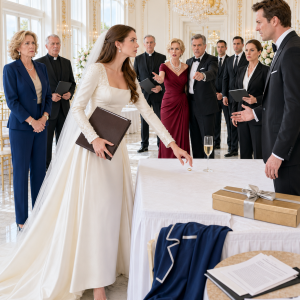
Guests began slipping out through the tall wooden doors. The flowers, candles, and elaborate table settings suddenly looked less like decorations and more like evidence of how much effort had been spent creating an appearance.
One of Scott’s aunts cornered me near the coatroom.
“Do you understand how much this wedding cost? You should have handled the child’s little incident privately.”
Before I could respond, the young server who had offered Owen the cupcake spoke from beside the dessert table.
“It wasn’t one incident. It was everything they did afterward to pretend it was acceptable.”
No one asked me to remain quiet again.
I collected Owen’s backpack and coat.
“We’re leaving,” I told Scott.
He followed us outside.
“Megan, wait. I need to apologize.”
“Your son looked at you when he needed protection. You looked at the guests.”
Scott’s shoulders sank.
“I was weak.”
He knelt in front of Owen.
“I’m sorry, buddy. I should have stood beside you.”
Owen studied his father solemnly.
“When Grandma got mad, I thought maybe you didn’t want me anymore.”
Scott’s eyes filled with tears.
“I love you more than I know how to say. I should have shown you that when it mattered.”
Owen placed one small hand on his father’s shoulder.
“Next time, will you protect Mom too?”
“Yes,” Scott said. “Both of you.”
A promise made after years of silence could not repair everything in an afternoon.
“Owen and I are staying with my parents,” I told him. “I need space, and you need to prove that your choices can match your words.”
He did not try to stop us.
As I passed Lorraine, she was sitting alone before the empty ceremony platform.
“Megan, please forgive me,” she murmured.
“Return what you took. Then apologize to Owen without asking him to make you feel better.”
A Home Where the Truth Was Welcome

Three days later, Scott came to my parents’ house carrying copies of every transfer and a repayment agreement signed by Lorraine. He had sold a small piece of inherited land and returned our savings, then deposited the missing wedding-gift money into Richard’s account.
“I didn’t come to ask you to return,” he said. “I came to begin repairing what I allowed.”
Over the following months, he rented a studio near his job, met regularly with a counselor, and stopped letting Lorraine control his finances. He visited Owen according to the schedule I established and never argued with my boundaries.
Whenever Lorraine blamed me for the canceled wedding, Scott corrected her.
“Megan didn’t ruin it. Dishonesty did.”
Two months later, Lorraine came to my parents’ porch carrying fruit and a box of cupcakes. She wore no expensive jewelry and brought no excuses.
She knelt before Owen.
“I treated you badly when you had done nothing wrong. I called you greedy and tried to frighten you into staying quiet. There is no excuse for that. I am sorry.”
Owen looked at me, but I let the decision remain his.
He handed Lorraine a napkin.
“My cheek feels fine now, Grandma. But you can’t ever do that again.”
“I won’t,” she promised.
Forgiveness did not erase the need for boundaries. Lorraine was not allowed to be alone with Owen until I felt confident that he was safe and respected. Visits were arranged in advance. She learned to ask before bringing gifts or making plans. Slowly, she began to understand that helping relatives did not mean controlling them or demanding endless sacrifices from others.
Bethany also called me.
“I benefited because I never asked who was paying,” she admitted. “I’m sorry for what happened to Owen, and I’m sorry I treated your savings as though they mattered less than my wedding.”
She later returned part of the money to Luke herself. They did not renew their relationship, but they parted respectfully, and Bethany began building a life in which her mother no longer handled every difficult consequence for her.
A year later, Lorraine completed the final repayment. With that money and the savings I had rebuilt, I purchased a small townhouse outside Hendersonville. It had two bedrooms, a sunny kitchen, and a narrow backyard where Owen could play.
The day we received the keys, he raced down the hallway.
“Mom, we finally have our own house!”
“Yes,” I told him. “And no one in this house has to stay silent just to belong.”
Scott did not move in immediately. For more than a year, he kept every agreement and defended every boundary. We began again with Sunday lunches, then afternoons at the park, and eventually family counseling. Only after his actions had become consistently different did I invite him to share our home.
One spring afternoon, Owen chose a chocolate cupcake from a neighborhood bakery and carried it proudly to a bench where Scott and I were waiting.
“Do you want to split it?”
We divided it into three pieces.
Scott watched our son wipe frosting from his nose.
“If Owen hadn’t spoken that day, I might still believe staying quiet was the same as protecting the family.”
“Silence was only protecting the people causing the harm,” I replied.
Owen was too busy laughing to understand the full meaning of our conversation, and I was grateful for that. A child should not have to carry an adult family’s secrets forever.
That afternoon taught me that happiness cannot be measured by towering cakes, expensive flowers, or envelopes filled with money. It is measured by whether a child feels safe enough to speak, whether an adult can admit being wrong, and whether a family has the courage to establish boundaries before love is mistaken for endless sacrifice.
Owen’s truth ended a wedding, but it also ended years of quiet humiliation.
And whenever someone now asks me to overlook something unfair for the sake of peace, I remember the cupcake on the marble floor and the little boy who refused to let the truth remain hidden.
A family that depends on the silence of its most vulnerable members was never truly at peace.