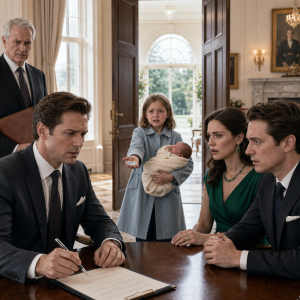
“You’re impossible!” she yelled, storming out of the room.
I sank into a chair, running my hands over my face. Gaby had revealed her true colors, and I knew it was time to act.
The next morning, I made a show of calling my financial advisor, making sure Gaby could hear. “Yes, I’d like to set up a new account for my stepdaughters,” I said. “We’ll fund it from our joint income moving forward.”
I turned to see Gaby standing in the doorway, her face a mix of shock and fury.

“What are you doing?” she demanded.
“Creating a fund for your daughters, as you wanted,” I said calmly. “We’ll contribute to it together.”
“And Edith’s money?”
“Remains untouched. That’s non-negotiable.”
She scoffed. “You think this fixes anything? You’re still choosing your daughters over us.”
“I’m honoring Edith’s wishes and respecting boundaries. If you can’t accept that, we have a serious problem.”
Her eyes filled with tears, but I couldn’t tell if they were genuine or manipulative. She stormed out again, leaving me with a heavy heart but no regrets.

In the weeks that followed, Gaby alternated between guilt-tripping me and giving me the cold shoulder. I stood my ground, refusing to let her sway me.
One evening, as I tucked my daughters into bed, my eldest asked, “Daddy, is everything okay with you and Gaby?”
I hesitated. “We’re working through some things, sweetheart. But don’t worry.”
Her worried eyes met mine. “We don’t want you to be sad again.”
I hugged her tightly. “I’m not sad, honey. Your happiness is what matters most.”
As I left their room, I found Gaby waiting in the hallway. “Your kids are lucky, Charlie. But my girls deserve the same.”
“They all deserve our support,” I replied.

“Support?” she scoffed. “That trust fund would’ve been real support. But you had to be the hero for your precious Edith.”
“This isn’t about being a hero. It’s about respect,” I said firmly.
Months passed, and while the arguments subsided, the tension lingered. One evening, as I watched all four girls play together in the backyard, Gaby approached me.
“They look happy,” she said.
“They are,” I replied, not taking my eyes off the children.
“But it could’ve been better for everyone if you’d just listened to me,” she said.

“No, Gaby,” I said, meeting her gaze. “It wouldn’t have been better. It would’ve been wrong.”
She turned away, her shoulders tense. I felt a mix of sadness and relief. Gaby had underestimated me, thinking she could rewrite the rules for her own benefit. But I stood firm, and I’d do it again.
Edith’s legacy for our daughters was untouchable. Always would be. Watching my girls laugh and play, I knew I’d done the right thing—for them, for Edith’s memory, and for myself.