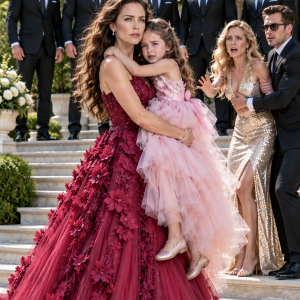
A month later, the gala had already become an old story.
The foundation continued under new leadership.
Not mine alone.
A board chosen for integrity rather than obligation.
Gavin called once.
We spoke for fifteen quiet minutes.
No requests.
No invoices.
Just weather.
His children.
Baseball season.
It wasn’t reconciliation.
But it was real.
My mother mailed back the silver invitation.
Inside she had written only one sentence.
“I finally noticed the empty chair beside me.”
I placed the card inside the same wooden keepsake box where my father had stored old ribbons for decades.
Then I tied one final silver ribbon around the lid.
Not to preserve the past.
To remind myself that love should never have to purchase its place at the table.
Outside my apartment window, the first snow of winter settled across the city in perfect silence.
For the first time in years, home felt like something no one else could decide for me.
The Ribbon Left Untied
Winter settled over Chicago a week after the gala, softening rooftops and muting traffic beneath fresh snow.
Harper had almost convinced herself the story was over.
Until Eleanor Pierce called.
“There’s one final meeting your father insisted you attend.”
Harper frowned.
“I thought everything had already been transferred.”
“Not everything.”
One Last Room
The conference room overlooking Lake Michigan was nearly empty.
Only Eleanor.
A financial auditor.
And a young woman Harper had never seen before.
She looked barely twenty-five, nervous enough to keep twisting a silver ribbon around her wrist.
Eleanor introduced her.
“This is Nora Whitfield.”
The name meant nothing.
Until Eleanor opened another folder.
Years earlier, Harper’s father had quietly funded scholarships for employees’ children through the family foundation.
Nora had been one of them.
After graduating law school, she had discovered irregular withdrawals hidden inside the foundation’s records—small amounts spread over years, disguised as consulting expenses.
None of the money had gone to Harper.
None had gone to the foundation.
Every trail ended with companies controlled by Gavin.
Harper felt the room become strangely still.
Not because of the money.
Because her father had known.
A Different Kind of Truth
“Why didn’t he expose him?” Harper asked quietly.
Eleanor looked toward the snow outside.
“Because he hoped your brother would stop before it destroyed him.”
Hope.
It was astonishing how often love disguised itself as hope.
Harper thought about every excuse she had ever accepted.
Every silence.
Every overlooked warning.
The ribbon in Nora’s hands tightened into a knot.
The Conversation That Finally Mattered
Harper asked Gavin to meet her alone.
Not at a lawyer’s office.
Not at the foundation.
At the small neighborhood diner where their father used to bring them every Saturday morning.
The booths were unchanged.
The coffee still tasted burnt.
For a long time, neither sibling spoke.
Finally Gavin sighed.
“So… you know.”
Harper nodded.
He didn’t deny anything.
Didn’t invent excuses.
Didn’t blame Elise.
Didn’t blame their mother.
He simply looked older than she had ever seen him.
“At first I borrowed it because I thought I’d pay it back.”
His fingers trembled around the coffee mug.
“Then I kept needing another month.”
Another silence.
Longer this time.
“I told myself Dad would understand.”
Harper looked through the window where snow drifted past the streetlights.
“He did understand.”
Gavin looked up hopefully.
Her next words ended that hope.
“He just couldn’t save you from yourself.”
Letting Consequences Stay
The investigation moved forward.
There were no dramatic arrests.
No shouting reporters.
No courtroom spectacle.
Only accountants.
Lawyers.
Repayment agreements.
Board resignations.
Gavin stepped away from every position connected to the foundation.
Not because Harper forced him.
Because for the first time in his life, no one stood between him and the consequences of his choices.
Months later, he took a modest job with a nonprofit completely unrelated to the family name.
It paid less than half his old salary.
He kept it anyway.
The Empty Seat
Spring arrived slowly.
The foundation held its first fundraising dinner under new leadership.
The ballroom looked beautiful.
Simpler than before.
No towering floral displays.
No extravagant decorations.
Just long wooden tables where donors, volunteers, and scholarship students sat together.
Harper noticed one empty chair near the front.
No name card.
No reserved sign.
Just an empty place.
She smiled.
Not every empty chair represented abandonment.
Sometimes it represented possibility.
She asked a nervous scholarship student standing near the wall to join her table.
The young woman hesitated.
“Are you sure?”
Harper pulled out the chair herself.
“That’s why it’s there.”
Home
That evening Harper walked home carrying the small wooden keepsake box her father had left behind.
Inside were old photographs.
Birthday cards.
Tiny keepsakes.
And dozens of faded ribbons collected over decades.
She added one final silver ribbon from her mother’s birthday invitation.
Then she closed the lid.
Not to preserve pain.
But to remember the lesson hidden inside it.
Love should never require proof of usefulness.
It should simply make room.
Outside, children laughed as they chased one another through the park, leaving crooked footprints across fresh grass where the last traces of snow had disappeared.
Harper watched them until sunset painted the sky gold.
For years she had mistaken being needed for being loved.
Now she understood the difference.
She slipped the wooden box onto the highest shelf in her apartment—not out of reach, but out of the center of her life.
Then she opened every window.
A cool spring breeze carried the scent of rain through the rooms.
The silver curtains stirred gently in the light.
Nothing had been erased.
Nothing had been forgotten.
But everything ahead finally belonged to her.
And this time, there was a place waiting at the table that no one else had the power to take away.