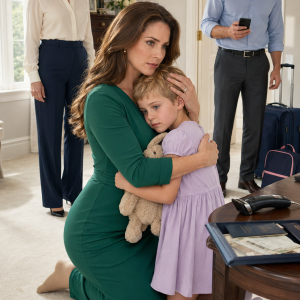
“Come home,” I told him.
His breathing eased.
“Good. We’ll handle this privately.”
“No, Aaron. You’ll explain it to the detective.”
A second officer entered the room carrying a clear evidence envelope. Inside was a photocopied birth certificate found beneath the mattress.
Aaron Mercer was listed as Lucy’s father.
The mother was identified as Rachel Bennett, a name I had never heard before.
On the back, written in blue ink, were four words:
Find Calvin Mercer first.
Before I could understand what they meant, someone knocked three times on the front door.
The sound was slow and deliberate.
Lucy’s stuffed lamb slipped from her hands.
“That’s him,” she whispered.
Detective Monroe turned toward her.
“Who is it, Lucy?”
Her face had lost all its color.
“The man Daddy said I must never talk to.”
Monroe approached the door from the side.
“Who’s there?”
“Delivery,” a man answered.
There was no delivery vehicle outside, only a dark sedan parked halfway down the street.
“Leave it on the porch,” Monroe called.
“It requires a signature.”
Monroe identified himself as a police officer and ordered the visitor to step away from the door. A moment later, footsteps raced across the porch. By the time two officers reached the street, the sedan was already disappearing around the corner.
The license plate had been reported missing from another vehicle.
Lucy began crying without making a sound.
When I sat beside her, she whispered, “Daddy said that man would come if anyone found me.”
“Do you know his name?”
She shook her head.
“He wears shiny black shoes, and he smells like the bottles in your cabinet.”
She pointed toward the old bourbon cabinet near the dining room.
Someone knew Lucy had been discovered, and whoever it was had reached the house within minutes.
The Blue House by the Railroad

While officers searched state records, Detective Monroe questioned Lucy gently. She said she had lived with her mother, Rachel, in a blue house where freight trains passed behind the backyard. Aaron had visited occasionally, but he had never lived there.
“What happened to your mother?” Monroe asked.
“One morning she wasn’t home. Daddy said she had gone somewhere far away and couldn’t come back yet.”
“When did he bring you here?”
Lucy held up three fingers.
Three days earlier.
By afternoon, investigators located the blue rental house outside Spokane, Washington. The lease had belonged to Rachel Bennett, but it had ended abruptly the previous month. Rachel’s car, phone, and banking activity had all gone quiet.
Lucy was taken to a children’s hospital for evaluation, and I followed the ambulance with Judith. I knew the official words—temporary placement, child advocate, supervised interview—but hearing them applied to my own family made them feel strange and distant.
When a social worker asked Lucy whether she wanted me to remain with her, she reached for my hand.
“Grandpa Calvin stays.”
No one had taught her to call me that. She had simply decided it was true.
That evening, Monroe arrived with another investigator.
Aaron and Brooke had been detained at the Maui airport. Instead of returning to Boise, they had purchased last-minute tickets to Anchorage and carried nearly one hundred and twenty thousand dollars in recently transferred funds.
Among Aaron’s belongings, airport security had found an old photograph of Lucy standing outside the blue house beside Rachel. Aaron was there, along with a tall man in a gray suit holding a glass of bourbon.
Lucy saw the photograph and pointed immediately.
“That’s the man with the shiny shoes.”
I recognized him before anyone asked.
Philip Mercer was my younger brother, whom I had not spoken to in fourteen years.
Philip had once been a successful commercial insurance broker, polished enough to charm almost anyone and clever enough to make questionable arrangements look respectable. Our relationship had ended after I discovered that he had diverted money belonging to an elderly aunt. I had demanded that he return it, and he had vanished from my life soon afterward.
Yet Lucy knew him.
“Mr. Philip told Mommy he could make problems go away,” she said.
“What did your mother say?” Monroe asked.
Lucy held the lamb beneath her chin.
“She said I wasn’t a problem.”
Police searched Philip’s condominium in Reno. He was gone, but investigators found a cabinet filled with files on Aaron, Brooke, Rachel, Lucy, and me. Some photographs had been taken through restaurant windows. Others showed me entering my bank, visiting my physician, or walking to my car.
The oldest photograph was nearly a decade old.
Philip had also collected copies of my insurance policy, retirement accounts, the deed to my Boise house, and an appraisal of a mountain cabin I had inherited.
“It resembles an estate file,” Monroe observed.
I knew my brother better.
“It resembles a list of things he wants.”