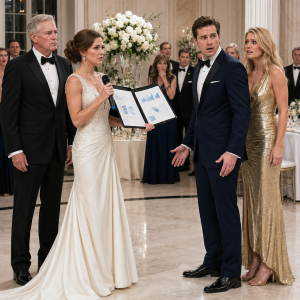
She looked directly at me.
“You know.”
“Say it.”
Julian interrupted.
“Don’t play games.”
I looked down at the papers.
“Why does my mother’s name appear on these withdrawals?”
Neither of them answered immediately.
Then Julian shrugged.
“Because she signed them.”
“No.”
He leaned forward.
“Excuse me?”
“She didn’t sign them.”
Chloe’s fingers tightened around her wineglass.
I looked at her.
“You forged her signature.”
Nobody spoke.
Then the front door opened.

“It Was Never Your House”
Sarah entered first.
Two detectives followed her, along with an investigator assigned to vulnerable-adult cases.
Chloe stood so quickly her chair struck the wall.
“What is this?”
Sarah placed a folder on the table.
“A temporary protective order concerning Mrs. Bennett and the trust property.”
Chloe looked at me.
“You brought police into our house?”
Sarah answered before I could.
“Mrs. Bennett’s contact protections are effective immediately. The disputed financial activity has been frozen pending investigation.”
Chloe laughed.
It sounded forced.
“He can’t throw me out of my own house.”
I finally looked at her.
“It was never your house.”
She stopped.
Sarah explained it simply.
The property belonged to the family trust.
I was trustee.
Mom held lifetime beneficiary rights.
Chloe’s name wasn’t on the property.
It never had been.
Julian pushed his chair backward.
One detective moved closer.
“Sir, stay seated.”
“I haven’t done anything.”
I opened my laptop.
“Then this should be quick.”
I played the kitchen recording.
Mom appeared on the screen in her wheelchair.
Chloe put papers in front of her.
Then Julian leaned down.
“The next fall might not be an accident.”
The room became completely quiet.
Chloe looked at the screen.
“That’s taken out of context.”
I played another clip.
Chloe stood outside Mom’s bedroom carrying her medication organizer.
Mom’s voice came from behind the closed door.
“Chloe, please open the door.”
Chloe walked away.
Another recording showed Julian and Chloe discussing signatures at the kitchen island.
Then came the office footage.
Julian with the pry bar.
The safe opening.
The papers disappearing into a bag.
Julian stood.
“I’m leaving.”
The detective blocked him.
“Sit down.”
“You can’t hold me here.”
The investigator placed photographs on the dining table.
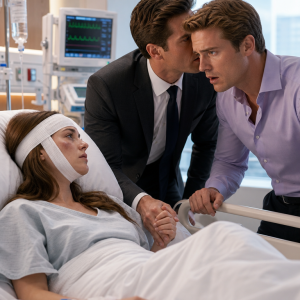
Mom’s bruises.
Her wrist.
The medical documentation.
Chloe looked away.
“She’s confused,” she said. “She’s been confused for months.”
“Then why were you asking her to sign financial documents?” the investigator asked.
Chloe opened her mouth.
Nothing came out.
It was the first question I had heard anyone ask her that she couldn’t explain away.
The Medicine Organizer Came Home Too
Chloe and Julian were taken into custody that night.
The case lasted about nine months.
Most of what happened afterward was less dramatic than people imagine.
There were interviews.
Bank records.
Signature comparisons.
Medical records.
Hearings.
More waiting than anything else.
The evidence from the house made the central facts difficult to dispute.
Chloe eventually pleaded guilty to charges connected to elder abuse, coercion, fraud, and unlawful confinement.
Julian faced additional consequences for the break-in, forged documents, and interference with evidence.
Restitution recovered much of what they had attempted to take.
Chloe received a prison sentence.
Julian was sentenced later.
I attended the necessary proceedings, but I didn’t feel victorious.
Mostly, I kept thinking about the kitchen.
Mom on the floor.
One slipper missing.
That wooden spoon on the counter.
And the medicine organizer under the table.
Mom came home after several weeks of treatment and rehabilitation.
The first evening, I placed her medicine organizer on the kitchen counter.
She rolled her wheelchair over and stared at it.
“You’re going to watch me take every pill now, aren’t you?”
“Probably.”
She smiled.
“Annoying.”
“I’ve been called worse.”
Maya stayed while Mom recovered.
I paid her medical expenses from the injury and offered her a substantial bonus.
She refused most of it.
“You protected my mother when I wasn’t here.”
Maya looked embarrassed.
“I did my job.”
“That wasn’t your job.”
She was quiet for a moment.
Then she said:
“You gave me enough.”
“What did I give you?”
“You believed me.”
I didn’t know what to say to that.
So I nodded.
Maya finished nursing school the following year.
By then, Mom was walking short distances with a cane.
Maya and I didn’t begin with some dramatic confession. We had coffee. Then dinner. Then another dinner.
Mom noticed before either of us admitted anything.
About eighteen months after the night Chloe and Julian were arrested, Maya and I were married in the garden behind the house.
Nothing elaborate.
Family, a few friends, white chairs on the lawn, and Mom standing between us for photographs.
She no longer needed the wheelchair.
She still used her cane.
Before the ceremony, she reached for Maya’s hand.
“You protected me when nobody was looking.”
Maya squeezed her fingers.
I glanced toward the porch.
One of the small cameras was still tucked beneath the eave.
I had considered removing the system after the case ended.
I never did.
“Somebody was looking,” I said.
Mom followed my eyes toward the camera.
Then she laughed.
Later that evening, after everyone had gone home, I walked into the kitchen and found Mom’s medicine organizer sitting beside three coffee cups.
I filled the next morning’s compartment, closed the little plastic lid, and left it on the counter where nobody would ever have to hide it again.