Into the Weather

At twelve fifteen, Nora led me through the service corridor and down two narrow staircases. The yacht creaked under the first pressure of the approaching storm, while rain ticked against the windows like handfuls of dry rice. We reached the stern without meeting anyone and began lowering the rigid inflatable boat.
Then a voice came from the balcony above.
“Grant! She’s down here!”
The speaker was Grant’s younger brother, Colin, whom I had believed was spending the week in Boston. He ran toward the stairs as Nora released the final restraint.
“Get in,” she ordered.
The small boat struck the water hard. Nora tied a safety line around my waist, and we climbed down the platform as Colin and two crewmen reached the lower deck. Grant appeared behind them in a rain jacket, no longer wearing the pleasant face he showed the world.
“Claire, you’re confused,” he called. “Come back inside, and we can talk.”
“I heard everything,” I answered.
His expression changed, and in that instant the marriage I thought I had entered disappeared completely.
Nora started the motor and pulled away. A second tender soon followed us, driven by Colin, but the growing waves made speed dangerous. Nora turned sharply across our own wake, forcing the pursuing boat to slow. Colin tried once more to draw alongside, and the two vessels struck at their rear corners. I lost my balance and went over the side.
The Atlantic closed above my head, cold and absolute. For one confused moment, I could not tell which direction led upward. Then the safety line tightened around my waist. I followed it, broke the surface, and heard Nora calling my name. She pulled me aboard, where I lay coughing and trembling as the other tender drifted away with an injured motor.
We continued south until the yacht’s lights became a pale cluster behind the rain. The service boat had only a partial tank of fuel, and the collision had damaged its emergency beacon. Worse, a jagged edge near the console had opened a deep cut along my forearm. Nora wrapped it firmly, then looked toward a dark bank of clouds swallowing the horizon.
“There are several protected barrier islands west of us,” she said. “If the engine holds, we can reach one before the storm reaches its strongest point.”
For nearly three hours, the ocean lifted and dropped us through walls of rain. I held the center rail with one hand and repeated the same sentence silently: My parents are safe. The evidence is safe. I will see morning.
Just before dawn, the boat scraped sand. We had reached a narrow, uninhabited island inside a federal wildlife preserve off Florida’s Gulf Coast. Nora pulled the craft beneath a stand of sea grape trees and helped me into an old concrete observation shelter left from a discontinued coastal research station.
She cleaned and closed my wound with supplies from the first-aid kit, then built a small fire behind a broken wall where its light could not be seen from the water. As my shaking eased, I noticed a faded emergency cabinet near the floor. Inside was a hand-crank weather radio installed for research teams years earlier.
Nora cleaned the corroded contacts while I turned the crank. Static filled the shelter, followed by fragments of a marine forecast. She adjusted the frequency and transmitted our call sign and position again and again until, at last, a voice answered.
“Whitaker party, this is Coast Guard Station Clearwater. We have your signal. Remain under shelter. Rescue aircraft is en route.”
I lowered my head and wept—not from fear this time, but from the release of having carried it for too long.
Ninety minutes later, the thrum of rotors moved across the island. As the rescue crew lifted us into the aircraft, I looked down at the small boat half hidden beneath the trees and understood that the life I had known was over. Oddly, the thought did not feel like loss. It felt like the first honest breath I had taken in years.
Seven Names in a Locked Drawer
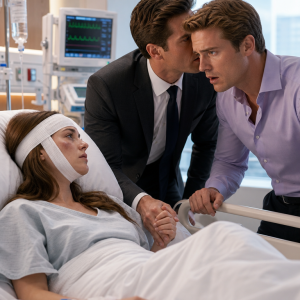
I spent four days at a hospital in Tampa while doctors treated my arm and monitored the effects of the substances I had been given. My parents arrived before sunrise on the first day. My father stood beside the bed with both hands around mine, unable to speak, while my mother leaned down and rested her forehead against my cheek.
“You came back to us,” she whispered.
“I knew where home was,” I said.
Grant and his relatives had returned to Charleston claiming that I had become disoriented during the storm and wandered from the yacht. They presented themselves as a grieving family and suggested Nora had abducted me. Because Evelyn and federal investigators did not yet want them to know I had been found, their story went unchallenged.
Meanwhile, the documents from Grant’s phone led to a private financial institution in Boston. One account had been opened using my copied signature, which gave Evelyn the legal basis to obtain an emergency court order preserving its contents. Two days after I left the hospital, Nora and I accompanied investigators into a secure archive beneath the bank.
The locked drawer held false identity documents, property records, prepaid cards, and a handwritten ledger. Beneath those papers were seven small envelopes, each marked with a woman’s name and a date. Inside the first was a green velvet hair ribbon with a tiny pearl.
Nora sat down abruptly.
“Audrey wore this at her wedding,” she said. “I fastened it for her myself.”
The other envelopes held equally personal items: a silver charm, a theater ticket, a pressed flower, a child’s photograph. The ledger paired each woman’s name with an insurance payment or transferred estate. On the final page, my own name appeared beside the date of our voyage and the estimated value of my family trust.
I had spent weeks believing my marriage was a love story. To them, it was bookkeeping.
The discovery widened the investigation beyond financial fraud. Six families who had lived for years with unanswered questions were contacted privately. Former employees began cooperating. Records tied Harold to a network of dishonest advisers, document forgers, and fixers who specialized in isolating wealthy women before making their disappearances seem accidental.
Yet Evelyn urged patience. The family’s public confidence was useful; confident people spoke freely, destroyed less evidence, and gathered in predictable places.
Grant soon announced a press conference at a grand hotel in Philadelphia, where he planned to introduce the Claire Whitaker Hope Fund and ask the public to help locate his “beloved missing wife.” When I saw the invitation, I felt no anger. What I felt was colder and far more useful: certainty.
“Let him have his stage,” I told Evelyn. “Then we’ll give him the truth.”
The Woman in the Back Row
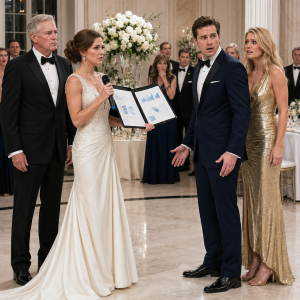
The ballroom was crowded with reporters when Grant stepped behind the podium in a dark suit, his face arranged into careful sorrow. Vivian held a handkerchief. Harold kept one protective hand on his son’s shoulder. To anyone who had not heard the recording, they looked like a family carrying an unbearable burden.
Nora and I watched from a service room while federal agents took positions around the exits.
“Claire was the light of my life,” Grant told the cameras. “I will spend every day searching for answers.”
The screen behind him went dark. Then his own recorded voice filled the ballroom.
“By two in the morning, she won’t understand where she is.”