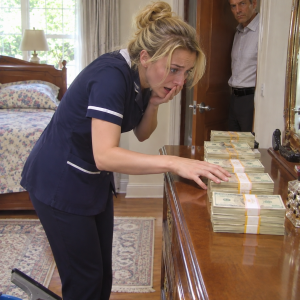
And don’t forget what you owe us.
I showed Sarah the messages.
“You don’t have to answer tonight,” she said.
I nodded, but I couldn’t stop looking at the yellow envelope on the dresser.
My mother had always been able to make me feel guilty, even when I knew I’d done nothing wrong.
This time, she was putting a dollar amount on that guilt.
And I was beginning to wonder whether the bill was really about money at all.
The next morning, my Aunt Carol called.
“Amanda, honey, your mother says you walked out after refusing to help with household expenses. What happened?”
I sat beside the window while Lily colored at the little desk.
“Dad hit me. Lily saw it.”
Carol went quiet.
“Robert did what?”
“He slapped me during an argument. Mom said I’d brought it on myself.”
“Your mother didn’t tell me that.”
“I didn’t think she would.”
Carol sighed.
“She says you’ve been staying there for free and refusing to contribute.”
I looked at the envelope.
“That’s not true. I’ve been buying groceries and helping with expenses. She never told me there would be rent.”
“Well, your parents are on a fixed income, Amanda. They’re worried about retirement.”
“I understand that. But they invited us to stay, and I told them we’d leave as soon as I could afford it.”
Carol hesitated.
“I think your mother expected you to be more grateful.”
I looked toward Lily, who was drawing a small house with a yellow door.
“I was grateful. I just wasn’t willing to let them frighten my daughter.”
After we hung up, I opened the envelope again.
My mother’s handwriting filled the page, neat and familiar. She’d used the same careful lettering on my school lunch notes and birthday cards when I was little.
I turned the paper over.
There was another line at the bottom that I hadn’t paid much attention to.
Any money paid toward this balance will be considered acknowledgment of the full amount.
I frowned.
My mother hadn’t simply written down what she thought we owed.
She wanted me to agree that the debt existed.
I took another photograph and placed the envelope beside my phone.
Then I began looking through our old messages.
PART 2 — THE PROMISE MY MOTHER TRIED TO TAKE BACK

I spent most of Sunday morning reading messages from the weeks before Lily and I moved into my parents’ house.
At first, there was nothing unusual. My mother had asked what time we’d arrive, whether Lily still liked spaghetti, and if I wanted her to wash the sheets in my old bedroom.
Then I found a message dated three days before our move.
Of course you can stay until you’re working again. Don’t worry about money right now. We’ll figure things out later.
I read it twice.
I remembered that conversation. I’d specifically asked whether I should pay rent, and my mother had told me not to worry about it until I was employed.
Yet she’d demanded eight hundred dollars before I’d earned a single paycheck.
I took screenshots and saved them with the envelope.
For years, I’d believed my mother had a terrible temper but usually meant well. Now I was beginning to see something else. Whenever I disagreed with her, she changed the terms of our conversations until I was the one who owed an apology.
The bill wasn’t just about groceries or electricity.
It was another way to make me admit she’d been right.
On Monday, I started my new job.
My supervisor, Denise, had allowed me to complete some onboarding paperwork remotely and adjust my first week’s hours while I arranged childcare. Sarah helped me find an after-school program for Lily.
The first few days were exhausting, but I liked the work. Nobody asked why I’d been unemployed or why I was staying in temporary housing. They wanted to know what I could contribute.
One afternoon, Denise stopped beside my desk.
“Amanda, that campaign summary you prepared was excellent. Have you worked with this kind of client before?”
“A few years ago. It’s been a while.”
“Well, it doesn’t show. Keep doing what you’re doing.”
I thanked her, then sat there for a moment after she’d walked away.
It had been a long time since someone had praised my work without adding a criticism afterward.
At home, Lily was beginning to relax too.
She made friends with a girl named Emma at the after-school program. She started singing again while she colored, and one evening she showed me a picture of a house with two windows, a garden, and a bright yellow door.
“Is that Grandma’s house?” I asked.
She shook her head.
“It’s ours. The one we’re going to have.”
I smiled.
“I like the yellow door.”
“And there’s a room for my rabbit.”
I promised we’d look for something with enough room for both of them.
Two weeks later, a certified letter arrived from my parents.
They were demanding the $1,475 listed in the yellow envelope and threatening to file a small claims case if I didn’t pay.
I brought the letter to a legal aid attorney Sarah had helped me contact.
The attorney reviewed the documents and explained that my parents could pursue a claim, but they’d need to establish a legal basis for the money they demanded.
There was no written rental agreement, no agreed monthly amount, and no evidence that I’d accepted the so-called inconvenience fee.
“Keep everything,” she advised. “The messages, the envelope, the receipts. And don’t ignore any actual court papers.”
I nodded.
“I think they’re trying to scare me into paying.”
“Then it’s important that you respond to the facts, not the pressure.”
That evening, I went through my bank statements and grocery receipts.
During our three weeks at my parents’ house, I’d spent more than four hundred dollars on food, cleaning supplies, and household expenses. I hadn’t kept every receipt, but I had enough to show that I hadn’t been living there without contributing.
I wasn’t planning to ask for that money back.
I wanted to know the truth before my mother told another relative that I’d taken advantage of her.
The following Thursday, my father called from an unfamiliar number.
“Amanda, it’s Dad.”
I sat up straighter.
“What do you want?”
“Your mother’s been upset for weeks. You’ve got everybody thinking we’re terrible people.”
“I told Aunt Carol what happened.”
“You made it sound worse than it was.”
I looked toward the kitchen, where Lily was eating dinner.
“You hit me in front of my daughter.”
He sighed.
“I lost my temper. You were talking back, and things got out of hand.”
“That doesn’t make it acceptable.”
“I’m your father.”
“I know. That’s why it hurt so much.”
For a moment, he said nothing.
Then he changed the subject.
“Your mother wants you to come over Sunday. We can put this behind us.”
“Have either of you apologized to Lily?”
He hesitated.
“She’s six. She’ll forget about it.”
I looked at my daughter, carefully arranging carrot sticks around her plate.
“No, Dad. She won’t forget just because you want her to.”
“So what are you saying?”
“I’m saying we’re not coming over. If you want a relationship with us, you need to acknowledge what happened and respect our boundaries.”
He gave a bitter laugh.
“You always did have a stubborn streak.”
“Maybe. But I’m not changing my mind.”
I ended the call.
My hands were shaking, but I didn’t call back to apologize.
That was new for me.
A month after we left, I received notice that my parents had filed a small claims case.
I wasn’t surprised.
What surprised me was how calm I felt when I opened the envelope.
The hearing was scheduled for a Tuesday morning. I arranged time off work, found childcare for Lily, and prepared my documents with guidance from the legal aid attorney.
I made three copies of everything: the original invitation, the yellow envelope, and the records showing what I’d contributed.
The night before the hearing, I sat at the little desk in our temporary room while Lily slept.
I thought about all the times I’d apologized to my mother just to end an argument. I’d apologized for being late to dinner, for choosing the wrong college, for not calling often enough, and for making decisions she didn’t approve of.
I had spent so much of my life trying to prove I was grateful that I’d forgotten gratitude didn’t require surrendering every boundary.
The next morning, I walked into the courthouse with my folder tucked beneath my arm.
My parents were already there.
Mom wore a navy blazer and carried a thick folder. Dad stood beside her with his hands in his pockets.
Neither greeted me.
When our case was called, my mother explained that she’d allowed me and Lily to stay in her home and expected reasonable compensation for the expenses we’d caused.
The judge asked whether we’d agreed on rent before I moved in.
“We discussed helping with household expenses,” Mom said.
“Did you agree on a specific amount?”
“Not exactly, but Amanda knew she couldn’t stay for free forever.”
The judge turned to me.
I explained that I’d asked for temporary help after my divorce, that my mother had invited us to stay without specifying rent, and that I’d contributed groceries and household supplies.