I thought of the unanswered applications and the years spent assuming I had not been good enough. Beneath my anger came compassion for the young mother I had been, working late while Emma slept nearby because I could not yet afford a crib.
“I want copies of everything,” I said.
“You’ll have them.”
“And I choose my own attorney.”
“You should.”
“And you will tell your aunt, your business associate, and anyone else who heard you that we are not married.”
He glanced through the doors. Eleanor stood inside with Laurel, both watching us.
“That may be the most difficult part.”
I stared at him, then, against all reason, laughed. It began as a single breath and turned into the first genuine laugh I had managed all evening. Adrian smiled, and the guarded man from beside the windows briefly disappeared.
“You owe me,” I said.
“More than one favor.”
“Start with a slice of wedding cake for my daughter.”
He nodded solemnly. “That I can arrange.”
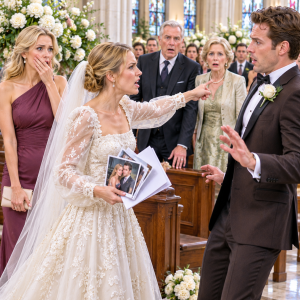
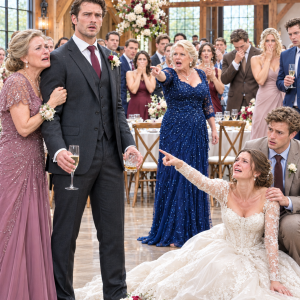
My mother arrived next, distressed not by what Mason had done but by the attention it had drawn.
“Claire, people are talking.”
For most of my life, that sentence had controlled me more effectively than any locked door. People might talk if I changed my major, if I raised a child alone, if I rented a small apartment, if I came to a wedding without a man beside me. That night, it finally sounded as small as it was.
“Then give them something accurate to say,” I replied. “Tell them I raised a wonderful daughter, built a career I’m proud of, and stood up when someone tried to make me feel ashamed of both.”
Natalie squeezed my shoulder. My mother looked startled, but after a long moment she nodded.
A Truth That Took Six Years to Reach Me
The following weeks brought interviews, boxes of documents, and long evenings reading records that explained why certain doors had closed. Adrian kept every promise. He provided copies, funded an independent review without asking me to surrender any rights, and never again spoke on my behalf without permission.
Mason first denied everything, then claimed another employee had instructed him, and finally insisted I had understood more than I admitted. The records disagreed. Brooke came to my apartment one rainy afternoon carrying a folder and looking ten years older than she had at the wedding.
I did not invite her in immediately.
“I know I don’t deserve your kindness,” she said. “I came because you deserve the truth.”
Inside were account statements and messages Mason had stored on a tablet. Brooke discovered he had hidden debts and exaggerated nearly every part of the life he claimed to have built. His expensive habits were a curtain drawn over instability.
“Why did you smile at me that night?” I asked.
She lowered her eyes. “Because he told me you wanted him back. He said you resented our baby and would try to ruin the wedding.”
“And you believed him?”
“I wanted to.” Her voice trembled. “Believing him allowed me to feel chosen instead of guilty.”
It was not an apology that erased six years, but it was an honest one. I accepted the folder, not her excuses. Before she left, I told her one thing I wished someone had told me at twenty-three.
“A man who makes you feel special by humiliating another woman will eventually need a new woman to humiliate.”
Brooke nodded through tears. Two months later, she moved in with an aunt in Vermont and began rebuilding her life before her son arrived.
The formal review cleared my name. Harbor Light contacted every institution that had received the incorrect report, including the medical center that withdrew my fellowship. Its director apologized and offered me a senior position in a new pediatric communication clinic.
Six years earlier, I would have accepted before she finished speaking. This time, I asked about the hours and whether I would be home to help Emma with homework. The salary was nearly twice what I earned, but the schedule required most evenings.
I declined.
It was the first important choice I made without trying to prove anything. Instead, I joined Harbor Light, which Adrian was reopening with stronger safeguards and a board that included therapists and parents. I directed its speech services three days a week while continuing at Adams Elementary for two. The position paid enough for Emma and me to move into a modest two-bedroom apartment with a tiny balcony.
Adrian and I saw each other often during the reopening. He was careful, keeping every conversation tied to budgets or services, yet small parts of him escaped the formal boundaries. He remembered that I took tea without sugar, carried dinosaur stickers for nervous children, and called his aunt every Sunday no matter how fiercely they argued.
Emma met him on a Saturday when I brought her to see the new therapy rooms. She regarded him with the solemn suspicion six-year-olds reserve for unfamiliar adults.
“Mom says you stole her at a wedding,” she said.
Adrian glanced at me. “Your mother came willingly.”
“Did you dance good?”
“Well,” I corrected automatically.
Emma sighed. “Did you dance well?”
Adrian considered this. “Your mother did. I mostly tried not to step on her shoes.”
Emma approved of the answer. Ten minutes later, she had recruited him to help arrange stuffed animals in the waiting room, and the most intimidating man at my sister’s wedding was sitting cross-legged on the carpet while a toy rabbit received an imaginary speech evaluation.
When Pretending Was No Longer Necessary

Nearly a year after the wedding, Harbor Light opened its third restored center. Families filled the bright reception area while children explored rooms stocked with books, games, and communication devices. Eleanor attended in a red coat, proudly telling everyone that Adrian had finally learned to seek advice from people who understood the work better than he did.
“She enjoys rewriting history,” he whispered to me.
“She may simply be improving it.”
After the ceremony, Emma tugged us toward the small courtyard behind the building. Music from the reception drifted through the open doors, and several couples began dancing beneath strings of white lights.
“You two should dance,” she announced.
Adrian looked at me. During the past year, we had built something neither of us named. There had been dinners after late meetings, Saturday walks with Emma, and phone calls that began with practical questions and wandered into childhood memories. He had never pressed for more. I had never admitted how safe his steadiness had begun to feel.
He extended his hand, but this time there was no command in the gesture.
“Would you like to?”
I placed my hand in his. “You’re not going to introduce me as your wife again, are you?”
“Not without written authorization.”
We moved slowly beneath the lights while Emma danced beside us with the toy rabbit. Adrian’s hand rested at my waist exactly as it had in the Boston ballroom, but everything else was different. No one was watching for scandal. Mason’s judgment no longer occupied a room in my mind. My dress was simple, my shoes were comfortable, and I had nothing to prove.
“I owe you an apology,” Adrian said.
“For which part?”
“The first thing I ever asked of you was to pretend.”
“You also helped me discover the truth.”
“That doesn’t excuse taking your choice away for even thirty seconds.”
I studied the man I had once mistaken for danger simply because he possessed power, and the man I had once mistaken for love because he possessed charm. The difference between them had become clear over time: Mason used what he knew about me to make me smaller, while Adrian learned what mattered to me so he could leave room for it.
“Then ask me something honestly,” I said.
He stopped dancing. “Claire, may I take you to dinner tomorrow—not for the foundation, not for your sister, and not to convince anyone of anything?”
“Yes.”
Emma clapped as if she had negotiated an international agreement.
We did not rush. Adrian became part of our lives through consistency rather than spectacle: fixing Emma’s bicycle, bringing soup when I had the flu, and sitting through school concerts where twenty recorders played twenty versions of the same song. I learned that he disliked olives, cried at old dog movies, and saved every birthday card he received.
Two years after the night we met, Natalie and her husband hosted an anniversary dinner at the Harborcrest. The hotel had renovated the ballroom, but I recognized the windows, the chandeliers, and the service corridor where I had once sat trying to become invisible. This time, my place card was at the center table beside Adrian and Emma.
After dinner, the orchestra began the same slow song that had played the night a stranger offered me his hand. Adrian led me toward the dance floor, then paused beside Table Nineteen.
“Do you remember what I said here?”
“Unfortunately, every word.”
“I’ve been practicing a better version.”
He lowered himself to one knee. Conversations softened around us, but I barely noticed. Emma stood beside him holding a small velvet box, her grin so wide that she could not possibly have kept the secret much longer.
Adrian took my hand.
“Claire Bennett, I will never ask you to pretend again. But if you choose me, I will spend the rest of my life honoring the woman you already are. Will you marry me?”
I looked at Emma, who nodded urgently, then at my mother, who was crying without concern for who might see, and finally at Adrian. The first time he offered me his hand, I accepted because staying seated felt more painful than taking a risk. This time, I accepted because I knew precisely who he was—and, at last, who I was.
“Yes,” I said.
The room rose around us in applause. Adrian slipped the ring onto my finger, and Emma threw both arms around our shoulders, nearly knocking him off balance. Everyone laughed, including me.
For years, I had believed the hardest chapter of my life was proof that I had chosen poorly and fallen behind. I understand it differently now. Raising Emma did not ruin my future; it taught me what a worthy future required. The work I accepted when better doors seemed closed became the work that led me back to my name, my purpose, and the people who saw my value without asking me to perform for it.
And the table beside the kitchen, the place meant to remind me that I belonged at the edge of the room, became the place where a good man knelt and asked to build a life with me.
Sometimes dignity returns quietly, through a letter that clears your name or a sister who finally takes your hand. Sometimes it returns beneath chandeliers while an entire ballroom watches. And sometimes it begins with one unreasonable invitation from a stranger—followed, years later, by a question that asks you to pretend nothing at all.