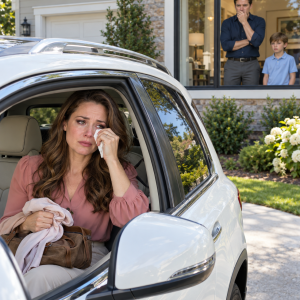
The children hadn’t done anything wrong.
“Please take them somewhere comfortable,” I said. “We can talk tonight when everyone’s settled.”
“You can’t just sell our family home and hang up!”
I looked around my small apartment.
There were moving boxes against the walls, a secondhand dining table, and George’s photograph waiting to be hung.
“Patrick, I loved you in that house for twenty-seven years. That doesn’t mean you own it.”
Then I ended the call.
My hands trembled afterward.
Not because I regretted selling.
Because I had finally said something I could no longer take back.
PART 2 — THE PROMISE MY HUSBAND NEVER WANTED ME TO KEEP
THE BOX BEHIND THE DRAWER

The next morning, Claire Hart called.
“Eleanor, I’m sorry to bother you. We found something while cleaning the hallway. I think it belongs to you.”
I drove to the lake house that afternoon.
Seeing another car in the driveway felt strange. The windows were open, and the kitchen smelled of fresh paint.
Claire welcomed me inside.
“We found it behind a built-in drawer,” she explained.
She handed me a narrow wooden box.
George’s box.
The lid bore the compass rose he’d carved during our first winter there.
I opened it carefully.
Inside lay an old brass key, a photograph of George and me beside the dock, and a sealed envelope.
My name was written across the front in his handwriting.
For Eleanor, when the house is no longer hers.
I sat down.
George had been gone six years. I’d sorted through his clothes, bank records, letters, and tools, believing there was nothing left to discover.
Yet here was an envelope he’d apparently prepared for a day he somehow anticipated.
Claire quietly offered me the sitting room.
I thanked her, broke the seal, and unfolded the letter.
My darling Ellie,
If Patrick is asking you to give him this house, there is something you need to know about the promise I made to him.
My breath caught.
I read on.
George described a conversation with Patrick three months before his illness was diagnosed.
Our son’s business had recently failed. He was worried about money and afraid he couldn’t provide the life Megan expected.
One evening, while I was visiting my sister, Patrick asked George whether the lake house would eventually belong to him.
George had said yes.
Not because he’d discussed it with me.
Not because he’d made a legal arrangement.
Because he wanted to reassure his frightened son.
I made a promise I had no right to make, George wrote. I told him what I hoped might happen, but I spoke as though the choice were mine alone.
I pressed the paper against my knee.
The next paragraph was harder to read.
When Patrick asked again, I told him the truth: the house belongs to you, and only you can decide what happens to it. He was angry. I intended to explain everything, but then the doctors called, and our lives became appointments and hospital rooms.
I remembered a conversation outside George’s hospital room.
Patrick had been speaking sharply to his father.
“You told me it would be mine.”
George had answered, “I told you what I hoped would happen.”
At the time, I’d assumed they were arguing about medical decisions.
Now I understood.
The letter ended with words I read three times.
Ellie, if Patrick ever uses my promise to make you feel guilty, remember that I made it. You didn’t.
Do not give him the house to prove you love him.
I folded the letter and sat quietly.
George had known our son might try to turn an uncertain promise into an obligation.
But there was more.
He mentioned a family trust he’d established to help Patrick recover financially.
I had never heard of it.
THE BLUE FOLDER
Before leaving, I asked Claire whether she’d found anything else behind the drawer.
She shook her head, then offered to help me check.
Daniel removed the drawer while Claire held a flashlight.
Behind a loose strip of molding, we discovered a thin blue folder.
My name was written on the cover.
The handwriting wasn’t George’s.
It was Patrick’s.
Inside were copies of documents from the law firm that had handled George’s estate planning.
The first page identified the George Henderson Family Support Trust.
Patrick was a beneficiary, with separate provisions for Megan and the children.
The documents described funds intended to help Patrick rebuild his finances. But before receiving distributions, he had to attend financial counseling and submit a realistic household budget.
A letter from the attorney confirmed an appointment.
At the bottom, someone had written:
Patrick called to cancel. Says he’ll reschedule.
There was no indication he’d ever attended.
Then I found a handwritten note from Patrick to his father.
Dad, I’m not signing anything that makes me look irresponsible. If the house is mine, I don’t need the trust. Mom will understand. She always does.
I stared at those last four words.
She always does.
For six years, I’d paid bills and transferred money because I thought George had left our son without a safety net.
But Patrick had known about a possible source of support.
He’d rejected it because he didn’t want to acknowledge his financial problems.
And he’d allowed me to carry the burden instead.
Claire was standing beside the window.
“Eleanor, are you all right?”
I looked at the papers.
“I think my son has been hiding something from me for six years.”
“YOU KNEW ABOUT THE MONEY.”
Back at my apartment, I placed George’s letter and the blue folder on the kitchen table.
Patrick had called four times.
I waited until I felt calm enough to speak, then returned his call.
“Mom, where have you been?”
“I found a letter from your father.”
He went silent.
“What letter?”
“One he wrote before he died. It mentions the lake house.”
His breathing changed.
“Mom, Dad promised me that house.”
“He also wrote that he withdrew that promise because it wasn’t his decision to make.”
“He was sick. He wasn’t thinking clearly.”
“He knew exactly who owned the property, Patrick.”
There was a long pause.
Then I opened the folder.
“I also found documents about a trust.”
He didn’t answer.
“You knew about it.”
“Dad wanted to set something up.”
“You signed the agreement.”
“I never took the money.”
“Because you canceled the appointment.”
His voice sharpened.
“I wasn’t going to sit in some office and have a stranger tell me how to run my life.”
I looked at the note he’d written.
“So you let me pay your bills instead?”
“That’s not fair.”
“You asked me for help every month, Patrick. You never once told me your father had made other arrangements.”
He exhaled.
“I was embarrassed.”
The admission surprised me.
“Of what?”
“Of failing. Of needing someone to explain a budget to me like I was a teenager. Megan’s parents already thought I couldn’t provide for my family.”
His voice grew quieter.
“I thought if I had the lake house, at least I’d have something to show for myself.”
I felt the familiar urge to comfort him.
But I looked at the folder and kept my hands still.
“You made me pay the price for protecting your pride.”
He said nothing.
“I love you, Patrick. But I’m not going to finance your life because you’re afraid of looking unsuccessful.”
His voice cracked.
“What happens now?”
“I’m going to speak with the attorney. Then you can decide whether you’re ready to take responsibility.”
Before ending the call, I turned over the last page of the trust documents.
A handwritten notation caught my eye.
Trust amended by George Henderson. See sealed addendum.
Attached to the back was another envelope.
Across the front, George had written:
Only open this after selling the house.
THE CONDITION PATRICK DIDN’T KNOW ABOUT
The following morning, I met with Mr. Lawson, the attorney who’d helped George prepare his estate documents.
He remembered the trust.
When I showed him the folder, his expression became serious.
“I wondered whether these papers would ever surface.”
“You knew Patrick hadn’t completed the requirements?”
“I knew he canceled his appointment. We sent reminders, but he didn’t respond.”
“Why didn’t anyone tell me?”
Mr. Lawson explained that the trust had been arranged separately and that he couldn’t simply disclose Patrick’s confidential financial matters to me.
He agreed to review the documents I’d found and explain what he could about their effect.
Then I showed him the sealed envelope.
He examined the writing.
“That’s George’s handwriting.”
“I know.”
“Would you like to open it?”