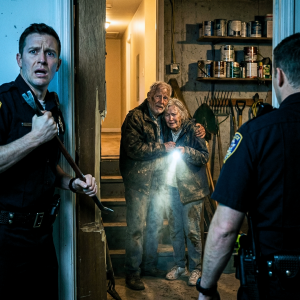
Seventeen-year-old Elena Brooks had grown up believing her father, Samuel Brooks, was the kindest soul in their quiet corner of Bloomfield, Wisconsin. Since her mother passed when she was five, it had been just the two of them. Samuel worked wherever he could—laying bricks in summer heat, hauling crates in frozen warehouses, even driving night shifts for a delivery company. He never complained, never rested much, and never failed to smile when Elena walked through the door after school.
There was only one thing unusual about him.
He never let anyone see his back.
He changed clothes behind closed doors, refused to swim even on the hottest days, and wore long sleeves in every season. Once, when Elena was small, she had seen a faint red line near his shoulder blade as he bent to lift a box, but he had quickly turned away, saying it was nothing. She never asked again.
Until the day everything changed.
It began with a news alert that spread through her high school like wildfire. Students huddled around phone screens as the story played on repeat. “Armed Robbery Suspect Still at Large. Distinct Scars Across Back. Considered Dangerous.”
The composite sketch showed a man in his forties, his back covered with long, uneven scars. Someone laughed and said the marks looked like burns or lashes. Another whispered that the man had survived a warehouse fire.
Elena stared at the image until her vision blurred. The shape of those scars—the way they curved across the shoulder and spine—looked familiar. Too familiar. Her heart thudded painfully as an old memory surfaced: her father’s shirt slipping for just a second, that same pattern etched into his skin.
No, she told herself. It was impossible.
Still, the thought refused to leave her mind.
That evening, when she came home early, Samuel’s bedroom door was ajar. He was changing his work shirt, sweat darkening the fabric. Before she could stop herself, Elena pushed the door open to ask about dinner.
And she saw.
His back—mapped in deep, ridged scars, pale and jagged like lightning across his skin.
Samuel turned sharply, startled. His eyes filled not with anger, but with something worse: fear.
“Elena,” he said quietly, his voice trembling, “I can explain.”
Before he could continue, police sirens wailed somewhere outside. Both froze, waiting. The sound grew louder, then faded as the patrol cars sped past their street. Silence fell heavy between them.
Later, they sat at the kitchen table beneath the soft hum of the refrigerator. Elena’s throat was tight. “Dad,” she whispered, “why do you have those scars?”
Samuel looked down at his rough hands. For a long moment he said nothing. Then his voice came, low and measured. “When you were little, I worked at a steel mill. The equipment was old and unsafe. There was an explosion one night, and a piece of the furnace caught me in the back. I was lucky to live. The scars came from that.”
Elena listened, but doubt lingered like smoke. The news report had mentioned fire too—only that fire came from a robbery gone wrong.
“I didn’t want you to see them,” he said softly. “I didn’t want you to look at me and remember pain.”