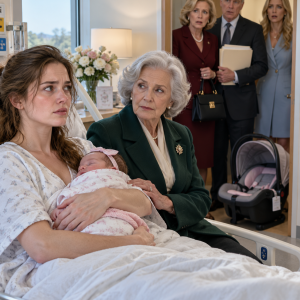
The Locked Room
Captain Ethan Walker knew something was wrong the moment his key no longer fit the front door.
He stood on the wide porch of his father’s farmhouse in Blue Ridge, Virginia, still in uniform, duffel bag hanging from one shoulder, mountain wind pushing cold through the seams of his jacket. The house looked the same from the outside—white siding, black shutters, porch swing creaking beside the rail—but the lock had been changed.
From inside, someone moved quickly.
Then the door opened.
Victoria Hale stood there in cream linen pants and a pale cashmere sweater, every silver-blonde hair tucked neatly behind one ear. She had married Ethan’s father seven months earlier, while Ethan was overseas, and she wore the house like she had been born inside it.
“Ethan,” she said, smiling without warmth. “We weren’t expecting you until next week.”
Ethan looked past her shoulder.
“Where’s my mother?”
Victoria’s smile tightened.
“Resting.”
“Then move.”
Her hand stayed on the doorframe.
“Your father isn’t home.”
“I didn’t ask where Dad was.”
For a moment, neither of them moved. Then a sound came from upstairs.
Not a scream.
Not even a word.
Just the faint, broken scrape of furniture against hardwood.
Ethan pushed past Victoria and took the stairs two at a time.
Behind him, she said his name sharply, but he was already moving down the hallway toward his mother’s old bedroom.
The door was locked from the outside.
His pulse slowed in the dangerous way it always did before combat.
He looked at the brass latch. New. Cheap. Installed badly.
“Open it,” he said.
Victoria came up behind him, breath controlled, voice smooth.
“Margaret has been confused lately. We had to take precautions.”
Ethan turned.
“You locked my mother in her bedroom?”
“For her safety.”
The scrape came again.
Then his mother’s voice, thin as paper.
“Ethan?”
Something inside him went still.
He didn’t wait for the key.
One hard kick split the frame.
The door crashed inward.
Margaret Walker sat on the edge of the bed in a faded blue robe, her silver hair loose around a face that had aged ten years since Ethan had last seen her on video. Her hands trembled in her lap. Her phone was gone. The windows were painted shut. A tray of untouched soup sat on the dresser.
And beneath the hem of her robe, both of her legs were marked with deep purple bruises.
Ethan dropped to his knees.
“Mom.”
Margaret tried to pull the robe lower, as if the shame belonged to her.
“You came home.”
He took her hands carefully.
They were cold.
“Who did this?”
Her eyes flicked to the doorway.
Victoria stood there, composed again.
“Your mother falls,” Victoria said. “Often.”
Ethan didn’t look away from Margaret.
“Mom, look at me.”
Margaret swallowed.
“I signed things.”
“What things?”
Her lips parted, but Victoria stepped into the room.
“Enough. She needs rest, and you need to calm down before you make a mistake that follows you back to the Army.”
Ethan rose slowly.
“Was that a threat?”
Victoria’s expression barely changed.
“It’s concern. Officers are held to a higher standard. Forced entry. Aggression. Harassment of a sick woman’s caregiver. I would hate for one emotional afternoon to become a formal complaint.”
Ethan felt the small recorder app running on his phone inside his jacket pocket.
He had started it the moment he saw the changed lock.
He said nothing.
Victoria’s eyes sharpened, sensing the silence but not understanding it.
“Your father gave me authority over this household,” she said. “Your mother signed the paperwork herself.”
Margaret flinched.
Ethan saw it.
That tiny movement told him more than any confession could.
He picked up his mother’s slippers from beside the bed and placed them gently near her feet.
“I’m taking her to a doctor.”
Victoria stepped in front of him.
“No, you’re not.”
For the first time, Ethan smiled.
It was not kind.
“Try stopping me.”
The Woman Who Owned The House
The urgent care doctor in Charlottesville spoke quietly, but every word landed like a stone.
Dehydration. Medication irregularities. Restricted mobility. Bruising inconsistent with simple falls.
Margaret sat on the examination table with a blanket around her shoulders, staring at the floor as if she had misplaced herself somewhere in the last year.
Ethan stood beside her, one hand resting on the back of her chair.
“Can you document all of it?” he asked.
The doctor looked at him.
“We already are.”
Margaret closed her eyes.
“I don’t want trouble.”
Ethan bent toward her.
“Mom, trouble already found you.”
She looked at him then, and for one second he saw the woman who had raised him after long deployments, bad report cards, broken bones, and every lonely Christmas his father had spent at the office. Margaret Walker had never been fragile. She had been gentle, which was not the same thing.
“She said I’d lose the house,” Margaret whispered. “She said your father would put me somewhere if I didn’t cooperate.”
Ethan’s jaw tightened.
“What did she make you sign?”
Margaret pressed her fingers together.
“Bank papers. Something about power of attorney. Something about the land.”
The land.
Four hundred acres outside Crozet, passed down from Margaret’s father, Samuel Reed. Apple trees, cattle fields, wooded ridges, and a creek Ethan had crossed barefoot every summer of his childhood. Richard Walker had always called it family property.
But Ethan remembered his grandfather’s voice.
Not ours, son.
Your mama’s.
That night, after Margaret was admitted for observation, Ethan sat in his truck under the hospital parking lot lights and made three calls.
The first was to Major Leland Price, his JAG contact from Fort Gregg-Adams.
The second was to Nora Whitcomb, an estate attorney in Richmond whose number Ethan had kept from a legal seminar years earlier.
The third was to the Albemarle County Sheriff’s Office.
By morning, he knew enough to be afraid.
Victoria held a newly executed durable power of attorney over Margaret’s finances. A petition for guardianship had been prepared but not yet filed. Two large wire transfers had moved from Margaret’s investment account into a limited liability company created five weeks earlier.
And a pending real estate transaction had been scheduled for Friday.
Three days away.
The buyer was a development group planning luxury cabins along the ridge.
The sale price was $8.6 million.
Ethan drove back to the farmhouse after sunrise.
His father’s truck was in the driveway.
Richard Walker met him in the kitchen, a tall man made smaller by avoidance. He wore the same brown work jacket he had owned for fifteen years, but his eyes looked hollow.
Victoria stood near the coffee maker, scrolling through her phone.
“You had no right to remove Margaret from this home,” she said.
Ethan set a folder on the kitchen table.
“I had every right to take my mother to medical care.”
Richard rubbed his forehead.
“Ethan, please. This has been hard on everyone.”
“Was it hard when you let your wife lock Mom upstairs?”
His father looked away.
That was the first confession.
Not in words.
In cowardice.
Victoria placed her phone down.
“Your mother is unstable. Your father knows it. The documents prove it.”
“Then you won’t mind showing them to my attorney.”
A flicker crossed her face.
Small, but real.
“Attorney?”
“Estate counsel. Real estate counsel. Maybe criminal counsel, depending on how the day goes.”
Richard’s head snapped up.
“Criminal?”
Ethan looked at his father.
“Adult financial exploitation is a crime, Dad.”
Victoria laughed softly.
“You’ve been home less than twenty-four hours and already you think you understand years of family decisions.”
“No,” Ethan said. “I understand fear. I understand coercion. And I understand what people sound like when they’re trying to hide something.”
Victoria stepped closer.
“Be careful, Captain Walker.”
Ethan did not move.
“You said that yesterday.”
Her eyes narrowed.
“I meant it.”
“So did I.”

The Red Tin Box
Nora Whitcomb’s office was above a bakery in downtown Richmond, with old brick walls and shelves full of estate binders labeled in tidy black ink. She listened without interrupting while Ethan laid out the bruises, the lock, the missing phone, the power of attorney, and the land sale.
When he finished, she tapped one finger against her desk.
“Your grandfather was Samuel Reed?”
“Yes.”
Nora turned to her computer.