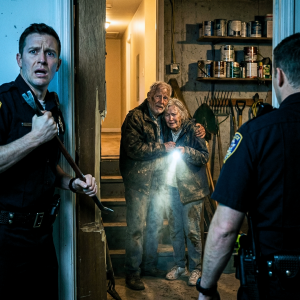
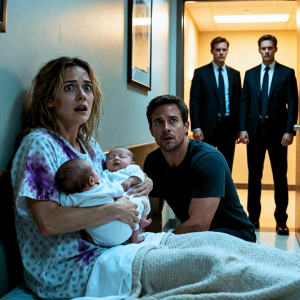
They walked through life on different tracks, never meant to intersect.
Ethan Brooks had once been a skilled architect in Chicago. Then came the layoffs, the divorce, the foreclosure. Life had stripped him bare, but it had not extinguished the gentleness in his heart. Nights were spent on half-finished building sites where no one asked questions. Mornings began with a quiet whisper of gratitude for simply waking up.
Across the city, Claire Whitmore lived a life of polished surfaces. The wife of a powerful real estate mogul, she attended charity galas, wore couture dresses, and smiled for the cameras. Yet behind every perfect photo, she felt like a guest in her own life—trapped in a mansion that felt more like a museum than a home.
Their worlds would have remained strangers if not for that stormy evening.
Rain battered the city like shards of glass, streets shimmering under the streetlights. Claire stood outside the Lincoln Theater, waiting for her driver, clutching her coat. That’s when he appeared—a man in a dark hoodie, desperate, trembling. Before she could scream, he yanked her bag and shoved her to the ground. The curb hit her head; the world spun. Bystanders scattered, eyes averted, feet quickening.

But Ethan heard.
He didn’t pause. He ran. Tackled the mugger, fought through the blows, wrestled the bag free. Blood ran down his temple, but he didn’t care. Kneeling beside the dazed woman, he slipped off his ragged jacket, propping it under her head while he called for an ambulance.
Claire’s vision blurred, but she remembered one thing—the stranger’s eyes. Tired, unshaven, but radiating warmth.
When Marcus Whitmore stormed into the hospital later, doctors told him his wife was safe thanks to an unknown man, who was now resting in another ward with a concussion and hypothermia.

“A drifter,” they said.
Marcus didn’t believe it. The cynical businessman who trusted no one was shaken. Not a guard, not an executive, not the countless “important” people around his wife—her savior was a man everyone else ignored.
He made sure to find him.
Ethan lay on a hospital cot, his belongings stuffed into a torn plastic bag. Marcus sat down silently, staring at him. After a long pause, he said quietly:
“Thank you for saving her. Let me help you.”
Pride flared in Ethan’s chest—he wanted to refuse. But Marcus looked at him without pity, without condescension. He looked at him like a man.
Weeks passed. Ethan had a small apartment now. A job at Marcus’s construction firm. He replaced lost IDs, shaved every morning, wore clean shirts again.
And Claire insisted on seeing him. She embraced him, eyes glistening.
“If not for you, I wouldn’t be here,” she whispered. “And you’ve reminded me there’s still something real in this world.”
Time moved on. Every New Year’s, Claire and Marcus sent him a card. Just one word written inside: “Thanks.”
Six months later, Ethan rented a modest room in an old brick building. A potted plant brightened the windowsill, and a gray stray cat—whom he named “Lucky”—slept curled at the edge of his bed. Each dawn, he still thanked life out loud.