The Things We Learn to Give Away

The morning after I donated bone marrow to my nine-year-old niece, my younger sister came into my hospital room holding my husband’s hand.
I remember that detail more clearly than I remember the ache in my hips, the bitter taste left by the anesthesia, or the pale September light slipping through the blinds. Her fingers were woven through his as though they had practiced the gesture somewhere private, and behind them stood our mother, wearing the composed expression she always wore when she had already decided whose pain mattered and whose did not.
My name is Hannah Pierce, and at thirty-six I had spent most of my adult life restoring old furniture in a workshop outside Portland, Maine. I loved the patience of the work, the way a scarred walnut table could be cleaned one careful inch at a time until its original grain appeared beneath generations of varnish. Old wood never truly hid what had happened to it. Water left shadows. Heat raised blisters. A careless hand cut across the grain. You could cover the evidence, sometimes beautifully, but sooner or later the light found it.
For most of my life, I did not understand that families could behave the same way.
My sister, Mallory, was four years younger and had always possessed the kind of warmth that made strangers lean closer. She could forget a birthday and still be forgiven before the cake was served; she could arrive two hours late with a story about a flat tire, a frightened dog, or a woman crying at a bus stop, and by the time she finished, everyone would be praising her generous heart. Our mother, Diane, believed every version Mallory offered because believing her was easier than holding her responsible.
I became the opposite kind of daughter. I remembered appointments, paid bills on time, brought casseroles when someone was ill, and drove through snow when a relative needed help. Dependability earned me many phone calls, though very little tenderness. In our family, Mallory was the one people protected, while I was the one they called when protection was needed.
The lesson began early. When I was sixteen, I spent an entire summer sanding cabinets for a local carpenter so I could buy a secondhand forest-green sedan. I loved that car because it represented freedom bought one hot afternoon at a time, but when Mallory received her license two years later, Mother announced that sharing would be “good practice for adulthood.” Within a month, Mallory had the keys more often than I did. When I objected, Mother sighed and told me not to make a possession more important than my sister.
That sentence became the family hymn: do not make a possession more important than Mallory. A sweater, a vacation weekend, money from my savings, even my right to be angry—everything could be handed over if she wanted it badly enough.
Then I met Luke Bennett at a restoration conference in Vermont. He managed a small community theater and had a quiet, practical gentleness that felt like shelter. He did not fill every silence; he simply stayed inside it with me, and after a lifetime of being told that love required surrender, his steadiness seemed like proof that love could also mean rest.
We married two years later and spent nearly a decade hoping to become parents. There were consultations, treatments, careful calendars, and many mornings when neither of us knew what to say. We eventually stopped preparing the spare bedroom because the unopened paint samples on the dresser had begun to feel like promises we could not keep. Luke would hold me while I cried, and I believed the sorrow had made us honest with one another.
Mallory already had a daughter, Sadie, whose father had never been part of family gatherings. The story changed depending on who asked, and Mother trained the rest of us to call questions “unkind.” Sadie herself was bright, observant, and solemn in a way that sometimes made me wonder how much she understood. She loved sea animals, grape jelly, and arranging the loose wooden knobs in my workshop from smallest to largest. Whatever was difficult between Mallory and me had never touched the way I loved that child.
Late that spring, Sadie began growing tired during ordinary things. She stopped racing me to the mailbox and started falling asleep in the car before we reached the end of the street. Tests revealed a serious blood disorder requiring months of treatment and, eventually, a stem-cell transplant. The news rearranged every room we entered. Mother talked constantly about hope, Mallory cried until other people took over the practical work, and I became what I had always been: the person who made lists.
I organized rides to the children’s hospital in Boston, filled Mallory’s freezer, cleaned her apartment, tracked medications, and learned more medical language than I had ever wanted to know. When the transplant team tested relatives and called to say I was the strongest available match, I agreed before the coordinator had finished describing the procedure.
There was never a decision to make. Sadie was nine years old, and she needed me.
A week before the donation, she came to my house wearing a soft blue cap and carrying a plastic box of embroidery thread. We sat at my kitchen table while rain tapped the windows, and for almost an hour she braided strands of green, white, and coral into a lopsided bracelet.
“Green is because you fix old things,” she explained as she tightened the knot around my wrist. “White is for getting better, and coral is because it’s almost pink but not too pink.”
“That sounds like a very serious color system.”
She nodded. “You have to wear it when you’re scared.”
I drew her carefully against me, mindful of the medical line beneath her sweater, and kissed the top of her cap.
“Then I’ll wear it until we’re both brave.”
The Morning After
The hospital allowed me to keep the bracelet if a nurse covered it securely. Just before the anesthesia took hold, I saw those three uneven colors beneath a strip of clear tape and imagined Sadie waking one day with enough energy to run through my workshop again.
When I surfaced hours later, discomfort spread through my lower back and hips like a deep winter ache. Luke sat beside me, lifting ice chips to my lips and brushing damp hair from my temple. His eyes were red, and when he told me he was proud of me, I believed him completely.
“How’s Sadie?” I asked.
“The doctors are encouraged,” he said. “Try to rest. I’m right here.”
I fell asleep holding his hand.
By the following morning, the medication had left me nauseated and slow. I was trying to sit higher against the pillows when the door opened and Mallory entered, followed by Luke and our mother. Mallory wore a cream sweater, carefully curled hair, and an expression of rehearsed sorrow. Luke carried a large brown envelope against his chest.
My first thought was still of Sadie.
“Is she all right?”
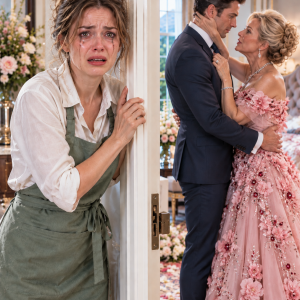
No one answered. Mallory walked to the foot of my bed, reached for Luke’s hand, and folded her fingers through his. He did not resist.
The monitor near my shoulder quickened, though the rest of the room seemed strangely still.
“Hannah, you should have known this a long time ago,” Mallory began. “Luke and I were together once, before your wedding. Sadie is his daughter. We kept it from you because we knew what it would do to you.”
I looked at Luke, waiting for him to laugh at the absurdity, but his face held only misery.
Mallory continued in a softer voice, as if gentleness could make the words merciful. “After what you did for her, we can’t keep pretending. Sadie deserves the truth, and Luke deserves the chance to be part of her life as her father.”
The room tilted, not dramatically, but just enough to make every familiar object look misplaced. I remembered Luke crying with me after failed treatments, Luke closing the spare-room door, Luke promising that the two of us were already a family. Now my sister was asking me to believe that through all those years, he had known—or suspected—that he already had a child with her.
Mother stepped closer and smoothed the edge of my blanket, a gesture so ordinary that it made her words crueler.
“At least something good came from all your disappointments,” she said. “You were able to help Luke’s daughter. You should try to see that as a blessing.”
I had heard Mother defend Mallory in a hundred ways, but I had never heard her use my deepest grief as evidence that I should be grateful. Her voice did not shake. She had arrived prepared to watch my marriage be taken from me and call the taking a blessing.